On a muted, drizzly early spring morning on the Greek island of Rhodes, Tarik Tuten, a local resident with a soft Turkish lilt, wanders the quiet sea-pebble alleys of the island’s Old Town – a ritual he has followed for decades, regardless of company. As the island has not yet been flooded by the annual summer tourist rush, only stray cats share these winding lanes with us, and the overcast sky casts a soft, melancholic haze over the faded Levantine architecture around us.
This quiet melancholy, known in Turkish as *huzun*, is a rare feeling in the modern eastern Mediterranean, where coastlines are either torn by conflict or transformed into exclusive playgrounds for the global wealthy. Neither war nor what Tuten calls “Dubaisation” leaves room for this quiet, layered sense of history – but it lingers on every corner of Rhodes’ back streets, where Tuten has spent his whole life navigating forgotten landmarks: overgrown gardens in the old Jewish quarter, a hidden Byzantine church tucked behind oleander and cypress groves.
But this walk is not just a casual ramble. I have come to Rhodes to visit one of the Mediterranean’s most extraordinary hidden cultural treasures: the Hafiz Ahmed Agha Library, a 1793 Ottoman institution that Tuten’s family has stewarded continuously for seven generations – a near-unique survival of a centuries-old *waqf* (pious charitable endowment) still under the care of its founding family.
Nestled unassumingly opposite the 16th-century Suleymaniye Mosque, tucked between a row of tourist-facing jewellery shops, the library is easy for casual summer visitors to miss. Step past its plain exterior wall, however, and you enter a treasure trove of 828 handwritten manuscripts spanning astrology, philosophy, medicine, Islamic law, and economics, penned in Ottoman Turkish, Arabic, and Persian. What makes the institution even rarer than its collection is its unbroken lineage: founded as part of a waqf by Tuten’s seventh-generation ancestor, it has never been seized by the state or broken from its founding family’s stewardship – a miracle of survival, Tuten says, that few other endowments across the former Ottoman Empire can match.
The library’s story begins with a pilgrimage. Tuten’s ancestor, Ahmed Aga of Rhodes, was an Ottoman official and wealthy merchant leading a camel caravan bound for Mecca and Medina on behalf of Sultan Selim III when he was assassinated under unclear circumstances somewhere between modern-day Syria and Saudi Arabia. Aga built a diversified fortune: he held tax farms in the Balkans, owned a soap factory in Izmir, and had stakes in shipping and salt mining, making powerful enemies amid shifting Ottoman political tides. When a new grand vizier took power, Aga was eliminated – a common practice in the era, Tuten explains, though the full story remains untold.
Rather than being dissolved after Aga’s death, his waqf flourished under his son, Ahmed Fethi Pasha, who rose to become one of the Ottoman Empire’s most prominent 19th-century statesmen. Born in the early 1800s, Fethi Pasha climbed the ranks of the Ottoman imperial establishment, distinguishing himself in the 1828–1829 Russo-Turkish War, where his bravery on the battlefield earned him the honorific *fethi*. He went on to serve as the Ottoman ambassador to Russia, Austria, and France, becoming a leading figure of the Tanzimat era – a period of sweeping Western-inspired reform to modernize the Ottoman state. A lover of European technology and design, he founded Istanbul’s Beykoz porcelain factory to satisfy the growing Ottoman bourgeoisie’s appetite for Western-style luxury goods, and oversaw a boom in clock tower construction across the empire that still shapes skylines from the Greek islands to Lebanese mountain villages. His 1852 clock tower, built to honor Sultan Abdulmecid I’s visit to Rhodes, still dominates the Old Town’s skyline as a marker of his forward-thinking vision.
When the library’s long-serving groundskeeper Yusuf pulls open the heavy wooden double gates to the compound, visitors step into a quiet oasis frozen in time. The courtyard, paved in alternating bands of white and black pebbles in the traditional Rhodian *krokalia* mosaic style, is fragrant with orange blossom, lined with rows of potted geraniums and basil, and shaded by loquat trees heavy with fruit. Tuten explains that Yusuf’s wife tends the garden, and the family has intentionally kept its relaxed, unmanicured form – a choice that feels like a quiet rejection of the slick, disposable modern development that has spread across much of the Mediterranean.
The library itself is a study in understated durability, built from Rhodes’ distinctive porous sand-colored limestone, with solemn wooden windows framed by delicate carved lintels and a red-tiled roof bound with Khorasani, an ancient mortar that has held together Byzantine, Ottoman, and Persian architectural masterpieces for centuries. It was built to outlast generations, a stark contrast to the temporary, tourist-focused developments that line much of the island’s coast today. The waqf’s original charter allocated a portion of its rental property income to support a full-time groundskeeper, a role Yusuf has held for 40 years. Tuten notes that Yusuf has rarely traveled more than two hours from the library in his four decades on the job, calling the role a sacred duty rather than just a paycheck.
Once inside, the library’s resident researcher Aydin Bostanci, a specialist in Islamic manuscripts and Ottoman calligraphy from Greece’s Western Thrace region, leads the tour. Bostanci’s home region is one of the few places that retained its Muslim population after the 1923 population exchange between Greece and Turkey mandated by the Treaty of Lausanne, and Rhodes itself has a similar layered history: around 2,000 descendants of Ottoman Muslims remained on the island after 1923, thanks to the Dodecanese being under Italian occupation from 1912 to 1947, exempting it from the population exchange.
In the high-ceilinged, whitewashed reading room with deep arched windows, Bostanci explains that the library’s rules have never allowed its manuscripts to leave the premises – for centuries, scholars would travel to Rhodes to request volumes, which the librarian would bring to them to read on site. Originally, the waqf also included a *medrese* (religious school) that taught young boys Arabic and Quranic studies, since literacy in Ottoman, Arabic, and Persian was limited to a small class of transitory religious and state officials.
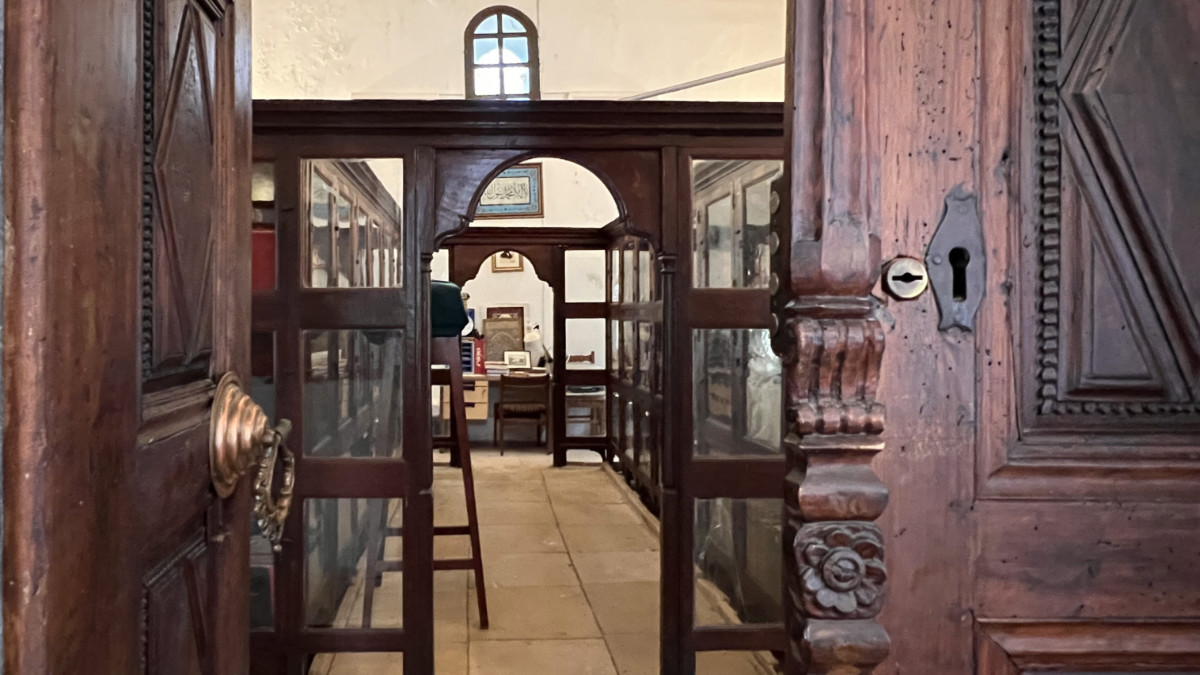
When Bostanci opens the door to the secured book room, the quiet weight of history hits immediately. A central cherry wood cabinet with glass panes holds the library’s collection, where the scent of aged wood mixes with oud – the fragrant resin placed between shelves to repel insects and preserve the fragile pages. Laid out for viewing are the collection’s rarest pieces: a 1735 copy of Ibn Khaldun’s 14th-century *Muqaddimah* (Prolegomena to History), a Mamluk-era Quran, texts on Hadith and astronomy, and an exquisitely illustrated 16th-century Safavid Quran.
Rhodes itself has always been a crossroads of empires, a place where layers of history overlap rather than erase one another. After the Knights Hospitaller were expelled from Jerusalem by Saladin’s armies, they captured Rhodes from the Byzantines in 1309 and built massive fortifications, churches, and a castle that still define the Old Town’s skyline. It took Suleiman the Magnificent six months of siege to oust the knights in 1522 – 70 years after the Ottoman conquest of Constantinople – transforming the island from a crusader fortress into a thriving trading entrepot and the Ottomans’ most important Eastern Mediterranean naval base. Commerce flourished, linking North Africa to the Black Sea and drawing multiethnic communities of Orthodox Christians and Jews to the island.
Today, Rhodes draws millions of tourists a year, drawn by its beaches and crowded waterfront cafes serving everything from overpriced sushi to traditional Greek fare. But the island has been a destination for curious travelers for centuries: French writer François-René de Chateaubriand wrote in 1812 that he found Rhodes more welcoming than any other Levantine destination, calling it “a little France in the midst of Greece” thanks to the Knights Hospitaller’s legacy. Even Egypt’s Khedival royal family vacationed here to escape the summer heat, and many elite members who died during their stays are buried at the Murad Reis Mosque near the port – the same cemetery where British writer Lawrence Durrell lived in a small cottage he named Villa Cleobolus for two years after World War II, before he found fame with *The Alexandria Quartet*. Durrell’s 1940s writings on Rhodes helped lay the groundwork for the Greek tourism boom of the 1960s, describing a poor island in flux, no longer Ottoman or Italian, not yet fully Greek.
On my final night, Tuten hosts a dinner for a diverse group of guests at a restaurant in Rhodes’ new city: a mix of people from Greece, Turkey, Istanbul, and Saudi Arabia, bound together by shared connection to the island’s layered history. A Greek writer friend from Istanbul whispers that the scene feels straight out of a Durrell novel: it is the Levant at its best, a messy, convivial mixing of cultures where conversations shift seamlessly between English, Greek, Turkish, and Arabic over wine and pizza.
Local researcher Savvas Pavlidis, whose great-grandfather was Rhodes’ last Ottoman-era mayor, explains that the island’s overreliance on tourism is no accident: after the 1923 population exchange and the severing of historic economic ties between the Dodecanese and the Anatolian mainland, Italian occupiers first turned to tourism to prop up the island’s economy, a path successive Greek governments continued. But while mass tourism shapes much of modern Rhodes, the Hafiz Ahmed Agha Library stands as a testament to the island’s natural connection to its eastern neighbors.
Today, Tuten hosts regular researchers and academics who come to study the library’s manuscripts and learn preservation techniques, but his core goal for the institution is far simpler. Drawing on the shared Greek-Turkish word *muhabbet*, meaning a warm, friendly exchange between people, Tuten says he wants the library to be more than an archive: it is meant to be a meeting place, a convivial space that unites communities across the borders and divisions that have reshaped the eastern Mediterranean over the past two centuries.