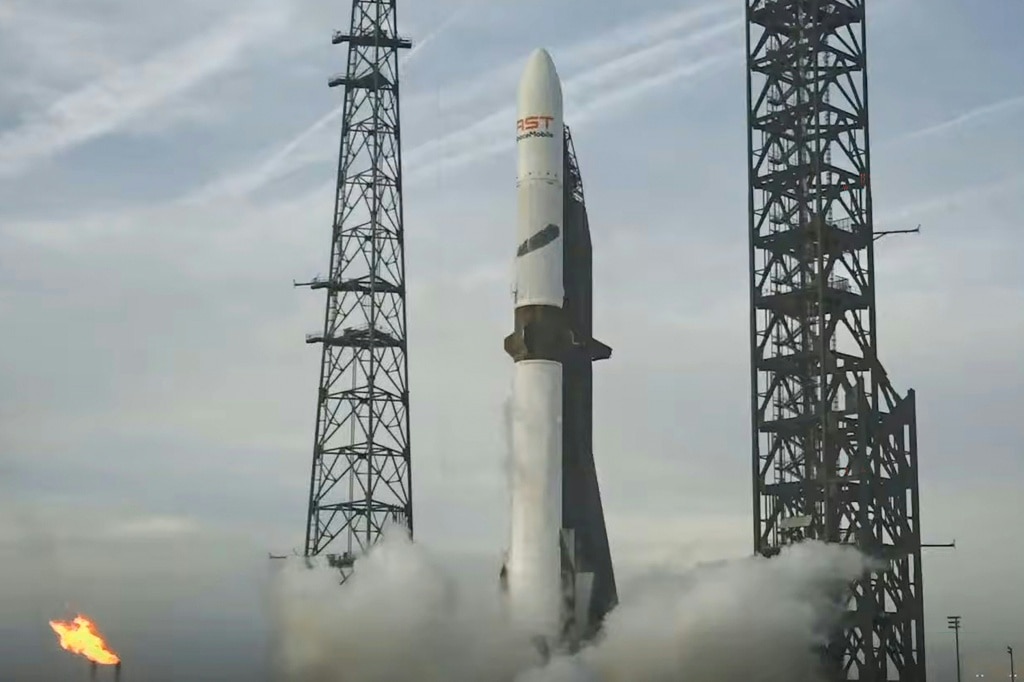
The high-stakes world of commercial space exploration faced a dramatic and costly setback on Thursday night, when Blue Origin’s next-generation New Glenn rocket erupted into a massive fireball during a pre-launch ground test at Florida’s Cape Canaveral Space Force Station. The incident, which occurred at approximately 9:00 pm local time (0100 GMT Friday), left no reported injuries but has sent ripples of concern across the global space industry, threatening timelines for both Jeff Bezos’s private space ambitions and NASA’s flagship Artemis Moon mission program.
Standing 98 meters (321 feet) tall, New Glenn is the most powerful launch vehicle ever developed by Blue Origin, designed to carry crewed missions, heavy commercial payloads, and key components for NASA’s lunar landing efforts. While routine testing anomalies are not uncommon in rocket development, industry experts note that full-scale explosions of this magnitude remain rare. Post-incident photos released on Friday confirm that the blast caused severe damage to both the rocket itself and the Cape Canaveral launch pad it was testing on. Florida Congressman Mike Haridopolos, whose district encompasses the Cape Canaveral space complex, told Fox News Friday that reconstruction work on the damaged facility will require a significant amount of time, adding further uncertainty to Blue Origin’s operational timeline.
In the immediate aftermath of the explosion, NASA Administrator Jared Isaacman released a statement via social media platform X acknowledging the incident. He reaffirmed NASA’s commitment to supporting a full, transparent investigation into the root cause of the anomaly, which is being conducted jointly by Blue Origin, NASA, and the U.S. Space Force. The New Glenn rocket will remain grounded indefinitely throughout the course of the investigation, and Blue Origin has declined multiple requests from Agence France-Presse for additional details on the scope of damage, investigation progress, or revised launch timelines.
The stakes of this setback extend far beyond Blue Origin’s corporate goals. Just days before the explosion, NASA awarded Blue Origin a major contract to develop a second lunar lander for the Artemis program, a move intended to create redundancy for the initiative after SpaceX, NASA’s primary lunar lander contractor, faced repeated delays to its own Starship development. The Artemis program, which aims to return the first American astronauts to the lunar surface since the Apollo program, currently targets a crewed landing by the end of 2028, with a critical in-orbit rendezvous test between lunar landers and a main spacecraft scheduled for 2027. Clatyon Swope, deputy director of the Aerospace Security Project at the Center for Strategic and International Studies, notes that any extended delay to New Glenn’s development could throw NASA’s carefully calibrated mission schedule off track.
The explosion also marks the second major malfunction for Blue Origin in just over a month, following a satellite launch failure caused by a rocket anomaly in March. Beyond the lunar program, the incident also threatens progress on Amazon’s Project Kuiper, a satellite internet constellation designed to compete with SpaceX’s Starlink. Project Kuiper relies heavily on New Glenn rockets to launch hundreds of its broadband satellites into orbit, meaning delays to the rocket program will likely push back the commercial rollout of Bezos’s satellite internet initiative.
This is not the first time a catastrophic rocket explosion has occurred at Cape Canaveral; a decade ago, a SpaceX Falcon 9 rocket exploded during pre-launch ground testing, destroying a $200 million communications satellite that was set to be deployed. While many in the space sector have expressed confidence that Blue Origin will ultimately recover from the setback, the immediate impact of Thursday’s blast is expected to reshape near-term plans for both U.S. commercial space development and NASA’s lunar exploration agenda.