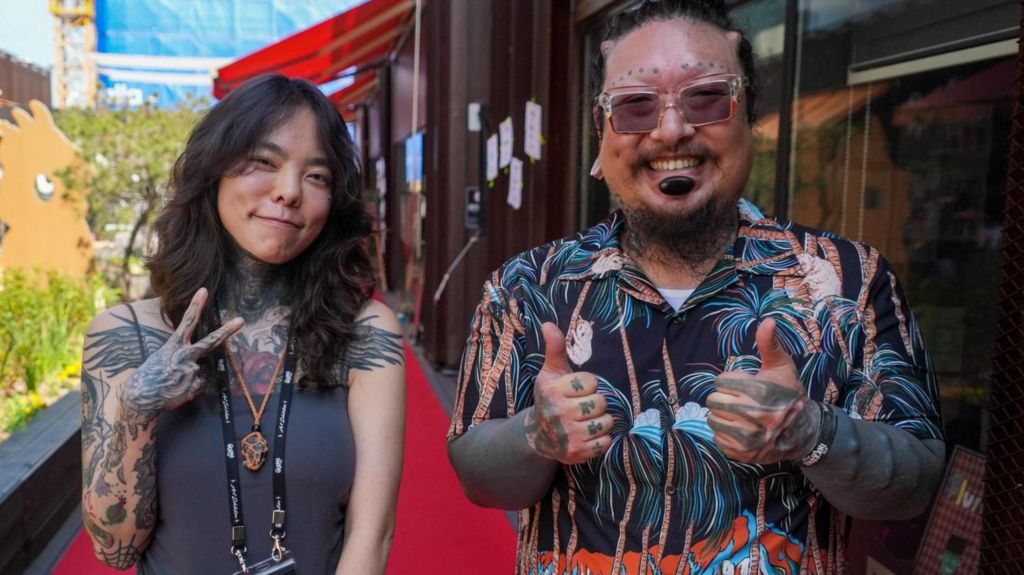
Last Saturday, on a rooftop in Seoul’s trendy Seongsu neighborhood, over 90 South Korean tattoo artists gathered for a celebration decades in the making. For 34 years, tattooing as a profession had been restricted exclusively to licensed medical practitioners in the country, forcing the entire industry to grow in the shadows. But following landmark rulings from the nation’s top court and legislative action from lawmakers, that era of criminalization has finally come to a close. When veteran tattooist Kim Tae-nam took the stage to open the Ink Bomb festival, his relief and joy were palpable to every attendee. “This was only possible because of our effort, all your sweat and tears,” he told the cheering crowd. “Let’s hear it from everyone: Tattoos are art!”
The path to legalization began decades ago, when South Korea’s Supreme Court ruled in 1992 that tattooing qualified as a medical practice, citing public hygiene and safety concerns. This ruling aligned with long-standing conservative social norms that framed body art as unseemly, reinforcing outdated stereotypes that linked tattoos to organized crime and gang activity. Violations of the restriction carried severe penalties, including heavy fines and even jail time, forcing thousands of artists to operate in secret. When Kim started his career in 2004 under the pseudonym Sunrat Tattoo, he ran his first studio out of an unmarked basement, accepting clients by invitation only. When he launched the Ink Bomb gathering in 2008, every event was shut down by police, who threatened arrest and criminal charges for participants. This year’s open, public festival marks the first time the event has been held legally since 2014.
The decades-long crackdown did not just push the industry underground—it created dangerous conditions for artists, particularly women. Disgruntled clients often exploited the illegal status of tattooing to blackmail, harass, or threaten artists, who could not turn to police for help without incriminating themselves. According to Kim Do-yoon, founder of the South Korean Tattoo Union who works under the pseudonym Doy, the vast majority of these harassment victims were young women artists. “The shock from these losses is what moved me to found the union and fight for our right to work safely and legally in Korea,” Doy stated, noting that some targeted artists died by suicide as a result of their exploitation. Each year, the union provided legal support to at least 50 prosecuted tattoo artists, with many more facing unreported fines. Despite the constant risk, the industry grew steadily: 2021 government data estimates there are roughly 350,000 tattoo artists working across South Korea today.
For many artists, the legalization brings an end to a constant state of anxiety. Tattooist Kali, who has never faced criminal charges herself, said she lived with constant hypervigilance from seeing peers prosecuted. “I was constantly working with anxiety. It still feels surreal to me that I no longer have to worry about this,” she said, describing her “ecstatic” reaction to the Supreme Court’s recent decision overturning the 1992 ruling. Just months before the court decision, in September, South Korean lawmakers passed legislation formalizing the legality of tattooing by non-medical professionals, capping off a years-long campaign by artists to end harassment and criminalization.
Shifting social attitudes laid the groundwork for this policy change, driven by younger generations of Koreans who have embraced body art as a legitimate form of self-expression. Over the 2010s, South Korean tattoo art gained global acclaim, particularly for its distinctive delicate fine-line style, which spread to global audiences via social media. High-profile South Korean celebrities—from K-pop idols like BTS’s Jungkook, Girl’s Generation’s Taeyeon and HyunA, to Olympian diver Woo Ha-ram and actress Han Ye-seul—have also helped normalize tattoos by displaying their body art publicly. Even as the legal framework changes, however, social stigma persists: many workplaces still hold negative biases against tattooed candidates, some public gyms and saunas maintain “no tattoo” policies, and mainstream conformist culture still marginalizes people who choose visible body modification. Still, artists note that younger generations are actively breaking down these long-standing norms.
While the end of criminalization is a historic win for the industry, uncertainty remains. South Korea’s Ministry of Health has announced plans to roll out a new licensing and testing system for tattooists in 2025 to standardize the profession, and dozens of older criminal cases against artists are still pending. Doy, who was charged under the old Medical Act for tattooing actress Han Ye-seul in 2019 (and has also inked high-profile clients including Brad Pitt and Steven Yeun), expects his charges and those of other artists will be dismissed following the Supreme Court ruling. For Doy, the moment is bittersweet: “Things are finally back where they should be,” he said. “But I can’t help but think of the fellow artists who aren’t here with us.”
Attendees at Ink Bomb reflected the growing mainstream acceptance of tattoo culture in South Korea, drawing a diverse crowd that included working artists, punk rock fans, and even parents accompanying their teenage children. Though no permanent tattoos were offered at the celebration—given the time and space the practice requires—attendees could pick up free custom sticker art from participating creators. For many in the crowd, the day was far more than a festival: it was a long-overdue recognition of decades of hidden work and cultural contribution. “It makes no sense that tattooing should be seen as a medical act. Nobody is going to medical school to become a tattooist,” said 48-year-old tattoo enthusiast Jay Hur. “Korean tattooists had to take risks to do their job to sustain this beautiful underground culture.”