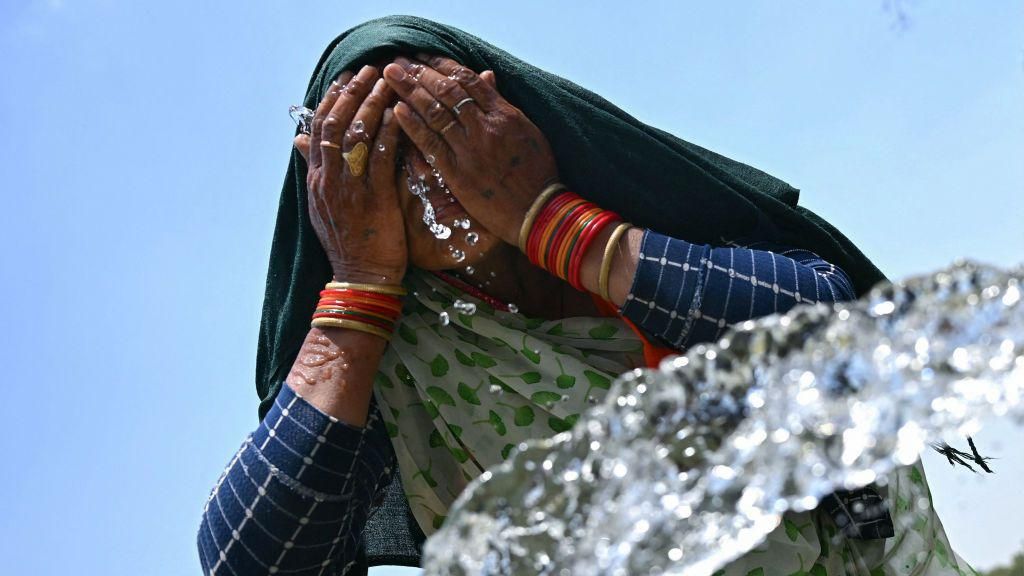
In one of Delhi’s busiest commercial hubs, a stark divide plays out on a sweltering 40-plus degree Celsius afternoon. Inside air-conditioned showrooms, shoppers browse clothing racks in cool comfort, shielded from the brutal summer sun. Just steps outside, under an unforgiving blaze, street vendors, cycle-rickshaw operators, fruit sellers and ice cream cart owners keep working, their livelihoods dependent on enduring temperatures that can overwhelm even the fittest bodies. Even a short walk across the market leaves visitors drained, but for millions of India’s informal workers, stepping out of the heat is not a choice they can afford.
Nearly 90 percent of India’s total workforce earns a living in the informal sector, where most lack formal employment contracts, job security or sick leave, and the vast majority rely on outdoor daily wage labor to put food on their families’ tables. Fifty-two-year-old cycle-rickshaw driver Harish Chandra is one of these millions, pedaling through Delhi’s congested streets until the heat becomes too crippling to continue. After splashing cold water from a public tap over his face, he sinks into a thin strip of shade edging the market, and sums up the struggle simply: “The body gives up.”
Clad in a thin, worn cotton shirt, Chandra says Delhi’s summers have grown increasingly unendurable year after year. “My day starts around 9 a.m., when the heat is still manageable,” he explains. “But by noon, it becomes unbearable. The sun is so harsh that sometimes I can feel my body giving out mid-pedal. Still, if we stop working, we stop earning. And if we don’t earn, our families don’t eat.” To escape Delhi’s suffocating heat, Chandra recently sent his wife and three children back to their home village in Bihar. While temperatures there are just as high, he says open countryside and better ventilation make it far easier to cope than the capital’s cramped, congested residential lanes. For workers like Chandra, who spend almost all their waking hours outside, summer is no longer just a season—it is an annual battle for survival.
India’s heat season typically runs from April through early July, when monsoon rains finally bring relief. But climate scientists warn that extreme heat events are growing longer, more intense and less predictable, as global warming supercharges heatwaves across South Asia. Former World Health Organization chief scientist Dr. Soumya Swaminathan told Indian news agency ANI this week that the temperatures now recorded across India are approaching the upper limits of human tolerability, representing a direct threat to both lives and livelihoods.
Since mid-May, Delhi and surrounding regions have logged daily highs above 40°C, with afternoon temperatures sometimes climbing past 45°C. While a brief cool-down is forecast for the coming weekend, repeated extreme heatwaves have become a normalized part of Indian summers. Cities like Delhi are disproportionately at risk due to the urban heat island effect: concrete infrastructure, heavy traffic and limited green space trap heat, leaving city centers several degrees hotter than surrounding rural areas.
India’s weather department and the Delhi government have issued regular heat warnings, and Prime Minister Narendra Modi recently posted on social media urging the public to stay hydrated, carry water when outdoors, and monitor for heat exhaustion, particularly among children, elderly people and outdoor workers. Delhi is one of several Indian cities with an official heat action plan, which includes color-coded heat alerts, public advisories to avoid outdoor activity during peak afternoon heat, free water kiosks and public cooling centers. But for daily wage workers, much of this guidance is impossible to follow. Rent is still due every month, and food still needs to be bought—regardless of how high the temperature climbs.
Fifty-year-old tuk-tuk driver Mohammad Umar has been waiting for passengers near a busy traffic intersection since dawn. He rarely takes a day off, but last week the heat finally forced him to stay home. “My heart was racing, and my body had no strength left,” Umar recalls. “I must have bathed five times that day just to stay conscious.” But skipping work comes at a steep cost. “Losing a day of work means losing 500 to 700 rupees (roughly $5 to $7),” he says. “We still have to pay for food and daily essentials, so that money comes straight out of our tiny savings.”
International projections paint a grim picture of the future. The International Labour Organization estimates that heat stress could cut India’s total available working hours by 5.8 percent by 2030, with outdoor workers in agriculture and construction hit hardest. A 2024 Lancet Countdown report found that India lost 247 billion potential labor hours to extreme heat last year alone, translating to $194 billion in economic losses.
Medical experts explain that prolonged exposure to extreme heat puts catastrophic strain on the human body, especially for workers who spend hours outside without shade, cooling or consistent access to clean drinking water. Dr. Satish Koul, principal director and unit head of internal medicine at Fortis Hospital Gurgaon, says hospitals see a steady surge in cases of dehydration, low blood pressure, kidney strain and heat exhaustion during extended heatwaves. “There are early warning signs people often ignore: dizziness, weakness, headaches, nausea and confusion,” Dr. Koul notes. “If someone stops sweating, becomes disoriented or collapses, it becomes a life-threatening medical emergency very quickly.”
For many informal workers, the danger does not end when they finish their shifts. Most of Delhi’s informal migrant workforce lives in densely packed unplanned settlements, with unreliable electricity, poor airflow and no access to air conditioning. Many homes are built from tin sheeting and plastic, which absorb heat all day and slowly release it overnight, keeping indoor temperatures sweltering long after the sun goes down. Doctors warn that overnight heat retention is especially dangerous, because it prevents the human body from cooling down and recovering after a day of exposure. “When the body can’t cool properly during sleep, exhaustion builds up day after day,” Dr. Koul adds.
This cumulative exhaustion shapes every part of daily life in these neighborhoods, where nearly every family relies on physically demanding labor to get by. Men leave for outdoor jobs before dawn, while many women take low-paying domestic work in nearby neighborhoods. Alongside long working hours, women are also responsible for cooking, childcare and household chores in cramped, sweltering homes with almost no relief from the heat.
Workers have adapted with small coping strategies: covering their heads to block direct sun, drinking salted water to replace electrolytes, and shifting work hours to avoid the harshest midday sun. But these measures offer only minimal relief. Sanjeeda, a 40-year-old widow who has worked in factories, small shops and private homes for years to support her children, says she was bedridden for days in mid-May after a severe heat exposure left her with crippling headaches and a fever. “The sun is harsh starting first thing in the morning,” she says. “By the time I get to a house and start sweeping and mopping, my clothes are completely soaked. Some days I even have to clean rooftops where the marble floors feel like they’re on fire.” While her employers sometimes offer water, lemonade or a few minutes of rest in front of a fan, she says, “No matter how hot it gets, the work has to get done.”