Four months after a fragile ceasefire paused open hostilities between the United States and Iran, a new round of mutual strikes has shattered the relative calm, triggering fresh fears of a wider regional conflict and roiling global energy markets already on edge over the future of the Strait of Hormuz.
The escalation unfolded Thursday, marking the most serious confrontation between the two adversaries since the truce took hold in April, and came as violence surged along the Lebanon-Israel border, where Iran-backed Hezbollah has been locked in continuous low-intensity conflict with Israeli forces. The clash also drew in Kuwait, a key US ally in the Gulf, which activated its air defense systems to intercept incoming fire shortly after the exchange of attacks began.
According to Iran’s state-run broadcaster IRIB, Iranian forces opened fire on four commercial vessels attempting to transit the Strait of Hormuz, the strategic waterway that Iran has fully blockaded since the war began in late February, when US and Israeli forces launched a coordinated attack on Iranian targets. In response, a US official confirmed that American military forces targeted an Iranian ground control station located in the port district of Bandar Abbas, Iran’s primary Gulf shipping hub.
Minutes after the US strike, IRIB quoted Iran’s Islamic Revolutionary Guard Corps (IRGC) confirming that it had retaliated against the American air base that launched the original attack. The IRGC declined to publicly disclose the base’s location, but the confirmation of a counterstrike aligned with Kuwait’s announcement that it was responding to an incoming attack on its territory, which hosts large contingents of US military personnel.
Iranian foreign ministry spokesman Esmaeil Baqaei issued a formal condemnation of the US action, framing the strikes as a clear violation of the April ceasefire and emphasizing that Iran would take “all necessary measures” to protect its territorial integrity and national sovereignty. The US pushed back on this framing, with an unnamed official characterizing the American strike as a purely defensive action taken to preserve the terms of the existing truce.
The latest escalation has cast deep uncertainty over the stuttering diplomatic negotiations aimed at reaching a permanent peace deal to end the conflict that began on February 28. While neither Washington nor Tehran has signaled a willingness to return to full-scale open war, the clash has reinforced fears that the fragile truce could collapse entirely. For ordinary Iranians, that uncertainty has become a constant part of daily life. “I feel like nothing is certain yet,” said Amir, a 27-year-old software developer based in Tehran, speaking before Thursday’s strikes. “The daily question is: Will there be missile strikes tonight?”
At the heart of the ongoing diplomatic talks is the future of the Strait of Hormuz, the waterway that carries roughly a fifth of global oil and gas supplies. The Iranian blockade has cut off that key transit route, leaving global energy markets grappling with constrained supplies and volatile pricing. Thursday’s strike news sent oil prices jumping higher, erasing most of the gains from the previous session, which had risen on growing optimism that a peace deal to reopen the strait was close.
The diplomatic wrangling over Hormuz took a dramatic turn this week when US President Donald Trump issued an unusual threat against Oman, another Gulf nation that has served as a neutral mediator in the conflict and has itself been targeted by Iran in recent months. When asked about a proposed short-term arrangement that would let Oman and Iran jointly manage transit through the strait, Trump rejected the idea outright. “No, the strait is going to be open to everybody,” Trump said. “It’s international waters and Oman will behave just like everybody else or we’ll have to blow them up.”
Baqaein condemned the threat against Oman, calling it “a worrying sign of the normalisation of anarchy and intimidation in international relations.” The verbal threat came one day after the US Treasury Department announced new sanctions against Iran’s Persian Gulf Strait Authority, the new Tehran-led agency established to collect transit fees from ships passing through the blockaded waterway.
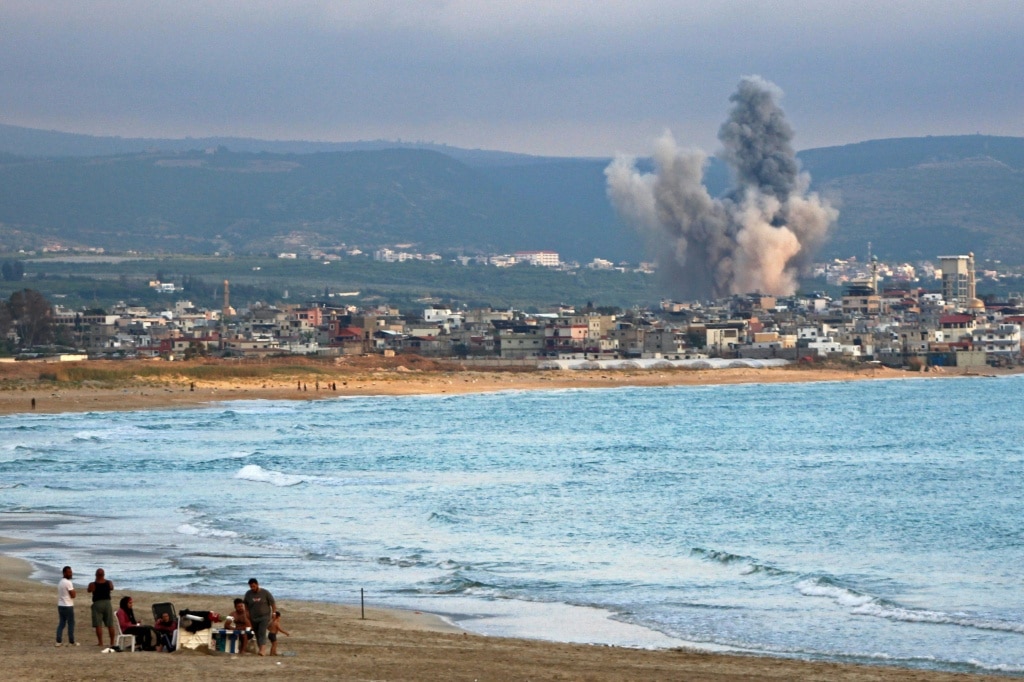
Beyond the Gulf, the violence has also escalated sharply in Lebanon, where a separate ceasefire between Israel and Hezbollah has failed to stop continuous skirmishes that have intensified over the past week. On Thursday, the Israeli military launched new airstrikes against Hezbollah infrastructure around the southern Lebanese city of Tyre, a day after it issued a sweeping order declaring all territory south of the Zahrani River — roughly 25 miles from the Israeli border — an active combat zone and ordering all civilian residents to evacuate immediately.
The evacuation order, the first large-scale such warning since the April 17 ceasefire between Israel and Hezbollah went into effect, interrupted Eid al-Adha celebrations for thousands of Lebanese families in the region. Lebanon’s official National News Agency reported multiple airstrikes targeting residential areas in the city of Nabatieh, causing what it described as “huge destruction” to civilian property.
As of Wednesday, Lebanon’s health ministry reported that the total death toll from the conflict that began on March 2 stands at 3,269 people. On Thursday, the Israeli military confirmed that one additional soldier was killed in a Hezbollah drone attack along the Lebanese border the previous day, bringing the total number of Israeli troops killed in the conflict with the Iran-backed group to 24. Iranian officials have insisted that any final peace deal between Tehran and Washington must also include a permanent ceasefire and resolution for the Lebanese front.