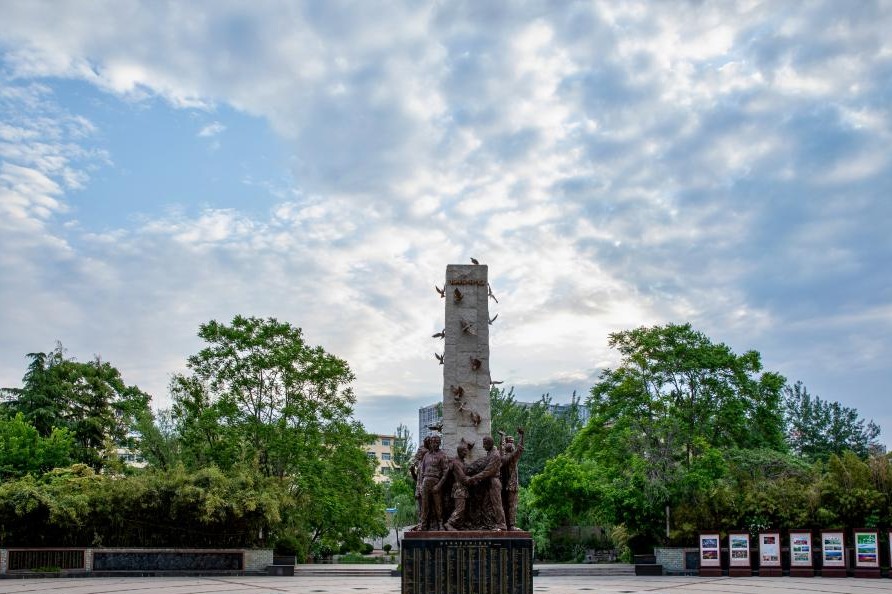
When discussions turn to World War II concentration and internment camps, Auschwitz, the haunting symbol of Nazi atrocities in Europe, immediately comes to mind for most people. Half a world away, however, in China’s eastern Shandong Province, sits a lesser-known site that holds a equally powerful story of suffering, courage, cross-cultural solidarity and enduring hope for peace: the former Weihsien Internment Camp, now preserved at the Courtyard of the Happy Way in Weifang.
The site’s origins stretch back to 1882, when an American missionary built a sprawling complex that housed a church, school, and hospital. After Japan launched its full-scale invasion of China during World War II, the occupying Japanese military seized the property and repurposed it into an internment camp to detain non-Chinese citizens from Allied nations. Established in retaliation for the United States’ internment of Japanese and Japanese American civilians following the 1941 attack on Pearl Harbor, the camp would go on to hold more than 2,000 civilians from 30 different Allied countries, making it the largest Allied civilian internment camp in Asia during the war.
Unlike the extensively documented Nazi concentration camps of Europe, the Weihsien Internment Camp’s history has remained largely out of global public consciousness, even for descendants of those who were imprisoned there. For Professor John Stanley, a history scholar at Pennsylvania’s Kutztown University, this forgotten chapter of World War II became a life-long research passion, sparked by a 1991 trip to the site with his father, Charles A. Stanley, who had been interned at Weihsien as an infant. Imprisoned alongside his parents at 10 months old in 1943, Charles remained in the camp until it was liberated by US soldiers and a Chinese translator in August 1945. Like many other survivors, Charles never spoke of his experience growing up; the trauma of internment led generations of survivors to leave this painful chapter of their lives unspoken.
Stanley’s 1991 visit was originally organized to dedicate a memorial to Eric Liddell, the legendary 1924 Olympic 400-meter gold medalist who died of illness in the camp due to severe shortages of food and medical care. That trip ignited Stanley’s broader interest in Chinese and East Asian history, and he has spent decades uncovering the details of daily life in the camp and the critical role local Chinese residents played in supporting the imprisoned civilians.
Among the detainees were several prominent figures, including Arthur W. Hummel Jr., who would later go on to serve as the second United States Ambassador to the People’s Republic of China. Hummel successfully escaped the camp months before liberation with help from local Chinese rescuers. Stanley’s research highlights that the support local residents provided went far beyond escape aid: it kept internees hopeful as the war dragged on and outside news grew increasingly scarce.
Most famously, local residents risked harsh punishment, even death, to smuggle scarce food and supplies into the camp through an informal underground network referred to as the “black market.” While eggs were the most common contraband thrown over the camp’s walls, Stanley even documented accounts of a live chicken being smuggled in to feed hungry detainees.
Zhang Zhiren, a Europe-based writer who spent years researching the camp for his book *Weihsien West Civilians Concentration Camp: 1943-1945*, says the quiet bravery of local Chinese people who risked their lives to help is the most moving part of the camp’s history. His book details the harsh conditions detainees faced: overcrowding, malnutrition, inadequate medical care that led to the deaths of at least 31 internees, and complete isolation from outside news. It also documents the selfless acts of solidarity from nearby residents who, despite facing their own hardship under Japanese occupation, chose to help the trapped foreigners.
One of the most notable stories of courage centers on Zhang Xingtai, a local villager who worked as a latrine cleaner inside the camp. Japanese guards dismissed him as an unthreatening ordinary farmer, but Zhang secretly operated as a critical information lifeline for internees cut off from the outside world. Working alongside his son, he smuggled outside news into the camp and carried notes from internees out — and it was the pair that secretly spread the word of Japan’s surrender to detainees days before the formal liberation, at enormous risk to their own lives.
Tragedy is also part of this story: Zhang documents the death of a local Chinese child who was electrocuted on the camp’s perimeter fence while attempting to deliver food to starving internees. Japanese guards refused to allow the child’s family to retrieve his body, leaving the small body caught on the electric wire as a grim warning.
“What strikes me most is that the people of Weifang did not care what nationality the internees were,” Zhang explained. “They only knew that people were suffering, and they had a duty to help. This simple kindness crossed all lines of war and national borders.”
As the decades passed after the war, survivors remained largely silent about their experiences, and the camp’s history began to fade from collective memory. Today, as the number of living survivors dwindles, Zhang and other researchers are working to preserve this shared history for future generations. Zhang notes that the story of mutual aid between Chinese civilians and foreign internees 80 years ago serves as a powerful example of shared humanity in the face of war, perfectly embodying the vision of a global community with a shared future.
The importance of this history has not gone unrecognized. In 2021, International Cities of Peace, a global non-profit dedicated to advancing the international peace movement, designated Weifang as the 308th International City of Peace — only the second Chinese city to receive the designation, after Nanjing. This year marks the fifth anniversary of that designation, and International Cities of Peace chair J. Frederick Arment has praised Weifang for its intentional work to heal historical trauma and turn a site of suffering into a beacon of hope for future peace.
In 2024, to mark the 45th anniversary of formal diplomatic relations between China and the United States, the story of the Weihsien Internment Camp reached a new international audience through a special traveling exhibition hosted in San Francisco. Stanley attended the opening as a representative of survivors’ descendants, and he praised Weifang’s ongoing work to preserve the camp’s original buildings and share its story with global audiences.
“These efforts show a real commitment to raising public awareness of the true human cost of war, and why we must work to avoid it whenever possible,” Stanley said. Speaking to the enduring relevance of the camp’s legacy today, he expressed hope that remembering this story would encourage global leaders to prioritize diplomacy and collaborative conflict resolution through international institutions, rather than turning to violence or coercive pressure to resolve disputes.