New climate projections from the United Nations paint a stark near-term outlook for the global climate, finding that over the next five years, the planet is extremely likely to repeatedly cross the internationally agreed safe warming threshold and break the current record for the world’s hottest year.
Released by the World Meteorological Organization (WMO) in collaboration with the United Kingdom’s Meteorological Office, the analysis projects a 75% probability that the average global temperature between 2026 and 2030 will exceed 1.5 degrees Celsius above pre-industrial levels. That temperature limit was formally established as a long-term global target in the 2015 Paris Climate Agreement, designed to avoid the worst impacts of human-caused climate change. Prior scientific research has confirmed that even a small overshoot of this threshold would sharply increase risks of mortality, extreme hazard, and mass biodiversity loss, with sensitive ecosystems such as tropical coral reefs and mountain glaciers unable to adapt to even minor additional warming.
The report’s statistics are even more sobering for individual years: there is a 91% chance that at least one year between 2025 and 2030 will cross the 1.5°C threshold, and an 86% chance that one of those years will break the current hottest-year record set in 2024. WMO projects annual global temperatures for the 2025–2030 period will land between 1.3°C and 1.9°C above late 19th-century baselines.
Contrary to common popular framing of the 1.5°C target as a hard “point of no return,” report co-author Melissa Seabrook, a climate scientist at the UK Met Office, emphasized that warming risk increases incrementally. “It’s important to note that 1.5 is not kind of a cliff edge that we’re going to fall off,” Seabrook said. “Every 0.1 of a degree brings more and more severe impacts.” She pointed to the unprecedented extreme heat that swept Europe in May 2025 as an immediate example of the hazards already unfolding.
Outside experts echoed that warning. Friederike Otto, a climate scientist at Imperial College London who was not involved in the report, noted that a full year or longer of temperatures above 1.5°C would unlock extreme weather events more intense than any modern societies have planned for. “This means a whole range of extreme weather events, probably many so hot/wet/dry that it exceeds anything we’ve experienced in the past and thus crucially, anything our city planning, agriculture etc. has anticipated,” Otto explained via email. “This will mean many people will lose their lives, we are in for a lot of food price shocks, and more intense wildfires.”
A major contributing factor to the projected near-term warming surge is the expected return of a strong El Niño event, the natural climate pattern that warms surface waters in the central Pacific, boosts global average temperatures, and alters weather systems worldwide. The WMO projects this upcoming El Niño could persist as late as 2028, and Seabrook noted that 2027 is the most likely year to break the 2024 heat record as a result.
If the 2026–2030 five-year average does exceed 1.5°C, that would mark a dramatic acceleration in the rate of global warming: the planet would warm 0.25°C per decade, up from the previous long-term average of roughly 0.2°C per decade. Seabrook noted that climate scientists are already divided over whether warming is accelerating, and the projection would add key evidence to the argument that the rate of climate change is speeding up. “That obviously is quite scary,” she added.
The report’s projections highlight two particularly high-risk regions that will face disproportionate warming impacts. First, the Arctic is projected to warm 3.5 times faster than the global average over the next five years, creating a dangerous feedback loop. As rising temperatures melt sea ice, the dark open ocean that replaces bright reflective ice and snow absorbs more solar radiation, driving further warming. The report finds that average winter temperatures in the Arctic between 2026 and 2030 will be 2.8°C (5.1°F) warmer than the 1991–2020 baseline, following a 1.2°C (2.1°F) average winter warming between 2020 and 2025. Summer Arctic sea ice extent is also projected to continue shrinking.
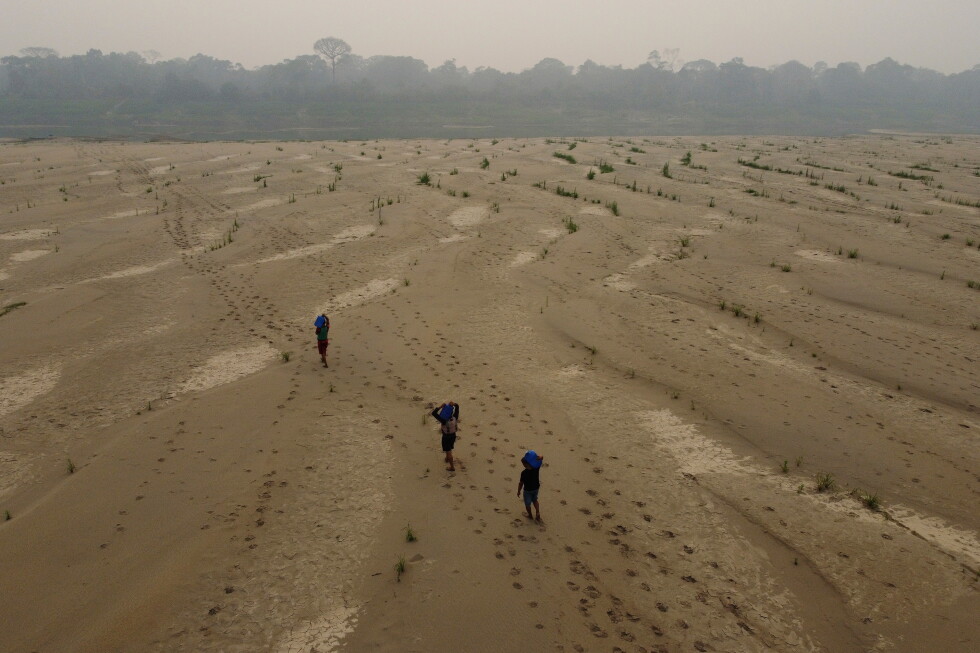
Second, the Amazon basin — the planet’s largest terrestrial carbon sink, a critical natural buffer against human-caused warming — is forecast to face prolonged unusually warm and dry conditions over the next five years. Those conditions would sharply increase wildfire risk, raising the alarming possibility that the Amazon could shift from absorbing heat-trapping carbon dioxide to releasing it, worsening global warming. The drought and wildfire risk also threatens the water security and livelihoods of millions of people who depend on the rainforest. By contrast, the already parched Sahel region of Africa is projected to receive above-average rainfall, increasing the risk of catastrophic flooding.
UN climate leadership emphasized that the stark projections show current global efforts to cut fossil fuel emissions are insufficient to slow warming. “Despite the progress of recent years, it’s clear that global heating is still outpacing global efforts to contain it, and the baking temperatures in Europe, India and elsewhere show yet again the brutal human and economic impacts of humanity still burning colossal amounts of coal, oil and gas,” said UN climate chief Simon Stiell. “Whether it’s extreme heat, mega-storms, floods, massive wildfires or droughts hitting food supply and prices, every nation is already paying a huge price from this global climate crisis.”
The Associated Press’ climate and environmental coverage receives financial support from multiple private foundations, with AP retaining full editorial control over all content.