Bolivia has entered its fourth week of widespread anti-government demonstrations, with President Rodrigo Paz warning Wednesday that the Andean nation has reached a critical “breaking point” as blockades have choked off supplies of food, fuel, and life-saving medical resources to the country’s political capital La Paz.
Six months into his term, the US-backed center-right leader took office during Bolivia’s most severe economic downturn in 40 years. Now he faces a growing wave of public anger rooted in policy disagreements, led by low-income workers and members of Bolivia’s Indigenous majority — the nation’s largest demographic group — who have gathered in La Paz demanding his immediate resignation.
Speaking at a public gathering in the capital Wednesday, the 58-year-old president reiterated his call for negotiation while stressing the urgent need for social order. “The country needs order, and is reaching breaking point,” Paz stated. The previous day, Bolivia’s Congress removed legislative barriers that would prevent the president from declaring a national state of emergency, clearing the way for a potential military deployment to clear blockades and restore calm.
To date, Paz has framed dialogue as his preferred path forward, but has refused to rule out activating what he calls “constitutional instruments” to end the ongoing siege of La Paz — a clear reference to emergency powers. “Anyone who wants to destroy the nation will have to deal with this president and the full force of the Constitution,” he added, confirming that police and military forces enjoy full public and government backing for their efforts to maintain order.
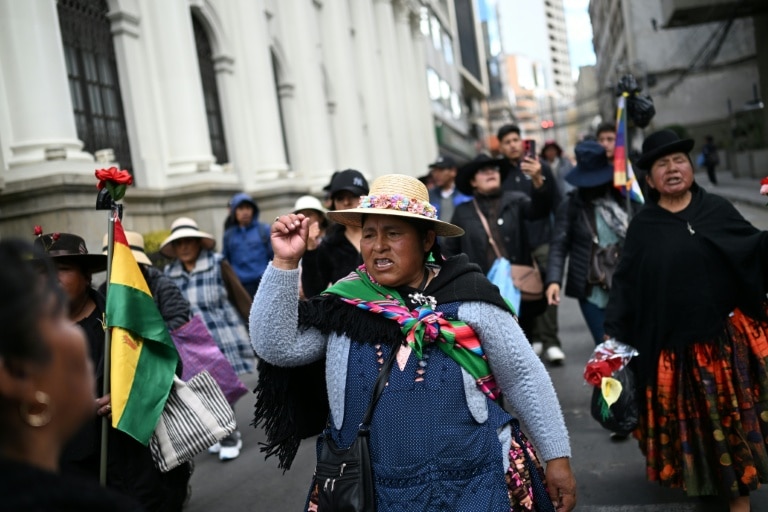
Paz’s warnings coincided with a high-profile Mother’s Day march in La Paz, where thousands of Indigenous women in traditional layered skirts took to the streets to back striking transport workers and amplify the call for the president’s ouster. “We are not afraid to die. We have already told him to pack his bags and leave,” protest organizer Marta Poma Luque told Agence France-Presse in an on-the-ground interview.
The unrest first erupted in early May, when demonstrators initially called for higher wages to offset the impact of the deep economic crisis, more reliable fuel distribution, and the full repeal of a deeply unpopular agrarian reform law. Though Paz has already backed down on several key demands, including rolling back parts of the land reform, demonstrations have expanded into a full-scale movement against his administration.
Over the past two weeks, La Paz has descended into repeated conflict, with riot police clashing regularly with thousands of blockading protesters. The blockades have cut off all major supply routes into the city, leaving residents facing acute shortages of critical goods. Local resident Zulm Hinojosa, whose 13-year-old son lives with chronic asthma and heart conditions, told reporters that essential medication has become exponentially more expensive and in many cases has run out entirely.
At Clinicas de La Paz, one of the country’s oldest and largest public medical facilities, medical staff confirmed Tuesday the hospital only has enough oxygen to sustain patients for a few more days. For his part, Paz has calculated total economic losses from the weeks of unrest at roughly $600 million.
In a bid to defuse tensions, the president has already announced a series of concessions: he pledged to halve his own presidential salary as a gesture of solidarity with low-income Bolivians, a largely symbolic move given his monthly salary of just 24,000 bolivianos (approximately $3,500). He has also promised greater policy input for Indigenous groups and labor unions, and dismissed his widely unpopular labor minister. None of these steps have managed to end the protests.
Paz’s administration has accused former president Evo Morales of secretly orchestrating the nationwide unrest. Morales is currently in hiding, facing criminal charges related to the alleged trafficking of a teenage girl with whom prosecutors claim he fathered a child.
In response to the crippling blockades, small groups of La Paz residents have held counter-demonstrations in recent days calling for an end to the supply disruptions that have turned daily life in the capital into a crisis.