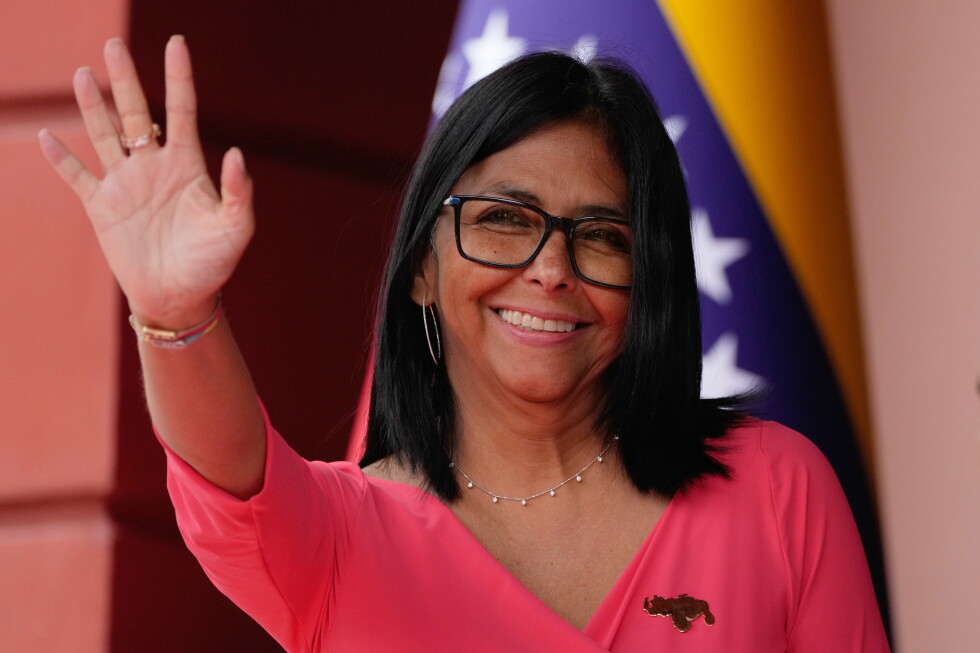
In a development that highlights the Trump administration’s shifting diplomatic approach toward oil-rich Venezuela, multiple current and former U.S. law enforcement officials have confirmed that the White House has quietly ordered federal prosecutors based in Miami to halt active criminal investigations into Venezuelan acting President Delcy Rodríguez, a figure who has been on the U.S. Drug Enforcement Administration’s watchlist for nearly a decade. This decision marks the most recent step in a rapid thaw of relations between Washington and Caracas following the ouster of former Venezuelan leader Nicolás Maduro.
It remains uncertain whether prosecutors had gathered enough evidence to implicate Rodríguez in any criminal activity, or whether law enforcement teams were on the verge of issuing a formal indictment against her. A spokesperson for the U.S. Department of Justice claimed in an emailed statement that “there was never an investigation into her to shut down.” However, DEA records obtained earlier this year by The Associated Press confirm that Rodríguez has repeatedly appeared on federal law enforcement’s radar since at least 2018. Unlike a number of other high-ranking Venezuelan government officials, she has never been formally criminally charged in U.S. courts to date.
Multiple officials familiar with the internal directive said the order to suspend investigations into Rodríguez was intentionally crafted to avoid disrupting the administration’s broader efforts to stabilize Venezuela in the wake of Maduro’s capture. It is still unclear whether the White House, which directed all inquiries about the decision to the Department of Justice, directly intervened to order the probes paused. “Everybody has been told to stand down,” one unnamed former senior law enforcement official told the AP. All sources who shared details of the internal deliberations spoke on condition of anonymity, as they were not cleared to publicly discuss confidential law enforcement and policy matters. Requests for comment from Rodríguez, her U.S. legal representative, and Venezuela’s Communications Ministry went unanswered.
By removing the lingering threat of a potential indictment, even on a temporary basis, the U.S. has significantly reduced diplomatic and legal pressure on Rodríguez as the Trump administration works with the acting president to rebuild stability in Venezuela and open the country’s energy sector to American investment. Shortly after U.S. military forces transported Maduro and his wife to New York to face federal narcotics charges — both have pleaded not guilty — former President Donald Trump publicly praised Rodríguez as a “terrific person.”
In recent months, the U.S. has lifted all sweeping sanctions that were imposed on Rodríguez during Trump’s first term, formally recognized her as Venezuela’s legitimate head of state, and cleared the way for her administration to re-establish working relationships with Western financial institutions. This shift has also cleared a path for U.S. energy firms to pursue access to Venezuela’s proven petroleum reserves, the largest on the planet. As bilateral ties deepen, some foreign policy analysts have pointed to the U.S.’s Venezuela strategy — which combines oil blockades, criminal indictments of incumbent leaders, and implicit military threats to force internal regime change — as a potential blueprint for pressure campaigns against other long-standing U.S. adversaries, including Iran and Cuba.
During Trump’s first term, Rodríguez and her brother Jorge Rodríguez, who currently leads Venezuela’s National Assembly, were sanctioned for their role in what the U.S. described as undermining Venezuelan democracy and entrenching Maduro’s authoritarian government. Despite that history, Trump publicly praised Rodríguez’s leadership in a social media post from early March, writing: “The Oil is beginning to flow, and the professionalism and dedication between both Countries is a very nice thing to see!” In recent weeks, Rodríguez has welcomed multiple high-profile delegations of American energy executives to Caracas, including groups led by U.S. Energy Secretary Chris Wright and Secretary of the Interior Doug Burgum.
Notably missing from the growing diplomatic goodwill between the two governments is any public commitment from Rodríguez to hold long-promised democratic elections. Last month, Rodríguez exceeded a 90-day temporary mandate to hold office that was set by Venezuela’s high court after Maduro’s ouster. When a visiting U.S. journalist asked her earlier this month for a specific timeline to schedule elections, she replied only: “Some time.”
Top Democratic lawmakers have openly criticized the administration’s softening approach to Rodríguez. Sen. Jeanne Shaheen of New Hampshire, the ranking member of the Senate Foreign Relations Committee, has demanded the administration publicly explain its favorable treatment of Rodríguez, calling her a “central figure in Nicolás Maduro’s repressive regime.” Shaheen, joined by Sen. Elizabeth Warren of Massachusetts, sent a formal letter last week to Secretary of State Marco Rubio and Treasury Secretary Scott Bessent, noting that “Sanctions have been lifted on Ms. Rodríguez without any indication that she has taken concrete and meaningful actions to restore democratic order.”
Rick de la Torre, former CIA chief of station in Caracas and current CEO of the geopolitical advisory firm Tower Strategy, said the decision to shield Rodríguez from prosecution aligns cleanly with the Trump administration’s core foreign policy priorities in Venezuela. “She’s a lifelong Marxist and was a senior leader of one of the world’s most corrupt regimes but the U.S. is providing her with breathing space and carrots to lay the foundation for democracy and U.S. investment,” de la Torre explained. He added, “There’s a shelf life to her utility, however. At some point she will face justice.”
As the AP previously reported, the DEA has built a detailed intelligence file on Rodríguez stretching back to at least 2018, with allegations against her ranging from large-scale drug trafficking to illegal gold smuggling. According to DEA records, a confidential informant told agency investigators in early 2021 that Rodríguez used hotels on the Caribbean Venezuelan resort of Isla Margarita as a front to launder proceeds from illegal activity. Her name has been connected to roughly a dozen separate DEA investigations spread across field offices from Paraguay, Ecuador, Phoenix and New York, with several of those probes still active earlier this year. Records also link Rodríguez to Alex Saab, a Colombian-Venezuelan businessman alleged to be Maduro’s chief bag man, who was first arrested by U.S. authorities in 2020 on money laundering charges. Just this month, Rodríguez ordered Saab deported as part of a broader purge of insider business figures accused of enriching themselves through corrupt deals with the former Maduro regime.
It remains unclear which specific active investigations in Miami included Rodríguez’s name, though two former officials confirmed she has also been discussed in meetings among investigators in Tampa, who were tasked last year by former Attorney General Pam Bondi with probing financial corruption linked to Venezuela. At the time the investigations began, Rodríguez was serving as Maduro’s vice president. Under long-standing Department of Justice policy, the attorney general must personally approve any criminal charges against a sitting foreign head of state, who generally enjoy broad immunity from prosecution under both international law and U.S. domestic law.
The pause in investigations into Rodríguez is not an isolated case: the Trump administration has also hit the brakes on ongoing federal probes into another high-profile Latin American leftist leader, Colombian President Gustavo Petro. The DEA had previously designated Petro a “priority target” over alleged ties to drug trafficking organizations, with federal prosecutors conducting a months-long investigation into the claims. The New York Times reported in March that U.S. officials have privately assured the Colombian government that Petro will not face criminal charges in connection with the probe.
Duncan Levin, a former federal prosecutor who previously served in the U.S. Attorney’s Office for the Eastern District of New York, said that ordering law enforcement to stand down from a legitimate investigation for political or diplomatic reasons would be “deeply troubling.” “The White House cannot use criminal enforcement as a diplomatic light switch,” Levin told the AP. “DOJ decisions are supposed to be based on law, evidence, policy and public safety — not on whether a foreign official is useful to the administration at a given moment.”
This report was contributed to by Durkin Richer from Washington, Mustian from New York, and Regina Garcia Cano from Mexico City, as part of an ongoing investigation tied to the FRONTLINE documentary *Crisis in Venezuela*, which premiered on PBS on February 10, 2026.