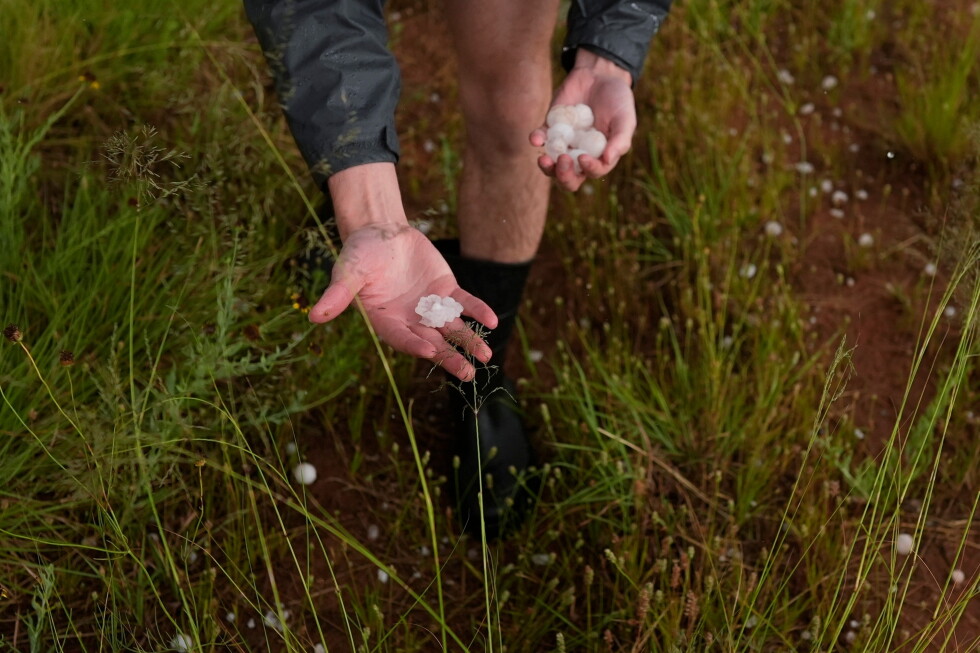
As human-caused climate change continues to reshape extreme weather patterns across the globe, a groundbreaking new study published in the journal *Nature* has uncovered a worrying consequence of rising global temperatures: a dramatic increase in the frequency of large, destructive hailstorms by the end of the 21st century.
Led by a research team with lead authors based in China, the study uses advanced three-dimensional modeling of hail formation – a method that fills key gaps in previous hail research, which mostly focused on the United States and only examined changes in storm frequency rather than hail size – to project how shifting atmospheric conditions will alter hail activity worldwide.
The core link between a warming planet and larger hail lies in two key atmospheric changes driven by greenhouse gas emissions from burning coal, oil, and natural gas. Warmer air holds more water vapor: roughly 4% more moisture for every one degree Fahrenheit increase in temperature, or 7% per degree Celsius. This extra moisture injects more energy into storm systems, generating stronger updrafts – the upward currents of air required to form and sustain hail. At the same time, higher atmospheric temperatures mean smaller hailstones are more likely to melt before reaching the ground, while larger, heavier stones survive the descent. “We’ve seen record hailstones in recent years. I find this extremely concerning because we’re not really building our environment to be resilient to hail,” said study co-author John Allen, a meteorology professor at Central Michigan University, in an interview from Guymon, Oklahoma, where he was joining field researchers who penetrate active hailstorms to study their inner mechanics.
Depending on the volume of future heat-trapping greenhouse gas emissions, the study projects that global occurrences of hail larger than 1.2 inches (30 millimeters) – roughly the size of a U.S. half-dollar coin, between a large marble and a golf ball – will jump by between 38% and 47% by 2100. By contrast, storms producing smaller hail will decline by 4% to 8% globally.
Geographically, the most pronounced increases in large hail are expected to hit Argentina, Western Europe, Canada, and the U.S. Northern Plains. Meanwhile, many tropical regions will see an overall reduction in hail as smaller stones melt more frequently in warmer upper-atmosphere temperatures.
Unlike many other extreme weather events, hail rarely causes direct human fatalities, but its economic toll is already staggering. The study estimates annual hail damage costs hit roughly $10 billion in the U.S. and $80 billion globally – figures that already outpace average annual damage from tornadoes, and rival the cost of multiple hurricane events each year. Larger hailstones deliver exponentially more destructive force: they weigh more, fall faster, and hit with far greater impact than smaller stones. While small hail mostly harms crops, hailstones measuring 2 inches (5 centimeters) or larger can punch through vehicle bodies, destroy roofs, damage solar energy infrastructure, and cripple other built assets, explained Andreas Prein, a climate scientist at ETH Zurich who was not involved in the research. Where a single large hailstone may only leave a repairable hole in a roof, a full hailstorm of large stones typically requires a complete, costly roof replacement, Allen noted.
Outside experts emphasized that while climate change is increasing the risk of more large hail, total future damage will not be shaped by weather patterns alone. “This is a meaningful climate signal,” said Walker Ashley, a meteorology professor at Northern Illinois University who did not participate in the study. “But disaster losses are not driven by the peril alone.” As population and development expand into hail-prone regions – including the rapid construction of residential properties and utility-scale solar farms in high-risk areas – total risk will rise even faster. “Climate change may be increasing the potential for larger, more damaging hail in some regions, but the future loss signal will also depend heavily on where people build, what they build, how resilient those structures are, and how land use changes,” Ashley added.
The Associated Press received financial support from private foundations for its climate and environmental coverage, and retains full editorial control over all content. Full details on AP’s standards for philanthropic partnerships, a list of supporters, and coverage areas are available on AP.org.