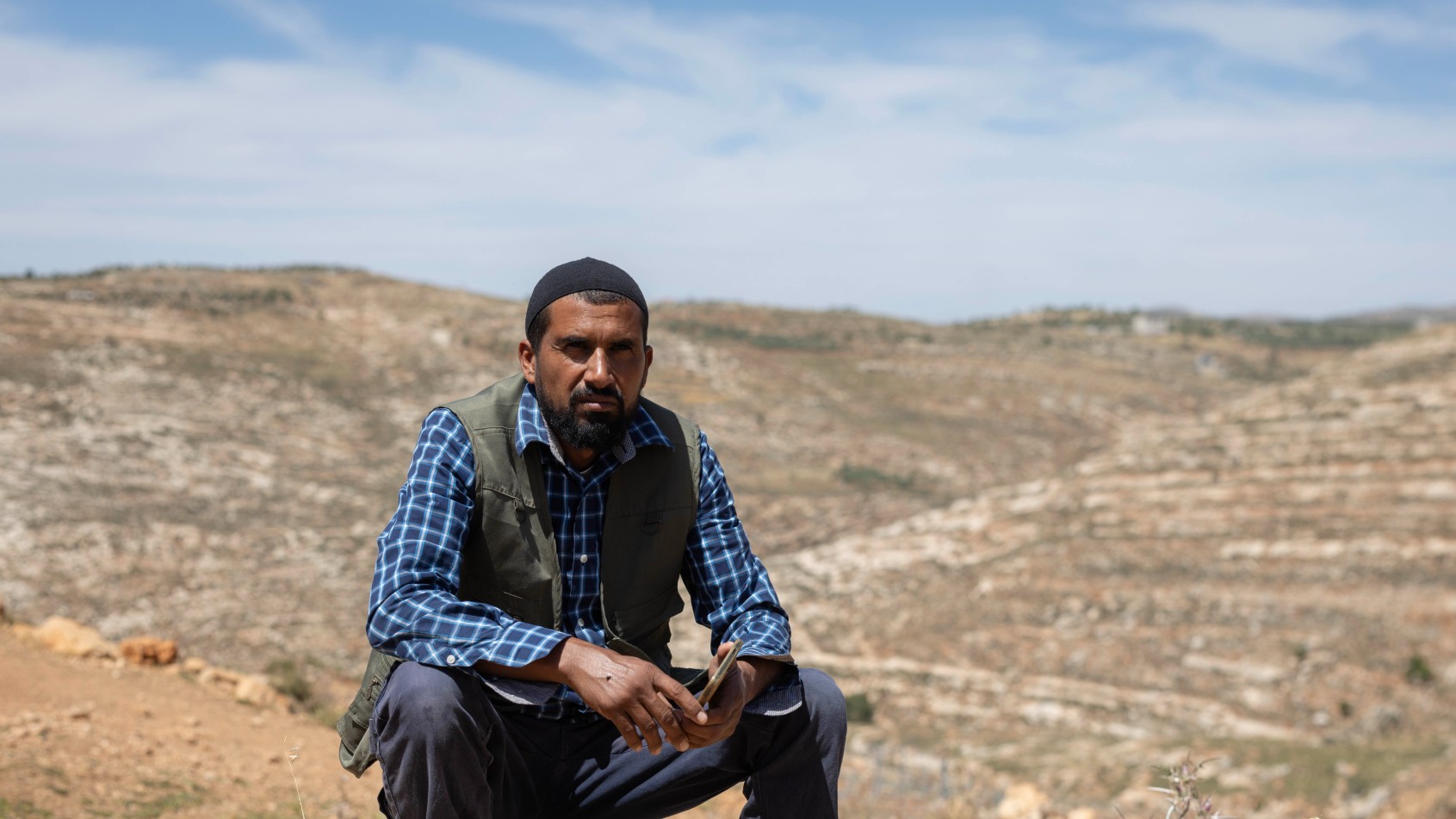
Deep in the occupied West Bank, north of Ramallah in the small village of Jiljilya, Ali Kaabneh stands on the exact patch of ground where his 16-year-old son Yousef was shot and killed last Wednesday, during a joint raid by Israeli settlers and soldiers that left a once-thriving Bedouin community displaced and its livelihood stolen. In an interview with Middle East Eye, Kaabneh laid bare the devastating human cost of what he calls a deliberate campaign of state-backed displacement and plunder targeting Palestinian communities in the occupied territories.
The raid was launched in response to unconfirmed claims that 120 sheep had been stolen from an illegal Israeli settler outpost called Tzur Levavi Farm, run by the Maguri family. The outpost sits in Jabal al-Batin, a section of Area A – the part of the occupied West Bank that is nominally under the full civil and security control of the Palestinian Authority, under the terms of the Oslo Accords. All Israeli settlements and outposts in the occupied West Bank are classified as illegal under international law, and this particular outpost was built on private Palestinian land belonging to the nearby villages of Sinjil and al-Mazra’a ash-Sharqiya.
Within hours of the theft report, dozens of settlers backed by uniformed Israeli soldiers launched a large-scale incursion into the three neighboring Palestinian villages of Sinjil, Jiljilya and Abwein. The armed group systematically entered local sheep pens, emptying them of livestock and seizing a total of 900 sheep from local residents. The operation was openly coordinated between Israeli security forces and settler participants, according to reporting from Israel National News (Arutz 7), a media outlet closely aligned with the Israeli settler movement. The outlet confirmed the seizure was only possible through direct collaboration between security search forces and settler civilian volunteers.
As the raid unfolded, the Israeli military deployed drones to track fleeing Palestinian herders and set up roadblocks across the entire region to guarantee unimpeded movement for the settlers and their stolen flock. Members of the Kaabneh clan, who maintained a small herding community in the wadi between Sinjil and Jiljilya, spotted the advancing group and attempted to flee with their flock toward the built-up center of Jiljilya. Military forces tracked the group via aerial surveillance, surrounded them, confiscated all their sheep, and took four Kaabneh family members into custody – including Ali Kaabneh, Yousef’s father. All four detainees were released later the same day, after no evidence linking them to the earlier sheep theft from the outpost was found.
Kaabneh, who was in detention when his son was killed, described the peaceful resistance his family offered to the theft. “We were at home working with the sheep. The settlers came under army protection,” he said. “We did not attack them, we did nothing. We moved the sheep about two kilometres away, and the army located them using drones.” Today, a circle of stones marks the spot where Yousef fell, and faint bloodstains still mark the dry earth just a few dozen meters from the main road where the stolen flock was driven away.
In a harrowing account of his son’s killing, Kaabneh said the 16-year-old was unarmed and posed no threat to the heavily armed soldiers. “The army killed my son deliberately. They shot him in the chest and he died on the spot,” he said. “He was 16 years old – what was his crime? He wanted his sheep back, and they responded by shooting him. What danger did he pose to them? He had nothing in his hands, he was unarmed. They could have arrested him, but instead they shot him. Like any child, he wanted to build a home in the future and get married. But here, during the day we worked, and at night we stood guard in shifts, without sleeping.”
Cell phone footage filmed by the family captures the moments before the shooting: several Israeli soldiers stand opposite an alley where Kaabneh and other family members gathered to protest the theft as the stolen flock passed, before multiple gunshots ring out. One of the bullets struck Yousef. Ali Kaabneh was arrested just moments after filming, and only learned of his son’s death when he was released from custody four hours later.
Fawaz Kaabneh, another local resident who had 200 sheep stolen during the raid and was also detained, said the rapid release of all detainees makes clear the allegations against them were baseless. “We were afraid they would reach the houses, so we went out. We were shocked by the number of settlers. They seized me and handed me over to the army, and from there I was transferred to the police. They took me to Sha’ar Binyamin. I told them the sheep were mine,” he said. After being questioned and released that night, Fawaz filed a formal complaint with Israeli police; in the days after the raid, the military returned roughly four dozen sheep to the village.
Iyad Ghafar, a Sinjil-based local activist who documented the entire raid, provided a step-by-step reconstruction of the coordinated operation. At 11:06 a.m., he filmed an armed settler drawing a pistol and charging toward him as he documented the stolen flock. Six minutes later, Yousef Kaabneh was shot dead by soldiers. Additional footage captured by Ghafar shows masked settlers throwing stones at Palestinian residents during the incursion. Ghafar confirmed all the stolen sheep were driven directly to the Maguri outpost, which is built inside former Palestinian agricultural structures in Area A. It is the same site where Israeli soldiers and settlers killed two young Palestinian men defending their land just last July. One of those victims was Saif al-Din Musallat, a 20-year-old U.S. citizen, who died from injuries sustained during severe beatings by the group, according to the Palestinian Ministry of Health.
Ghafar emphasized the full coordination between soldiers and settlers throughout the incursion. “It began on the edge of Sinjil, and afterwards they started attacking Jiljilya. We managed to get there in time, and I filmed the settlers and the army, and where they came from. The settlers chased us. One of them drew a weapon and came straight towards us. We got into the car and drove away. The military patrol stopped and started shooting at us – we almost died. It was a joint operation by the army and the settlers, acting together at the same time. Together they entered homes, together they chased the shepherds, together they took the flock,” he said.
Before last week’s raid, around 20 Palestinian families – roughly 200 people, all of whom are refugees originally displaced from land east of Ramallah in 1948 – lived in the small community between Jiljilya and Sinjil. Today, every last resident has fled the area, leaving behind empty sheep pens and intact tents filled with mattresses, clothing, and baby cots, abandoned in the rush to escape. Residents only returned briefly this week to collect personal belongings and rescue dogs that were left behind during the evacuation.
The Kaabneh family’s story is a stark example of the ongoing pattern of displacement and dispossession facing Palestinian communities across the occupied West Bank, rights observers note. The clan has been repeatedly displaced by settler violence backed by the Israeli military over the past three years. Originally expelled from their traditional land between the Negev and Masafer Yatta in the 1948 Nakba, the family lived in Mu’arrajat Centre near the Taybeh junction until the outbreak of Israel’s war on Gaza in October 2023, when settlers and soldiers forced them to leave. Some members relocated to the outskirts of Lubban ash-Sharqiya, while others moved to the al-Batin area – where the Tzur Levavi outpost was built a year later, shortly after soldiers killed Musallat and 20-year-old Mohammad Razek Hussein al-Shalabi. The family was forced to flee again.
Ali Kaabneh and other remaining family members settled near Route 60 on the outskirts of Lubban ash-Sharqiya, but were attacked again just weeks before the Jiljilya raid. On April 6, settlers burned two cars and a tent that family members were sleeping in, injured one relative with a club, and spray-painted the far-right “Price Tag” and “Zionist Revenge” slogans on the remains of the camp. The attack was launched as retaliation for the evacuation of another illegal outpost, Ora Yisrael, built in Wadi Salfit deep inside Area B – dozens of kilometers away from the Kaabneh camp. The clan moved to their Jiljilya compound after that attack, believing that since the area is formally under Palestinian Authority control, it would be safer.
“We moved from Mu’arrajat to Lubban ash-Sharqiya. We were attacked there on 6 April, so we moved here. This is under Palestinian Authority control, so we thought it would be safer, but there is no safe place,” Ali Kaabneh said. The repeated targeting of displaced Bedouin families after relocation is not a new pattern: in April 2025, settlers who built an illegal outpost near Sinjil attacked another group of displaced residents from Wadi as-Siq, burning their vehicles and residential tents.
In conflicting official statements issued after the incident, Israeli military spokespersons attempted to downplay the military’s role in the raid. A spokesperson acknowledged the Tzur Levavi outpost is located inside Area A, but claimed soldiers only entered the area “to remove the civilians” – not to support or protect the settler operation. “Upon arriving at the scene, [Israeli army] and Border Police forces acted to remove all Israeli civilians from the village, prevent friction in the area, and recover the livestock,” the spokesperson said, adding that forces had arrested several suspects in the initial sheep theft from the outpost. The statement does not explain how forces allowed settlers to leave the area with 900 Palestinian sheep if the goal of the operation was to prevent theft and friction.
In a later update, the Israeli army acknowledged that “some of the Israelis who entered the village took animals belonging to local residents” and confirmed that approximately 40 sheep had been returned to the village, adding that “the entire incident remains under review and is still being investigated.” Israeli police, for their part, said all detained suspects were questioned and released with conditions, and that a counter-complaint filed by Palestinian residents is currently under examination “with the aim of establishing the truth.”
The incident has underscored growing international concerns over rising settler violence and state-backed land grabs in the occupied West Bank, as settlements and outposts continue to expand into Palestinian territory formally designated for Palestinian self-governance under the Oslo Accords.