In the central Ukrainian city of Kryvyi Rih, 50-year-old Iryna Nakonechna carries a quiet, unbreakable resolve forged in unthinkable tragedy. Last year, a Russian missile strike took everything she once knew: it killed her husband Serhii Nakonechnyi and tore away her left leg, leaving her with lasting mobility damage to her arms.
In the immediate aftermath of the attack, which struck as the couple enjoyed an unseasonably warm post-dinner stroll near a downtown hotel on March 5, 2025, Nakonechna made a deliberate choice to let go of the life she had shared with Serhii. She cut off her long dark wavy hair, cleared almost every memento—furniture, clothing, personal trinkets, and most photos—from the apartment they once shared. Only one portrait of the couple remains, a quiet anchor to the past while she forges a new future. “Shedding my old identity was the only way I could endure the painful reinvention I needed to build a new life with my prosthetic,” she explains.
Today, Nakonechna cuts a sharp, vibrant figure: her signature pixie cut frames a face lit by quick, loud laughter, and bold red cat-eye glasses sit atop her nose. But beneath her effervescent wit lies a deep, unspoken grief that is rarely centered in mainstream narratives of wartime resilience. She is one of tens of thousands of Ukrainians—both soldiers and civilians—who have lost limbs to Russia’s full-scale invasion, a growing population whose invisible wounds often go unmentioned.
The exact number of Ukrainian war amputees remains unknown, but the count climbs steadily every day. Landmines planted across occupied territory, relentless artillery barrages, and ongoing missile and drone strikes continue to inflict catastrophic, life-altering injuries on people across the country. This surge has pushed Ukraine to rapidly expand rehabilitation and prosthetic services, and it has reshaped Ukrainian society at large: prosthetic limbs are no longer hidden, but have emerged as bold, visible symbols of survival and defiance against aggression.
For Nakonechna, the journey of recovery is both physical and psychological. She still walks with a cane, learning to trust the prosthetic that extends to her upper thigh, and her injured arms leave her unable to lift heavy objects. Every week, she attends an hour-long physical therapy session with Anastasiia Stetsenko, a therapist who is guiding her toward the next milestone: walking without assistance.
Their sessions follow a gentle but rigorous routine. Nakonechna begins by removing her prosthetic to rest it against the wall, then moves through seated weight lifts timed to her breathing, slow circular rotations of her residual limb to test range of motion, and eventually squats while gripping a ballet barre—one of the hardest movements to relearn. When exercises grow grueling, Nakonechna jokes with Stetsenko, calling her therapist a “demon” and quips that the routine feels like an extreme sport. When challenged to attempt a difficult squat, she laughs and deadpans, “I will respond as my grandson would: Just no.” The room fills with shared laughter, the dynamic between the two women far closer to old friends than clinician and patient.
The work is not just about building physical strength; it is about rebuilding the confidence to complete everyday tasks most people take for granted: climbing stairs, bending to pick up a dropped item, navigating cracked, uneven city streets, and chasing her 2-year-old grandson Tymofii across a playground.
That fateful March day stripped Nakonechna of more than her limb and her husband. After the missile detonated, throwing the couple dozens of meters apart, she woke to find herself separated from Serhii, admitted to a different hospital. He died the next day, and she never got to say goodbye. “I wasn’t even at his funeral,” she says quietly. For two months, she endured two surgeries a week, her days blurring into a fog of pain and recovery. By May, she could finally sit up on her own—a small relief, but only the first step of a far longer journey.
Now, the apartment she once shared with Serhii is almost unrecognizable from its former self. “I had to get rid of everything from the past,” she says. “I had to focus on living my life, even if it was only half the life I had before.” She invited her 77-year-old mother, who lives with dementia, to move in, and builds small moments of joy around their daily routines. The one thing she still grieves is that she cannot lift her grandson into her arms. Not long ago, Tymofii stuck a cartoon sticker of a capybara wearing a prosthetic leg onto her prosthetic—she has never peeled it off.
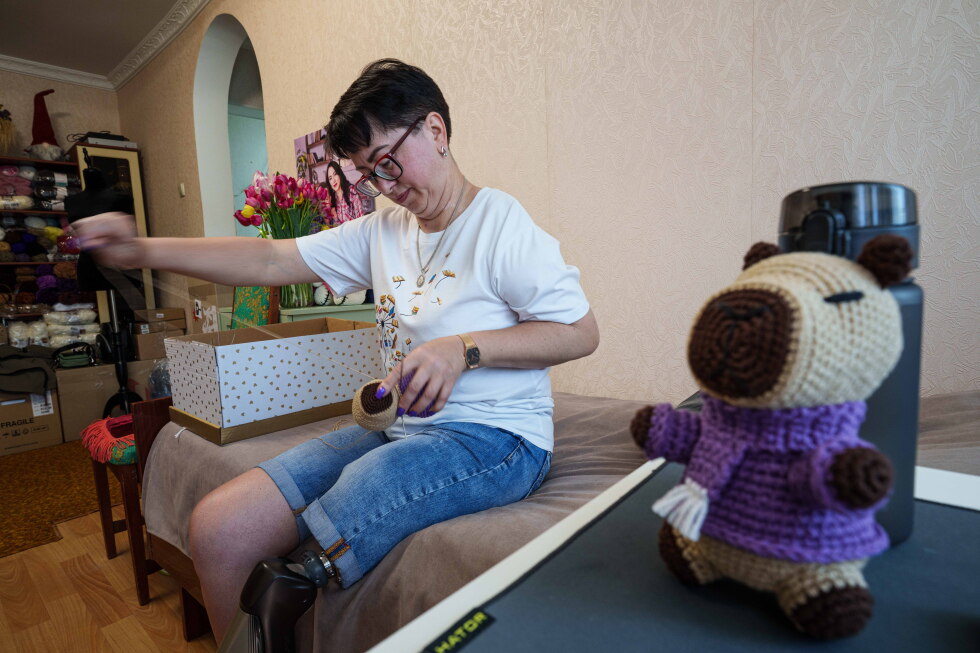
A skilled craftswoman, Nakonechna found a new purpose through Superhumans, a modern Ukrainian trauma center that specializes in prosthetics and rehabilitation for war survivors. She began knitting small toy capybaras, a gentle animal that has become an unofficial symbol of resilience for Ukrainian amputees. The trend started when veterans began placing capybara toys and stickers on their prosthetics to put strangers at ease; over time, the fuzzy, playful animal has grown to represent the quiet determination to reclaim joy after utter devastation.
Nakonechna’s hand-knit capybaras quickly became popular with other survivors, and she spends hours every week working on the toys. For her, the repetitive craft is a form of healing: “When I count the stitches, I think only about the stitches, not about the life that could have been and unfortunately is not,” she says. Her favorite part of the process is assembling the pieces, turning separate bits of yarn into a whole, finished toy—a small mirror of the work she is doing on herself.
Recently, she notched a small but transformative personal victory: for the first time since her injury, she put on a pair of shorts and went out in public, no longer hiding her prosthetic from the world. The small act marked a huge internal shift. “I accepted myself as I am,” she says.
For Nakonechna, and for thousands of Ukrainian amputees like her, resilience is not just about surviving. It is about learning to live with invisible wounds, rebuilding an identity from scratch, and finding small, precious moments of joy in a life forever changed by war.