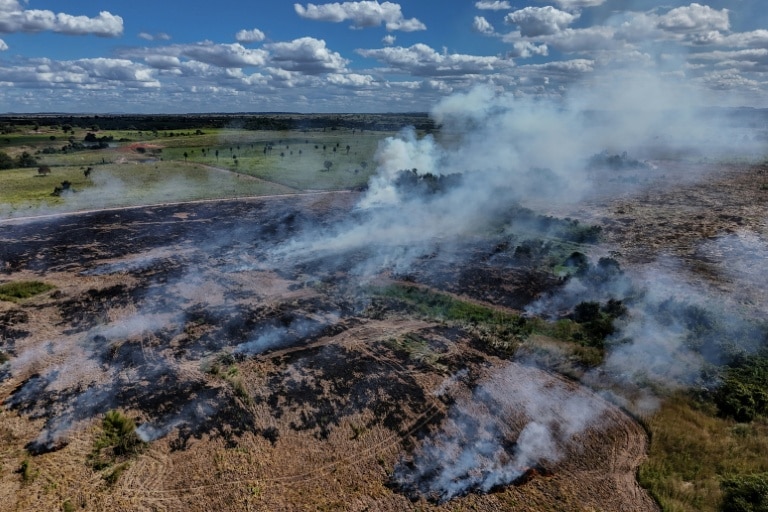
A landmark new report from Brazilian environmental monitoring network MapBiomas has confirmed that deforestation across Brazil’s Amazon rainforest dropped to its lowest annual level in 2025 since consistent recording began in 2019, delivering a key environmental win for the administration of leftist President Luiz Inácio Lula da Silva ahead of national elections this October.
MapBiomas, a collaborative consortium of leading Brazilian universities, non-profit environmental organizations, and technology firms, released its findings Wednesday. Data shows Brazil lost 985,000 hectares (approximately 2.4 million acres) of native vegetation across all its biomes in 2025, marking a 20.6% decline in total forest and vegetation clearance compared to 2024. While the official count does not include vegetation destroyed primarily by wildfire, the 2025 fire season brought far less extreme destruction to the region after the all-time record blazes recorded in 2024.
Deforestation reductions were recorded across all six of Brazil’s major ecosystems, with the Amazon seeing the steepest drop of 23.5% year-over-year. MapBiomas technical coordinator Marcos Rosa linked the downward trend directly to sweeping policy changes implemented by Lula after he took office, noting that sharp increases in federal enforcement operations and penalties for illegal logging have corresponded directly with falling clearance rates nationwide.
Lula has positioned the fight against Amazon destruction as a core policy priority of his administration, after four years of surging unregulated logging under his far-right predecessor Jair Bolsonaro. The Brazilian president has pledged to eliminate all illegal deforestation across the country by 2030, a goal rooted in the global scientific consensus that intact old-growth Amazon forests are critical natural carbon sinks that slow global climate change. Last year, Lula leveraged Brazil’s role as Amazon steward to host the COP30 United Nations climate summit in the northern Amazonian city of Belém, using the gathering to highlight his environmental agenda.
Despite the historic decline, the report underscores that mass deforestation remains a pressing crisis for the world’s largest rainforest. Even with the slowdown, an average of five trees are cut down every single minute second *[correction: every second*] in the Amazon. The Cerrado, a biodiverse tropical savanna ecosystem located south of the Amazon basin, remained the hardest-hit region, accounting for more than half of all vegetation clearance recorded in 2025. MapBiomas data confirms that agricultural expansion continues to drive nearly 99% of all native vegetation loss across Brazil.
The progress on deforestation has also been tempered by ongoing criticism from environmental advocates, who have pushed back against Lula’s approval of a controversial large-scale oil exploration project near the mouth of the Amazon River, a development that threatens marine and terrestrial ecosystems in the estuary. With Lula campaigning for a fourth presidential term in October’s general election, the conflicting pressures of environmental protection and economic development look set to remain a central dividing issue in the race.