In a move that escalates regional military tensions on the Korean Peninsula, North Korea officially announced Wednesday that its latest round of projectile launches carried out Tuesday involved a suite of advanced weapon systems — including a nuclear-capable cruise missile powered by artificial intelligence navigation, which leader Kim Jong Un has ordered deployed to front-line units positioned opposite South Korea. The disclosure comes amid Pyongyang’s sustained push to expand and modernize its nuclear and conventional military capabilities, a years-long effort that has shifted into higher gear in recent years.
The confirmation from North Korea’s state-run Korean Central News Agency (KCNA) followed a Tuesday statement from South Korea’s Joint Chiefs of Staff, which first announced it had detected multiple projectiles launched into the peninsula’s western waters, including at least one short-range ballistic missile that traveled approximately 80 kilometers. South Korean officials did not initially identify other weapons tested in the exercise, and did not issue an immediate response to North Korea’s full disclosure of the test components.
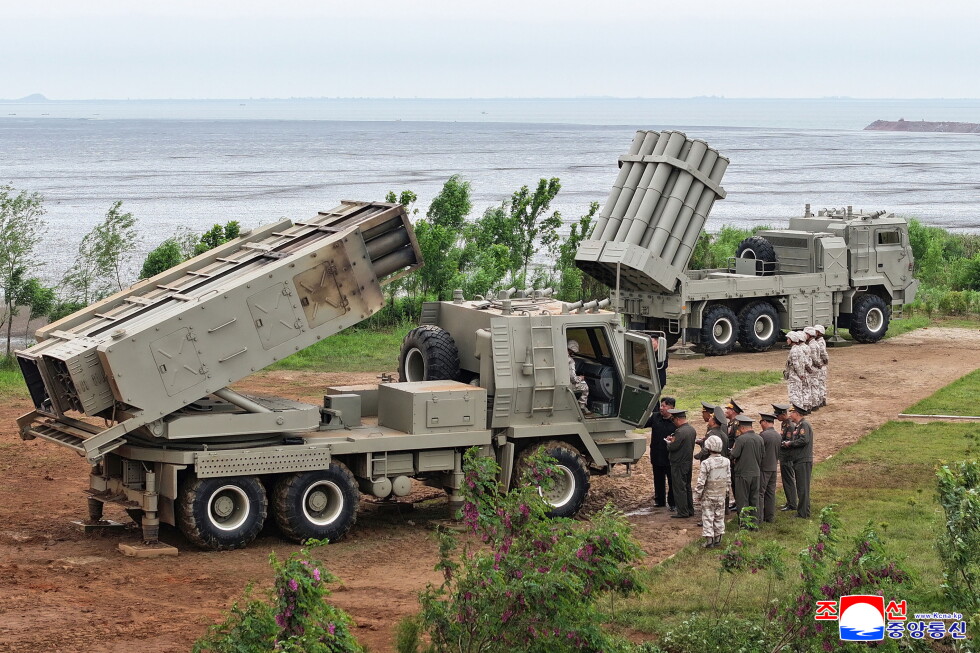
According to KCNA’s detailed account, Kim Jong Un personally oversaw Tuesday’s test activities, which featured three distinct types of armaments: ballistic missiles fitted with new warheads engineered for battlefield nuclear deployment, the AI-guided nuclear-capable cruise missiles, and 240-millimeter rocket artillery outfitted with cutting-edge “ultra-precision” navigation systems. The outlet added that Kim expressed full satisfaction with the test results, particularly the performance of the new cruise missile systems, which are earmarked for assignment to front-line long-range artillery units stationed along the inter-Korean border.
Kim further ordered accelerated work to modernize and bolster North Korea’s artillery corps, with the goal of building a force that “no one can match,” KCNA reported.
The latest tests align with a well-documented pattern of escalating military development from Pyongyang that began after 2019, when nuclear diplomacy between Kim and then-U.S. President Donald Trump collapsed without reaching a disarmament agreement. In the years since, Kim has adopted an increasingly hard-line stance toward Seoul, officially branding South Korea North Korea’s “most hostile enemy” and moving to sever decades-old established diplomatic and communication ties between the two nations. Just one week before the latest tests, during a meeting with senior military commanders, Kim outlined plans to strengthen border front-line units as part of a state objective to transform the entire inter-Korean frontier into “an impregnable fortress,” per prior KCNA reports.
In recent years, Kim has also reshaped North Korea’s foreign policy orientation, leaning heavily into closer alignment with Moscow. Multiple open-source and Western intelligence reports confirm that North Korea has supplied thousands of troops and massive shipments of conventional weapons to Russia to support its ongoing full-scale invasion of Ukraine. Pyongyang has also sought to deepen its longstanding economic and strategic partnership with China, its primary ally and main economic lifeline, while framing itself as a core member of a growing global counter-Washington bloc.
Despite former President Trump’s repeated public calls to restart bilateral diplomacy with Kim, Pyongyang has rejected all such overtures to date, maintaining that Washington must first drop its requirement that North Korea commit to nuclear disarmament as a precondition for any renewed negotiations.