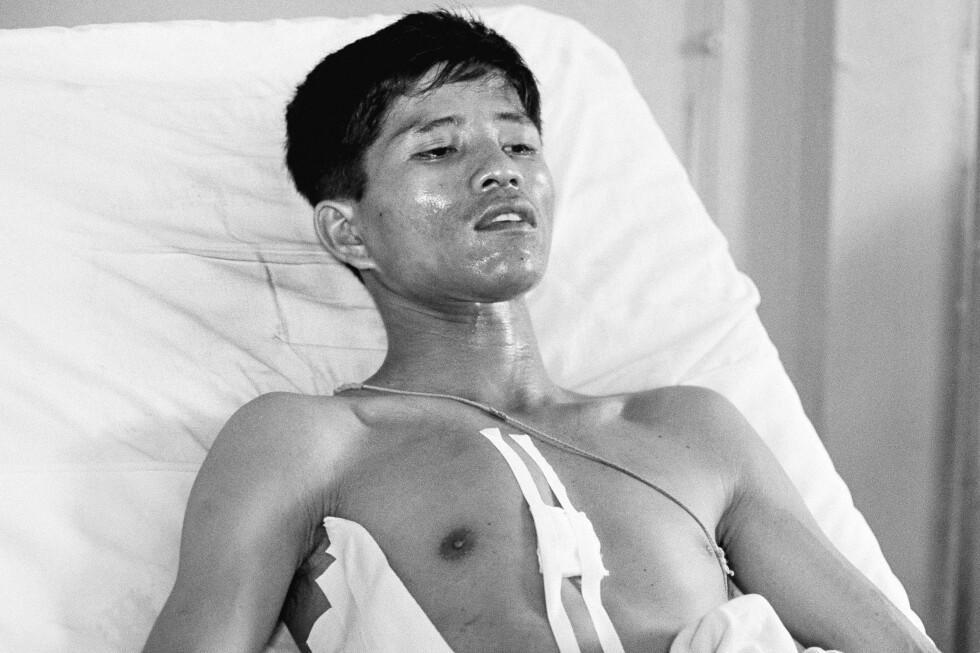
Dang Van Phuoc, the fearless former Associated Press photographer who built a legendary career covering the Vietnam War through devastating personal injury and immense hardship, has passed away at the age of 91. He died suddenly Saturday at his home in Southern California, confirmed his nephew Van Nguyen.
Phuoc’s life was marked by struggle from its earliest days. Born in 1935 in a small Vietnamese village near Quang Ngai, south of Da Nang, he was orphaned by his mid-teens: his father was killed by Viet Cong insurgents when Phuoc was around 10 years old, and his mother died a few years later, leaving him homeless with no support system.
In his young adulthood, Phuoc volunteered to carry equipment at a Saigon film studio where his aunt worked as a cook. It was in this space that he first encountered a camera, teaching himself the fundamentals of photography through self-guided practice and on-the-job observation.
In 1965, Horst Faas, AP’s then–photo chief, hired Phuoc to replace a local photojournalist who had been killed while on assignment. It did not take long for Phuoc to earn a distinctive reputation among fellow journalists and coalition troops: he had an almost preternatural ability to reach the center of active combat, putting him in position to capture raw, unflinching images of the war that other photographers could not access. Faas would later dub Phuoc the news agency’s “secret weapon” for his unmatched prowess in the field. Phuoc regularly walked alongside the lead point man on combat patrols, a choice that produced extraordinary photography but exposed him to constant mortal danger.
Over his 10-year tenure covering the war for AP, Phuoc sustained at least five separate combat injuries. Just five months after he was hired, a grenade explosion sprayed shrapnel into his chest and leg, but he returned to frontline reporting within a few months to continue covering the protracted conflict between North Vietnam’s Communist forces and the U.S.-backed South Vietnamese military. In 1968, he suffered a concussion when a rocket fragment struck his head while he documented intense street fighting in Saigon. That same year, he braved continuous sniper fire to carry a wounded U.S. soldier to safety, earning a formal commendation from the Ninth U.S. Army Infantry Division for his act of courage.
The most devastating injury came in 1969, when a grenade explosion during a patrol with a U.S. Ranger battalion south of Da Nang cost Phuoc his right eye. Undeterred, he relearned how to frame and shoot photographs with a single eye and returned to his post within months. In a 2011 interview for AP’s institutional archives, Phuoc opened up about the unique challenges of working with one eye: he had to balance peering through his camera viewfinder while also staying alert for silent hand signals from the soldiers accompanying him on patrol.
Huỳnh Công “Nick” Út, Phuoc’s colleague in AP’s Saigon bureau and the Pulitzer Prize-winning photographer behind the iconic image of a burned Vietnamese girl fleeing a napalm attack, remembered Phuoc as both a fearless professional and a devoted friend. “He was fearless and resourceful in the field,” Út said. “Behind the scenes, he was a giving man and loyal friend who treated me like a brother. When I heard he had passed, I cried, ‘My brother, he’s gone.’ Everyone loved him so much.”
Though Phuoc was celebrated for his gripping combat photography, he often said the images that mattered most to him were those that captured the suffering of civilian civilians trapped in the crossfire of war. In the 2011 interview, he framed his work as a quiet act of service, comparing himself to “a small grain of sand” who used his camera to amplify unheard stories of civilian hardship to a global audience.
When Saigon fell to North Vietnamese forces in 1975, Phuoc fled Vietnam with his family, carrying only the clothes on their backs and a single bottle of milk for his child. After being stranded in a Guam refugee camp, AP reporter Linda Deutsch—who was covering the camp at the time—intervened to help the family resettle, and they were flown to the U.S. to process at Camp Pendleton in Southern California.
Phuoc briefly returned to Asia to work for AP’s Hong Kong bureau before leaving the news organization and settling permanently in Southern California with his family. He built a second career as a professional portrait photographer in Orange County, home to Little Saigon, the largest community of Vietnamese refugees outside Vietnam.
In retirement, Phuoc remained deeply engaged in his craft and his community. He was a founding member of The Artistic Photography Association, where he trained generations of young emerging photographers. He also served as a civilian volunteer for the Los Angeles County Sheriff’s Department, and was named the county’s Volunteer of the Year in 1994.
Kim Nguyen, Phuoc’s great-nephew, reflected on his legacy Tuesday, recalling the childhood portraits Phuoc took of him as an infant and a recent visit to a Vietnamese museum where he brought his own infant son to view Phuoc’s wartime work on public display.