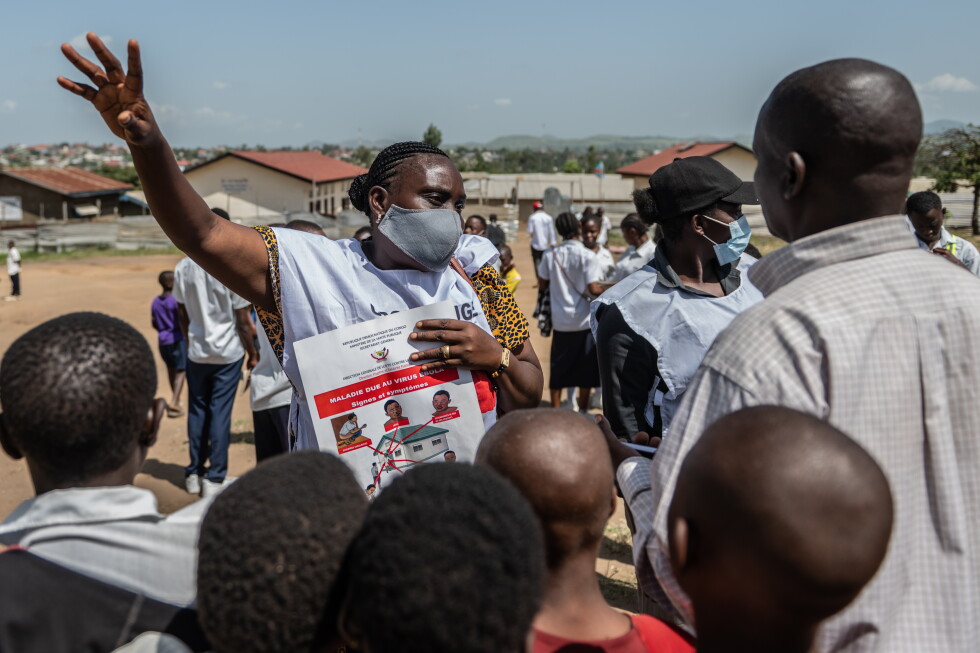
In the sun-scorched working-class neighborhoods of Bunia, the epicenter of a spiraling Ebola outbreak in eastern Democratic Republic of the Congo, Red Cross volunteer Vanny Birungi carries out her daily awareness work against two lethal enemies. The first is the rare Bundibugyo strain of Ebola, a pathogen for which no licensed vaccine or targeted treatment currently exists. The second is the open hostility of local residents, who have responded to outreach with stone-throwing, verbal harassment, and deep-rooted suspicion that has derailed containment efforts even as suspected cases creep toward the 1,000 mark.
This volatile northeast region of Congo has been fractured by years of armed insurgency, which has left thousands dead and hundreds of thousands displaced. For a population long traumatized by violence and distrustful of outside actors, even aid workers focused on stopping a spreading virus are viewed with skepticism. That distrust has been compounded by critical delays: experts confirm the outbreak was detected weeks after it first began spreading, and years of funding cuts to global health surveillance programs from the U.S. and other donors have gutted local capacity to monitor for emerging pathogens.
For many residents like 56-year-old Bunia local Pierre Basola, suspicion curdles into outright denial. “Ebola is a white man’s invention,” Basola said. “These people just want to get rich, and they should stop bothering us.” This widespread skepticism has turned violent in recent days, with three separate attacks on healthcare facilities in just one week. On Sunday, a mob of angry young men stormed a hospital treating Ebola patients, forcing all medical staff to evacuate as gunfire echoed through the building. A day earlier, local residents set fire to an Ebola screening and isolation tent run by Doctors Without Borders in the nearby town of Mongbwalu, leading more than a dozen suspected Ebola patients to flee into surrounding communities. Just days before that, an Ebola response center in Rwampara was burned to the ground after relatives were blocked from retrieving the body of a man who died from suspected infection.
Public anger is amplified by a core cultural conflict: standard Ebola infection control protocols bar traditional handlings of deceased bodies, which are a central part of local final rites. This restriction hits especially hard because the Bundibugyo strain causes sudden, dramatic illness marked by vomiting and external bleeding, leaving families reeling and unwilling to abide by rules they do not understand. Ebola spreads exclusively through close contact with bodily fluids of infected people or the deceased, meaning traditional funeral practices are among the highest-risk activities for new transmission. Yet without community buy-in, even the most evidence-based protocols cannot be enforced.
“Trust is almost as important as the health response, because if you get this massive distrust in the communities, they’re not going to go to the health centers,” explained Heather Kerr, country director for the International Rescue Committee in Congo. Beyond community distrust, aid groups face a second deadly obstacle: ongoing armed conflict across the region. The outbreak is centered in Ituri province, more than 620 miles from Congo’s capital Kinshasa, and travel between outbreak zones requires passing through territory regularly targeted by insurgent attacks. A key regional airport that serves as a humanitarian hub has been under rebel control for more than a year, and many local clinics rely on old generators for power, leaving barely any infrastructure to support outbreak response.
As of Monday, World Health Organization Director-General Tedros Adhanom Ghebreyesus confirmed the outbreak has reached more than 900 suspected cases and more than 220 suspected deaths. “We are now playing catch-up with a very fast-moving epidemic,” Tedros said.
For long-time residents like 70-year-old Mado Nditamba, the scale of the outbreak has left communities feeling helpless. “The last time Ebola came, it was not on the scale that we see today,” Nditamba said. “But this epidemic today is worse. We go to the doctors in the hospitals, but they also die. That’s what worries us. We don’t know what to do and we leave everything to God.”
Congo has faced 17 previous Ebola outbreaks, and the WHO says the country has the general infrastructure to mount a response, but critical missteps early on cost valuable time. Initial diagnostic tests only screened for the more common Zaire strain of Ebola, failing to identify the rare Bundibugyo variant and delaying formal recognition of the outbreak. Even now, there are few laboratories in the region capable of testing for this specific strain.
Frontline health workers report they are drastically underprepared and underprotected, and the virus has already begun to infect responders. A Congolese doctor working on the response was confirmed dead in Rwampara on Sunday, and at least three Ugandan health workers have been infected after the outbreak crossed the border into Uganda, where a small cluster of cases has emerged. Most concerningly, three Red Cross volunteers died in Mongbwalu in late March after handling bodies for a non-Ebola related task. If their deaths are confirmed to be from Ebola, that would push the start of the outbreak back weeks earlier than the first officially confirmed death in late April, meaning the virus has been spreading undetected far longer than initially thought.
Even as funeral homes in Bunia prepare for an increasing death toll, a large share of the local population remains convinced Ebola is a myth. A mid-May survey by Action Aid, one of the international humanitarian groups working on the response, found widespread skepticism and lack of basic understanding about the virus across Ituri province. Humanitarian leaders agree that sustained, trusted community engagement is the only path to getting the outbreak under control, but it remains unclear how that engagement can be scaled quickly enough to reverse the outbreak’s trajectory. Both the WHO and Africa Centers for Disease Control and Prevention warn that the actual number of cases is almost certainly far higher than the current confirmed count.