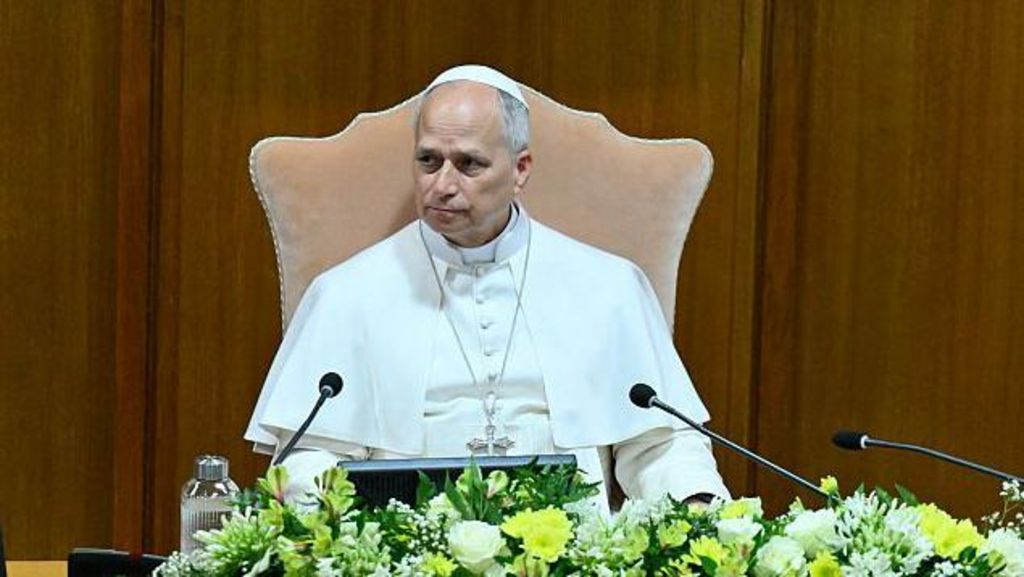
In a historic, wide-ranging address marking the first major teaching document of his papacy, Pope Leo has delivered a urgent call to rein in unregulated artificial intelligence, warning that unchecked advancement of the technology risks creating what he terms “new digital slaveries” while issuing one of the Vatican’s most comprehensive apologies ever for the Catholic Church’s historical role in the transatlantic slave trade.
Titled *Magnifica Humanitas* (“Magnificent Humanity”), the encyclical — a formal papal document that, in modern times, functions as a global moral message rather than solely a communication to Catholic bishops — was presented personally by Pope Leo at the Vatican, in an unusual break from tradition. He was joined by leading AI sector figures including Christopher Olah, co-founder of major U.S. AI developer Anthropic.
In the text, Pope Francis defended his sharp, uncompromising language, noting: “The word is strong, I know, but deliberately chosen because this moment needs words capable of attracting attention.” He frames modern AI risks through a direct parallel to historical chattel slavery, arguing that the world is currently at the same kind of moral crossroads humanity faced centuries ago, when the exploitation of marginalized people was normalized and accepted by global institutions.
He draws explicit connections between historical exploitation and emerging digital harms, warning that both the supply chains that build AI hardware and the real-world applications of advanced algorithms risk normalizing a new wave of dehumanizing exploitation. He also coined the term “digital colonialism,” linking the extractive abuses of 19th-century colonial rule to modern unregulated tech development that exploits vulnerable communities and nations.
Alongside his warnings about AI-driven exploitation, Pope Leo issued a formal apology for the Church’s complicity in slavery. “It was impossible not to feel deep sorrow when contemplating the immense suffering and humiliation endured by so many,” he wrote, adding that he “sincerely asked for pardon” in the name of the entire Catholic Church. The apology is one of the most sweeping the Vatican has ever issued on the topic of historical slavery.
The encyclical addresses multiple specific risks posed by advancing AI, going beyond exploitation to condemn the development of AI-augmented weaponry. “No algorithm can make war morally acceptable,” Pope Leo wrote, arguing that reducing human control over weapons not only fails to erase the “intrinsic inhumanity” of war, but also lowers the threshold for armed conflict by making violence less personal and turning civilian casualties into abstract data points. He explicitly warned against the rise of a global AI arms race.
Pope Leo also criticized the use of AI in political systems, particularly the spread of AI-generated deepfake images and videos that manipulate public perception and expose audiences to biased, misleading content that erodes trust in democratic processes. Echoing past remarks, he compared the current need for AI guardrails to the protections that had to be put in place to protect human dignity during the Industrial Revolution, noting that both the Church and global society were far too slow to condemn the historical scourge of slavery — a mistake he argues must not be repeated with AI.
In a special direct appeal to AI developers worldwide, the Pope emphasized that creators of the technology carry unique moral and spiritual responsibility: “Developers bear a particular ethical and spiritual responsibility, for every design choice reflects a vision of humanity.”
Olah, the Anthropic co-founder, echoed the Pope’s framing during the post-presentation remarks, acknowledging that the questions raised by AI extend far beyond the technical research community. “Every AI lab including his operated ‘inside a set of incentives and constraints that can sometimes conflict with doing the right thing’,” Olah said, adding that “the questions raised by AI are bigger than the AI research community, not just in their implications, but also in their nature.”
To advance the recommendations laid out in the encyclical, Pope Leo has convened a special commission to continue work on AI governance and ethical standards. Still, observers have raised questions about how much impact the papal message will have amid the breakneck pace of global AI development. Analysts point to the 2015 encyclical *Laudato Si* from the late Pope Francis, which called for urgent action on climate change, only for Pope Francis to publicly express disappointment at global inaction on the issue eight years later. Many wonder that, despite his passionate call for AI regulation today, Pope Leo may be forced to issue a similar frustrated warning in years to come.