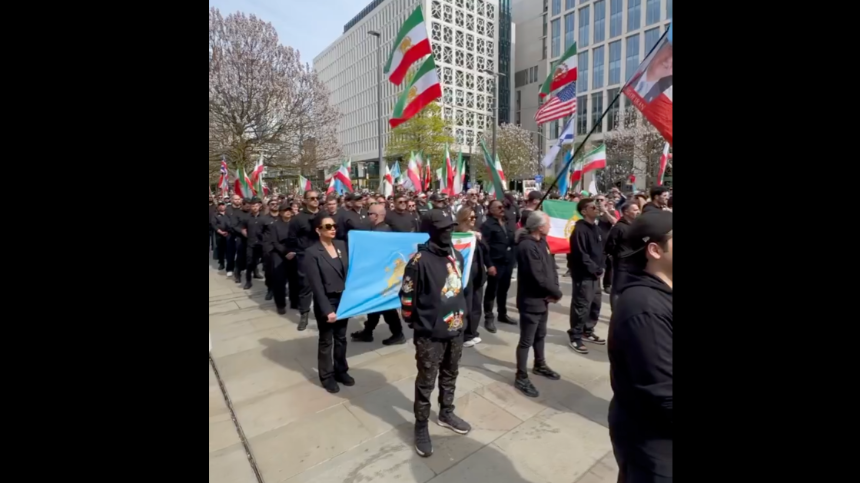
In recent weeks, public marches organized by supporters of Reza Pahlavi, the son of Iran’s ousted former shah, across multiple European capitals have ignited fierce controversy for their open display of symbols tied to Savak, the widely condemned secret police force that oversaw systematic torture and political repression during the Pahlavi monarchy.
Participants in these demonstrations have marched in coordinated military-style formations, carried large portraits of Pahlavi – who has publicly endorsed recent U.S. and Israeli military strikes against Iran – and openly called for repeated attacks on Iranian territory and the restoration of the former crown prince to power. Leading the processions have been flags emblazoned with the Savak insignia, a symbol that for generations of Iranians immediately evokes decades of state-sponsored violence.
The first of these high-profile events took place in London on April 26, shortly after a bilateral ceasefire halted direct military clashes between the U.S. and Iran. London marchers dressed head-to-toe in black, marched in rigid military formations with arms folded behind their backs, chanted slogans praising the deposed shah, and some hid their identities behind balaclavas, with the Savak flag at the head of the parade. A nearly identical demonstration followed in Copenhagen on May 9, where participants wore khaki military-style uniforms. A third event was later held in Regensburg, Germany, where attendees wore printed T-shirts marked with the Savak official emblem.
To understand the outrage these parades have sparked, it is necessary to revisit the history of Savak, formally the State Security and Intelligence Organisation, founded in 1953 with direct training and assistance from the U.S. Central Intelligence Agency and Israel’s Mossad. For nearly 25 years under Shah Mohammad Reza Pahlavi, Savak functioned as the primary tool of state repression to crush all political dissent against the monarchy. International human rights groups have documented decades of abuses committed by the agency, including widespread arbitrary detention, forced disappearances, extrajudicial executions, systematic torture of political prisoners, coercion against the families of detainees, and intimidation campaigns targeting Iranian dissidents living abroad. A 1976 Amnesty International investigation into Savak’s operations formally documented the agency’s pattern of torture and extrajudicial killing, describing it as an organization that operated “with extreme ruthlessness.”
Reactions to the public display of Savak symbols have split along generational and political lines within Iranian communities both inside the country and in the global diaspora. Many younger Iranian opponents of the current Islamic Republic government, who were born after the 1979 revolution that ousted the shah and never experienced Savak’s rule firsthand, have dismissed the marches as a desperate, absurd publicity stunt. A 27-year-old opponent of the Islamic Republic living inside Iran told Middle East Eye, “I could not stop laughing when I saw them wearing T-shirts with the Savak emblem. They could have identified themselves with something linked to knowledge, change, freedom or justice. Anything. But Savak? Really?” He described the marches as a “clown show” and a “pathetic reaction to losing momentum” among monarchist groups, which have seen domestic support collapse in Iran since the start of the U.S.-Israeli military campaign against the country in February.
Older Iranians who survived Savak’s repression, however, view the parades as a deeply alarming normalization of state brutality that echoes the rise of fascist movements in 20th century Europe. Behrouz Farahani, a veteran anti-Islamic Republic activist who has lived in exile in Paris for 20 years and worked closely with French labor organizers, argued that the marches are part of a growing aggressive push by monarchists to marginalize and silence other Iranian opposition groups that oppose foreign military intervention in Iran. He noted that monarchists have increasingly resorted to online harassment, verbal attacks, and even physical confrontations against anti-war demonstrators at opposition events outside Iran. “Anyone with historical memory, anyone aware of the rise of fascism in Italy and Germany, would immediately think of these movements,” Farahani said. “When I saw the black-clad march, I was reminded of Mussolini’s supporters in Italy and pro-Hitler militia groups in Germany.”
Farahani added that the current political shift toward far-right, authoritarian-leaning politics in many Western countries has allowed Iranian monarchists to organize these events openly without pushback. He outlined two core goals behind the public parades beyond silencing dissent within the Iranian diaspora: first, to recruit younger Iranians who have no direct memory of the Pahlavi era and lack awareness of Savak’s widespread atrocities, and second, to build strategic alliances with far-right political movements currently holding power across Europe. “They want to signal to fascist and far-right parties in power that they share the same views, in order to gain their support,” he explained.
Sudabeh Jazani, a former political prisoner under the Islamic Republic who now lives in U.S. exile, shared Farahani’s comparison of the marches to interwar fascist rallies. Jazani’s own family suffered direct loss at the hands of Savak: her brother Bijan Jazani and uncle Saeed Kalantari were among nine political prisoners executed without trial by Savak in 1975 in the hills north of Tehran, and the regime never permitted the family to hold a public funeral for the victims. She warned that the open intimidation displayed by monarchists already holding no official power offers a clear preview of what rule by Pahlavi would mean for Iranians. “These people, who still have no power, are creating fear and terror. Those who did not live through Iran under the Shah need to ask themselves what they would do if they came to power,” Jazani said. Like Farahani, she argued that Pahlavi and his supporters, who receive political and financial backing from foreign interests including Israel, are deliberately distorting modern Iranian history to recruit younger Iranians who lack firsthand knowledge of the monarchy’s abuses. She expressed particular shock that the march in Germany – a country with strict legal restrictions on displays of fascist and violent authoritarian symbols – was allowed to proceed openly, and called on international human rights groups to condemn the events.
Recounting her own experience with Savak, Jazani described being arrested in 1975 after she offered condolences to the family of a political prisoner killed by the agency. During her interrogation, she was forced to flip through a photo album filled with graphic images of tortured bodies and executed political prisoners. “The interrogator gave me the album and said, ‘I will give you time to look at these carefully. If you don’t speak, the same will be your fate,’” she recalled. “When I hear the name Savak, I feel enraged, because they destroyed my family. For me, Savak means destruction, suffering, and torture.”
Multiple survivors of Savak detention who currently oppose both the current Iranian government and the restoration of the monarchy shared similar firsthand accounts of the climate of fear Savak imposed across Iranian society for decades. A sociology professor based inside Iran, who asked to remain anonymous for security reasons, was arrested during the shah’s rule for possessing a dissident political pamphlet and spent one year in Savak custody, where he endured what he described as “soft torture”: prolonged sleep deprivation, being forced to stand for hours at a time, and repeated physical abuse including pulling of his hair, moustache, and ears. “The very conversation we are having now, during the shah’s time, even a father and son would be afraid to have it, because there was a belief that Savak could be listening and that it could lead to arrest and torture,” he said.
The professor also noted that public, military-style marches by pro-shah groups are not a new phenomenon, tracing the pattern back to the early 1950s, when a pro-shah neo-Nazi group called Sumka, which promoted an ideology of Iranian Aryan racial superiority, carried out violent attacks on leftist and nationalist opposition gatherings with clubs and knives ahead of the 1953 CIA-backed coup that overthrew Iran’s democratically elected Prime Minister Mohammad Mossadegh and restored the shah to power. It was after the 1953 coup that Savak was formally established to consolidate the shah’s control over every sector of Iranian society, targeting students, political activists, intellectuals, and even independent poets.
An Iranian writer based inside Iran, who has been interrogated by intelligence agencies both under the monarchy and after the 1979 revolution for his literary work, echoed these memories of terror. “The name Savak reminds me of horror and torture; of when I was sitting in an interrogation room and waiting for the interrogator, looking at the shah’s picture on the wall,” he said. He cited a poem by prominent Iranian poet Mehdi Akhavan-Sales, who was himself detained and interrogated by Savak, as the most accurate depiction of the constant fear the agency imposed: “And I am frightened by this image on the wall. In this image, that man, with the ominous and merciless whip of Xerxes, lashes out like a madman, but not at the sea; at my back, at my withered veins, at what lives in you, at what is dead in me.”