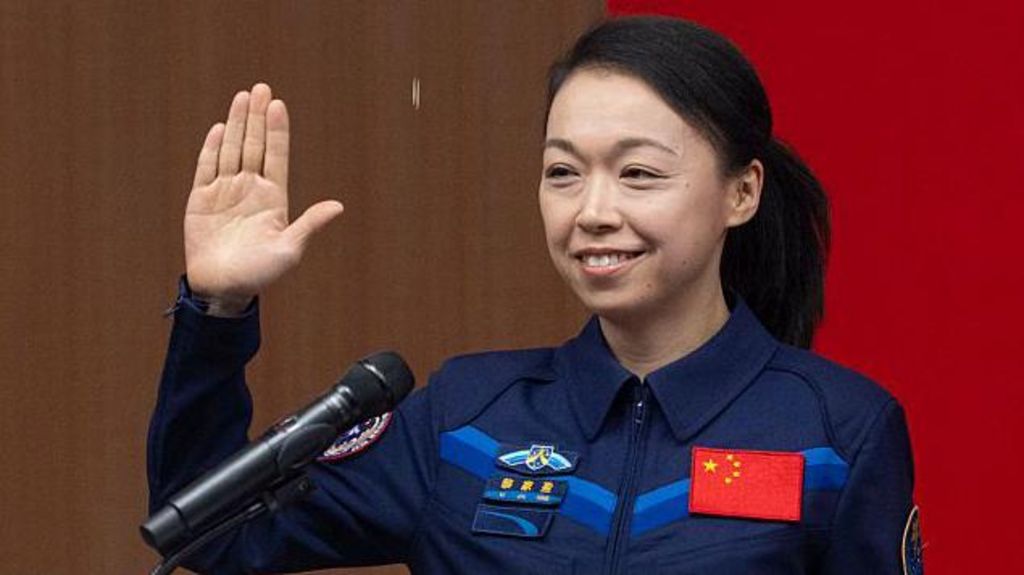
In a landmark moment for both Hong Kong and China’s expanding space program, history was made Sunday night when 43-year-old Li Jiaying, a Hong Kong police officer and mother of three, lifted off for orbit as the city’s first astronaut to reach space. Li joined two other crew members — 39-year-old space engineer Zhu Yangzhu and 39-year-old former air force pilot Zhang Zhiyuan — aboard China’s Shenzhou-23 spacecraft, which launched atop a Long March 2-F rocket from the Gobi Desert in northwest China at 23:08 local time (15:08 GMT). Thousands of spectators gathered at the launch site, waving Chinese flags to mark the historic departure, and the spacecraft successfully docked with China’s Tiangong space station just a few hours after liftoff.
Li will serve as the mission’s payload specialist, leading a suite of planned experiments. One of the core research objectives for the Shenzhou-23 mission is studying how extended exposure to microgravity impacts the human body, research that is critical for preparing future long-duration deep space missions. A key milestone planned for the mission will see one crew member remain in orbit for a full 12 months, a duration that will rank among the longest continuous space stays in human history. Mission officials have not yet announced which crew member will take on the year-long stay, and a final decision will be made at a later date. The 12-month mission will fall just short of the all-time record of 14 months set by Russian cosmonaut Valery Polyakov in 1995.
The mission marks a key step forward in China’s ambitious timeline to land the first Chinese astronauts on the moon by 2030, pushing forward the country’s progress in long-duration human spaceflight as it competes in a renewed global space race with the United States, which targets its own crewed lunar landing by 2028. In comments carried by China’s state-run Xinhua News Agency, Li said her journey into space was inspired by Yang Liwei, China’s first astronaut to reach orbit, and that she seized the rare opportunity to push her own limits. “This is a rare chance. Why not try?” she said.
Hong Kong Chief Executive John Lee called Li’s participation in the mission a “historic” milestone for the special administrative region. For China’s human spaceflight program, Shenzhou-23 represents a major advance beyond the standard six-month stays that have become routine for crews visiting the Tiangong space station since regular crew rotations began in 2021. Astrophysicist Richard de Grijs, a professor at Australia’s Macquarie University, explained that extending mission duration to a full year pushes both spacecraft hardware and human endurance into a new operational frontier that previous shorter Shenzhou missions never tested. “This shows how China is building its expertise in long stays in space as well as deep space exploration,” de Grijs told Agence France-Presse.
The mission comes on the heels of another major Chinese space success in 2024, when the Chang’e-6 probe became the first spacecraft ever to collect and return rock samples from the far side of the moon to Earth. Later this year, China plans to conduct an uncrewed orbital test flight of the Mengzhou spacecraft, the next-generation vehicle designed to carry astronauts to the lunar surface as part of the country’s 2030 crewed landing goal.