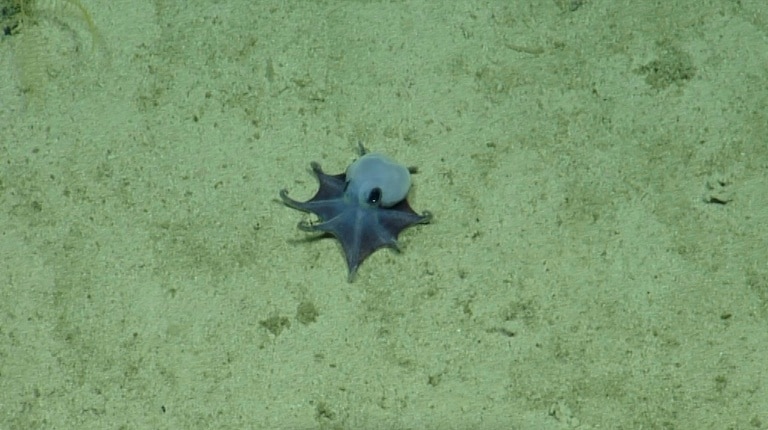
Nearly 1,800 meters below the sunlit surface of the Pacific Ocean, off the rugged coast of the Galapagos Islands, a research submersible navigated the dark, unexplored abyssal plain and captured footage of a creature that would rewrite what we know about deep-sea cephalopod diversity. As the clear, blue-tinted image of the tiny animal beamed back to the research team on the surface, one excited researcher could not contain her awe, blurting out the simple, enthusiastic observation that has now become tied to the find: “He’s tiny! It’s blue!”
The discovery, formally published this week in the taxonomic journal *Zootaxa*, confirms the creature is a previously undocumented species of octopus, now officially named *Microeledone galapagensis*. The journey from first sighting to formal classification took nearly a decade, after the initial 2015 encounter near Darwin Island — the same Galapagos landmark that helped inspire Charles Darwin’s theory of evolution more than 180 years ago.
Octopus expert Janet Voight, a curator at Chicago’s Field Museum of Natural History, was brought on to identify the unusual specimen after the Charles Darwin Foundation research team captured it. Voight told Agence France-Presse that she recognized the creature was extraordinary from the first photographs she received. When the preserved specimen arrived in the mail weeks later, that initial excitement only grew: “When it arrived, I was like ‘Oh! My goodness! It’s beautiful,’” she said.
What struck Voight immediately was the strange geographic gap between this new octopus and its closest known relative. The most similar shaped octopus on record lives thousands of kilometers away off the coast of Uruguay, on the opposite side of the South American continent in a completely different ocean basin. This unexpected range separation adds new questions about the evolutionary history and dispersal of deep-sea octopus species.
Faced with only a single specimen, the research team refused to dissect the fragile animal for traditional anatomical study, a common step in describing new species. Instead, they turned to cutting-edge imaging technology: the Field Museum’s CT scanning lab captured thousands of high-resolution X-ray images, which were compiled into a detailed 3D model that revealed the octopus’s internal anatomy without damaging the irreplaceable specimen. “There’s nothing like spending the day looking at something no other human has ever seen,” said Stephanie Smith, head of the museum’s X-ray lab, in a public statement announcing the find.
Beyond its one-of-a-kind status as a new species, *Microeledone galapagensis* stands out for multiple unique traits. Most notably, its pale cerulean blue back is an extremely rare coloration in natural animal populations, while its underside is a striking deep purple. It is also the smallest known member of the Megaleledonidae family, a group of octopuses that typically grow to much larger sizes and are mostly found in the frigid Southern Ocean surrounding Antarctica.
Voight explained that the unusual two-tone color pattern likely serves an important defensive purpose. Deep-sea environments are home to many bioluminescent organisms that emit light when disturbed, and a glowing captured prey could draw the attention of larger predators. The octopus’s dark purple underside is used to cloak glowing prey it has captured, hiding the light and keeping the octopus concealed from larger hunters. Additional distinguishing features include its short, stubby arms that bear only a single row of suckers, and its uniquely smooth dorsal skin that sets it apart from other closely related species.
Despite the excitement of this new find, Voight emphasized that discoveries of new octopus species in the deep sea are far rarer than they should be — not because new species are uncommon, but because so little of the world’s deep ocean floor has been explored. To put that in perspective, Voight notes that if all of Earth’s landmasses were combined into a single continuous landmass, they would still not cover the area of the Pacific Ocean alone. The deep sea remains the largest and least explored ecosystem on the planet, meaning countless new species are still waiting to be discovered by researchers. Voight added that this is already the second new octopus species she has identified in just two years, following a 2023 discovery off the coast of Costa Rica.