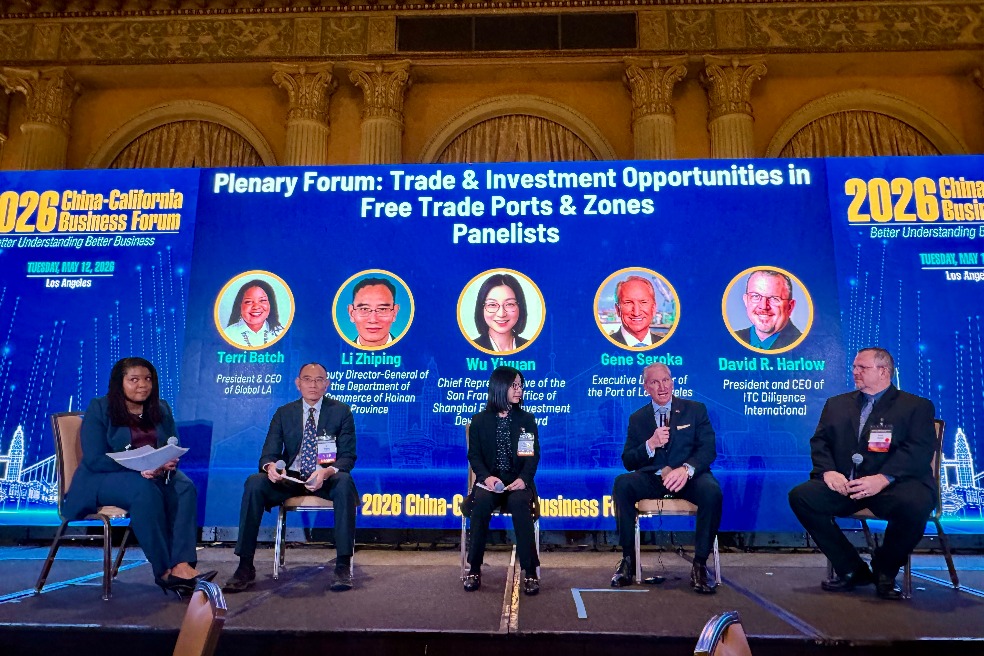
In the lead-up to the high-profile 2026 China-US summit, business leaders, trade policymakers, and industry stakeholders from China and California gathered in Los Angeles for the 2026 China-Californian Business Forum on May 12, where they united in calling for expanded bilateral economic collaboration amid growing global economic uncertainty. The forum, held one day before the US president’s state visit to China, centered on unlocking new opportunities through free trade zones, targeted industrial partnerships, and streamlined investment facilitation — all measures participants framed as critical to stabilizing global supply chains and strengthening two-way trade ties between the world’s two largest economies.
During a panel session focused on trade and investment opportunities in free trade ports and zones, Gene Seroka, executive director of the Port of Los Angeles, underscored the urgent need for sustained commercial engagement between China and the United States, even amid ongoing global headwinds ranging from geopolitical tensions to shifting tariff policies. “These are the two largest economies in the world, making sure that we continue to trade and build up business to new heights is my hope for this week’s dialog,” Seroka told reporters on site. “We have a lot of work to do around policy and tariffs.”
As the busiest container port complex in the United States, the Port of Los Angeles and its neighbor the Port of Long Beach have long served as the primary gateway for US trade with Asia. Seroka highlighted that the ports’ existing Foreign Trade Zone (FTZ) infrastructure and bonded warehouse facilities already help thousands of importers and exporters mitigate tariff-related cost pressures. Currently, the Port of Los Angeles manages roughly 5,400 acres of FTZ-designated land, with dozens of operational units and subzones strategically located near major transportation and industrial hubs surrounding Los Angeles International Airport. “In a very small way, the ports can assist in bringing down some of those tariff costs for importers,” Seroka explained. He added that demand for these specialized facilities has surged in recent years as companies reconfigure their supply chains to adapt to changing trade conditions, noting that “right now, these facilities are very highly subscribed.”
Seroka also tied the need for stable bilateral relations to broader global challenges, including ongoing geopolitical conflict in the Middle East and soaring global fuel prices. “While there are many geopolitical issues happening around the world today, including the war in Iran, it is our goal that the two presidents, the two leaders of the world’s two largest economies, can make some progress,” he said.
For California’s business community, the upcoming high-level summit between Beijing and Washington sends a much-needed positive signal to industries across the state that rely heavily on cross-border trade and investment. Stephen Cheung, president and CEO of the Los Angeles County Economic Development Corporation and World Trade Center LA, emphasized that Los Angeles — one of America’s most vital international trade hubs — reaps substantial economic benefits from deep cooperation with China. “We’re so dependent on international trade and foreign direct investment, we see this opportunity between the US and Chinese government getting together as a positive step,” Cheung said.
Cheung shared key data illustrating the deep economic ties between the region and China: Chinese-invested enterprises currently operate 756 business locations across California, supporting more than 23,500 local jobs and generating an estimated $4 billion to $5 billion in annual worker wages. These investments, he noted, are concentrated in sectors that form the backbone of California’s long-term economic growth, including advanced manufacturing, clean energy technology, logistics, trade, and technological innovation.
Chinese trade officials and investment representatives at the forum highlighted a wealth of untapped collaboration opportunities created by China’s ongoing market opening reforms, the expansion of national pilot free trade zones, and the development of the Hainan Free Trade Port. Zhao Feng, vice-governor of China’s Hainan province, outlined deepening industrial collaboration between Hainan and US partners across high-growth sectors including the digital economy, healthcare, information technology, and high-end consumer goods. Over recent years, Zhao said, multiple leading US enterprises have set up local operations in Hainan, driving growth in digital services, data processing, and cross-sector technological innovation. In the healthcare space, cross-border medical projects have strengthened research and clinical cooperation between Chinese and American institutions, while leading US consumer brands have expanded access to the vast Chinese consumer market through the annual China International Consumer Products Expo. “These projects reflect the growing industrial synergy between Hainan and the United States and underscore the broad potential for mutually beneficial cooperation between the two sides,” Zhao said.
Li Zhiping, deputy director-general of Hainan’s Department of Commerce, added that the Hainan Free Trade Port is intentionally positioned as a high-standard platform for international openness and cooperation at a time of global economic uncertainty. “Hainan is using institutional opening-up to offset uncertainties in the international landscape,” Li said, noting that the province has implemented consistent policy reforms to protect the legal rights and interests of American and all foreign investors operating within its borders.
Representatives from Shanghai, another of China’s core economic hubs, also outlined ongoing reforms to improve market access and the business environment for overseas investors, pushing back against common misperceptions about operating in China. Wu Yiyuan, chief representative of the San Francisco Office of Shanghai Foreign Investment Development Board, noted that many California business leaders still hold outdated views of China’s market access rules. “One common misconception is that market access to China is still highly restricted,” Wu said. She explained that China’s modern negative list system allows foreign investment in all sectors except those explicitly restricted, and the scope of restricted sectors has shrunk consistently in recent years. Wu added that Shanghai’s latest round of opening-up measures is focused specifically on sectors that align with California’s core industrial strengths: healthcare, finance, artificial intelligence, telecommunications, and advanced manufacturing. She also pointed to recent upgrades to cross-border data governance frameworks and streamlined administrative processes that have made doing business in Shanghai far more efficient for foreign firms. “Once companies gain a clearer picture of the market and better local support, many of the initial concerns become much more manageable,” Wu said.
Small and medium-sized enterprise (SME) representatives also emphasized the critical role that trade facilitation programs like FTZs play in supporting cross-border trade for smaller businesses. David Harlow, president and CEO of ITC Diligence International, explained that FTZ programs give California-based manufacturers significant operational flexibility when importing components from China for final production, while also supporting export-oriented business models. “The FTZ program offers a tremendous amount of flexibility,” Harlow said, adding that these structures allow businesses to minimize disruptive delays to manufacturing, assembly, and global distribution processes. Harlow shared the example of a California client that imports the vast majority of its production components from China, completes final manufacturing in Southern California, and exports finished goods to markets around the world. “Ninety-five percent of our consumers do not exist in the US, but exist around the world,” Harlow noted. “For US businesses to be able to compete globally, utilizing programs like the FTZ become essential.”