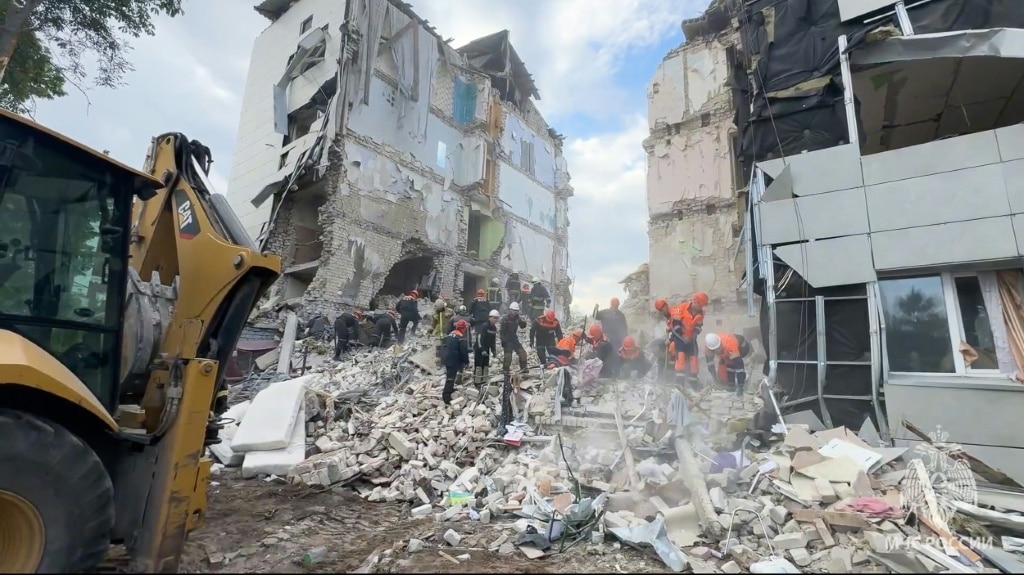
In an early Sunday attack that followed explicit Russian threats of retaliation for a deadly Ukrainian drone strike on Russian-occupied eastern Ukraine, a large-scale ballistic missile barrage slammed into Ukraine’s capital Kyiv, leaving at least five people wounded, local officials confirmed.
AFP correspondents on the ground reported hearing multiple loud explosions across the city, which rattled a residential structure located close to Kyiv’s government district. Dozens of panicked residents rushed to take shelter in underground metro stations in the city’s central core as the attack unfolded.
Tymur Tkachenko, head of the Kyiv City Military Administration, announced the mass attack via his official Telegram channel, confirming that blasts had impacted at least four districts across the capital: Shevchenkivsky, Dniprovsky, and Podilsky. Initial assessments documented multiple blazes and structural damage to civilian residential buildings. As the attack continued, Tkachenko warned that additional drone strikes were still ongoing and the threat of more ballistic missile launches remained active, urging all residents to remain in secured shelters.
Kyiv Mayor Vitali Klitschko later confirmed the casualty count, noting that five people had been hurt, with one person admitted to a local hospital for treatment. Klitschko added that response teams had been deployed to Podilsky district in northwest Kyiv, where missile debris fell on a non-residential plot of land, while a separate fire broke out adjacent to a residential building in Shevchenkivsky district.
The Sunday strike came as no surprise to Ukrainian and international authorities, who had explicitly warned of imminent large-scale Russian retaliation in the 24 hours leading up to the attack. The escalation followed a major Ukrainian drone barrage launched overnight between Thursday and Friday against Starobilsk, a city held by Russian forces in the occupied Lugansk region. Russian officials claimed the strike hit a college dormitory, pushing the confirmed death toll to 18 with an additional 42 people wounded after rescuers pulled two more bodies from the rubble on Saturday. Leonid Pasechnik, the Moscow-appointed governor of occupied Lugansk, reported that most of the fatalities were young women born between 2003 and 2008.
Ukrainian officials have rejected Russia’s claims of targeting civilians, asserting that the strike was focused exclusively on a Russian military drone unit based in the Starobilsk area.
Within days of the strike, the Russian Ministry of Foreign Affairs vowed that those responsible would face “inevitable and severe punishment”, setting off warnings from Ukrainian leadership. On Saturday, Ukrainian President Volodymyr Zelenskyy posted a public alert on social media noting that intelligence showed clear preparations for a combined large-scale strike across Ukrainian territory, with a specific focus on Kyiv that could include deployment of the Oreshnik, Russia’s nuclear-capable hypersonic missile. The United States Embassy in Kyiv echoed the warning hours later, confirming it had received credible intelligence of a potentially major air attack that could strike at any point within the following 24 hours.
The United Nations issued a statement Friday condemning all attacks on civilians and civilian infrastructure regardless of location, though the organization added it could not independently verify casualty and targeting details due to restricted access to occupied Ukrainian territories.
This latest exchange of heavy strikes fits within a broader pattern of escalating cross-border attacks that has defined the 4-year full-scale Russian invasion of Ukraine. Kyiv has significantly expanded its domestic drone production capabilities in recent months, allowing it to step up strikes against both Russian-occupied Ukrainian territory and undisputed Russian soil, targeting military positions, energy infrastructure, and logistics hubs. For its part, Russia has launched near-daily mass missile and drone barrages across Ukraine since it launched its full-scale invasion in 2022, causing widespread damage to civilian infrastructure and thousands of civilian casualties. Like Ukraine, Russia denies intentionally targeting civilian populations.
Starobilsk, the site of last week’s fatal drone strike, sits roughly 40 miles from the active front line in eastern Ukraine and was captured by Russian forces in the early weeks of the 2022 full-scale invasion.
International diplomatic efforts to end the conflict, led by the United States, have stalled in recent months as U.S. political and military attention has been diverted to the ongoing conflict in the Middle East, leaving little momentum for new peace negotiations.