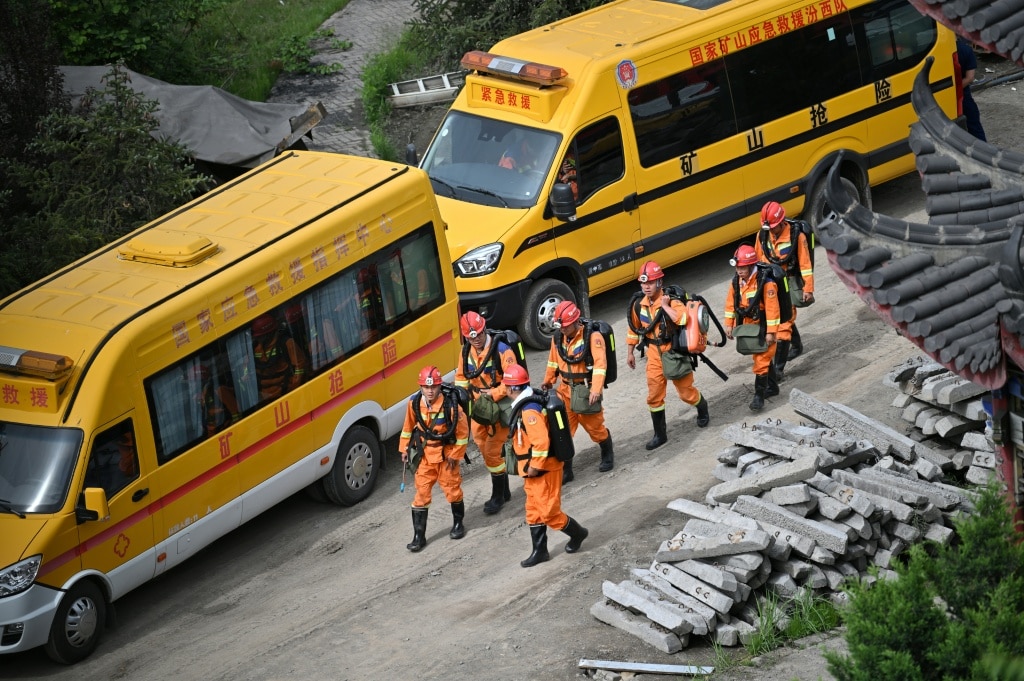
Two days after a devastating gas explosion ripped through the Liushenyu coal mine in northern China’s Shanxi province, emergency response teams continued a desperate search operation Sunday for the last two missing workers, after the blast claimed the lives of 82 people. The explosion, which occurred Friday, ranks as China’s deadliest mining disaster in nearly 20 years, and unfolded when 247 miners were working underground at the shaft, according to official Chinese state media. Hundreds of rescuers have been deployed to the remote accident site, with medical teams evacuating 12 injured people to nearby hospitals by Saturday evening. Late Saturday, AFP correspondents observed a heavy police cordon blocking all access roads to the mine, with only credentialed emergency and official vehicles permitted entry. State media reports confirm teams of helmeted rescue workers rotated shifts descending into the damaged mine shaft overnight to continue the hunt for the two missing workers. “As long as there is hope, we will make every possible effort,” one rescue worker told China’s official Xinhua News Agency. In the wake of the disaster, Chinese national and provincial authorities have launched a full formal investigation into what caused the blast. Preliminary investigations have already uncovered “serious illegal violations” on the part of the company that operates the mine, officials told a press conference carried live on state-run China Central Television (CCTV). Authorities have pledged that anyone found responsible for the accident will face strict punishment under Chinese laws and regulations. Xinhua also confirmed that a senior leader of the operating company has already been taken into police custody. China’s national cabinet, the State Council, has responded to the disaster by ordering immediate sweeping nationwide safety crackdowns on violations common in the country’s mining sector, including falsification of workplace safety data, unreported underground worker headcounts, and unregulated illegal contracting of mining work. One survivor of the blast, Wang Yong, recounted his harrowing escape to CCTV, saying he detected no loud explosion but noticed a strong sulphur odor right before toxic smoke filled the mine tunnel. “I didn’t hear any sound at all, but then a cloud of smoke appeared. When I smelled it, it was the smell of sulphur like when people set off firecrackers. When the smoke came down, I shouted for people to run,” he told reporters. Wang recalled seeing multiple fellow miners overcome by toxic smoke before he lost consciousness. “After more than an hour, I came to on my own, and then I woke up the person next to me” before the pair escaped the mine, he said. Shanxi, one of China’s less economically developed provinces, is the core of the country’s national coal mining industry, producing much of the fossil fuel that powers China’s industrial grid. While national mine workplace safety has improved markedly over the past three decades, deadly accidents still occur with some regularity, as many smaller operations cut corners on safety protocols and regulatory enforcement remains inconsistent in many regions. Just last year, an open-pit coal mine collapse in the northern region of Inner Mongolia killed 53 workers. Beyond the human cost of the disaster, the accident draws renewed attention to China’s ongoing reliance on coal: the country is the world’s largest consumer of coal, and the world’s top greenhouse gas emitter, even as it expands renewable energy capacity at a global record pace.