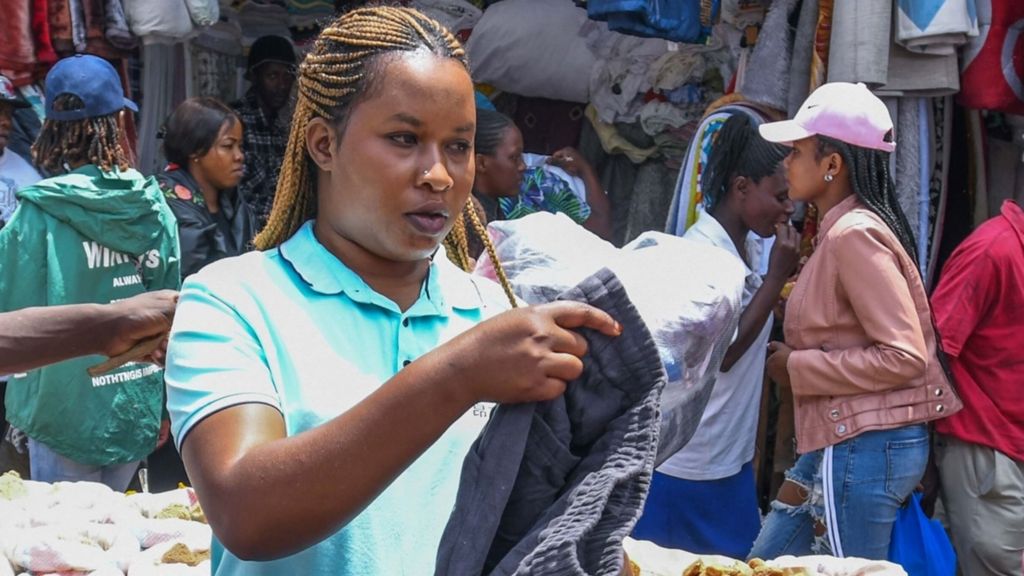
Even torrential downpours cannot dampen the energy of Nairobi’s Gikomba Market, East Africa’s largest open-air second-hand clothing hub. When a BBC reporting team visited, flooded walkways did not stop throngs of shoppers, many donning rubber boots, from squeezing through packed aisles in search of affordable, quality second-hand garments known locally as mitumba. This bustling scene sits at the heart of a decade-long regional debate: how can East Africa grow a vibrant domestic fashion industry when its markets are flooded with cheap, imported cast-offs from the U.S., Europe and China?
Local clothing designers across the region say they stand no chance against the price point of mitumba. “We’re competing with second-hand clothing, but we can’t compete on price,” explains Zia Bett, founder of Kenyan womenswear label Zia Africa, who supports a full ban on mitumba imports. Elizabeth Paul, owner of Kuya Creations in Tanzania’s Dar es Salaam, echoes this frustration: a single new dress in her shop costs a minimum of 50,000 Tanzanian shillings (£14.50), a price that can buy shoppers 10 pre-owned garments at local mitumba markets.
The debate over mitumba is not new. A decade ago, the East African Community (EAC), the regional bloc counting Kenya, Uganda, Tanzania and Rwanda among its members, moved to implement a region-wide ban on second-hand clothing imports to protect local manufacturing. The plan collapsed after heavy diplomatic pressure from the U.S., a top mitumba exporter, which threatened to revoke EAC nations’ access to the African Growth and Opportunity Act (AGOA) — a trade deal that allows duty-free access to the U.S. market for thousands of African goods. Now, the conversation has reignited, with member states taking divergent approaches to regulation.
Uganda has led the charge with a new 30% additional levy on mitumba imports, layered on top of existing 35% import duty and 18% VAT. Officials say the tax serves two goals: cutting environmental damage from textile waste and supporting domestic garment production. Uganda’s president has previously drawn controversy for describing second-hand clothing as cast-offs from deceased white people, framing the trade as incompatible with national economic development. The new tax has faced fierce pushback from mitumba traders, who note the industry supports millions of livelihoods across the region. “This has to be a free economy,” argues Ugandan mitumba trader Aaron Sekky. “The second-hand trade supports so many people.” His point is widely shared by proponents: the mitumba supply chain extends far beyond street retailers, supporting importers, wholesalers, tailors who repair damaged garments, and food vendors at markets. Industry research from the Mitumba Consortium Association of Kenya (MCAK) estimates up to 4.9 million East Africans rely on the trade for income.
Neighboring Kenya recently saw a proposed overhaul of mitumba taxation dropped quickly after widespread public backlash over fears it would push up prices for consumers. Kenya already charges a 30% customs duty on used clothing imports, 5 percentage points higher than the tariff on new clothing imports. Current trade data confirms Kenya is Africa’s largest mitumba importer: the country brought in nearly 180,000 tonnes of second-hand clothing in 2022, a 76% jump from 2013 import volumes. A 2024 government-backed study in Uganda found mitumba is the most popular category of clothing in the country, outstripping both imported new clothing and locally manufactured garments.
Critics of the unregulated mitumba trade argue the employment argument masks deeper economic downsides. “Retail is the most limited form of job creation you can have in an economic sector, versus production, marketing and distribution,” explains Dr Andrew Brooks, a King’s College London academic and author of *Clothing Poverty: The Hidden World of Fast Fashion and Second-hand Clothes*. “If you’re just importing things and selling things, you’re doing very, very little to contribute to your nation’s economy.” Kenya Fashion Council board member Lisa Kibutu adds that most mitumba-related jobs are low-income, hand-to-mouth roles that offer little room for upward social mobility. Still, Kibutu acknowledges mitumba fills a critical gap for low-income Kenyans: “When I left Kenya in the 80s, you would see poor people without clothing. Right now even the poorest person has decent clothing.”
Affordability is no longer mitumba’s only draw, however. Today, shoppers across income levels seek out second-hand garments for their quality and unique style. “Most of the clothes have good quality… they last long,” says Najma Issa, a shopper at Dar es Salaam’s Ilala mitumba market. Twenty-two-year-old Juma Awadh agrees, noting he buys mitumba “because of quality and they look unique.” Even with Tanzania’s 35% import tax on used clothing, Ilala Market remains constantly crowded with shoppers.
Rwanda is the only EAC member that held firm to its 2015 commitment to restrict mitumba, after other nations backed down to U.S. pressure. In 2016, Rwanda raised mitumba import taxes from $0.20 to $2.50 per kilogram, prompting the U.S. to impose a 30% retaliatory tariff on Rwandan clothing exports. Rwandan authorities say the policy has delivered clear results: before the tax hike, mitumba made up 26% to 32% of all garment and textile imports, a figure that dropped to just 2% to 7% in the two years after the change. Local garment exports have also grown, indicating the domestic industry is expanding, officials say. Even so, smuggling of mitumba from neighboring countries remains widespread, with police regularly seizing illegal bales of second-hand clothing. Rwanda also hit an unexpected hurdle: with mitumba supply reduced, many consumers shifted to buying cheap new fast fashion imports from Asia, rather than purchasing locally made garments.
Environmental concerns have added new urgency to the mitumba debate. Environmental activists note that more than one in three second-hand garments shipped to East Africa are too low-quality to be resold, and end up in local landfills. A 2023 estimate from the non-profit Changing Markets Foundation confirmed this trend for Kenyan imports. “There is no infrastructure to dispose of these massive amounts of textile waste, and official dump sites have been overflowing for years,” Greenpeace says. MCAK chairperson Teresia Wairimu Njenga pushes back on this framing, arguing mitumba is actually more environmentally friendly than mass-producing new clothing: “Can you imagine what would happen to Kenya if we are manufacturing 198,000 tonnes [of new clothes] per year?”
Global regulation could soon reshape the mitumba trade: signatories to the Basel Convention, the global treaty governing waste, are currently debating whether to reclassify used garments — most of which now contain plastic-based synthetic fibers — as controlled waste, which would lead to tighter restrictions and higher import costs globally.
Many industry stakeholders across East Africa say a full ban on mitumba is impractical right now, given the gaps in local manufacturing capacity. Ugandan designer Joel Okalany, whose brand Ekikumba Fusion upcycles mitumba into new statement pieces, says the region’s garment sector is still underdeveloped: “The reality is, we are not yet ready for our own manufacturing to take off. In farming, the person who uses a tractor is more efficient than the person who uses the horse. In the tailoring industry, we are still at the level where we are using the horse.” Even Rwanda’s government acknowledged this reality in a 2022 report, saying it would delay implementing a full mitumba ban because of “current domestic gaps in the production of textiles and apparels.”
A shared frustration across both mitumba traders and local designers is the flood of cheap new clothing from China and Turkey, which undercuts both sectors. Designers like Zia Bett say cheap counterfeit garments copy high-end designs and sell for a fraction of the price of authentic local pieces. Still, Bett remains optimistic about the future of East African fashion, arguing the region should focus on building premium, desirable local brands rather than just competing on price: “We need to focus on storytelling and content and quality. I think what the question should be now is: ‘How do we build brands that people choose – and not just afford?’”
For Njenga and other mitumba proponents, the solution is not a ban, but coexistence. “We should allow them to coexist,” Njenga says. “Let’s not kill mitumba – give the consumer power of choice.”