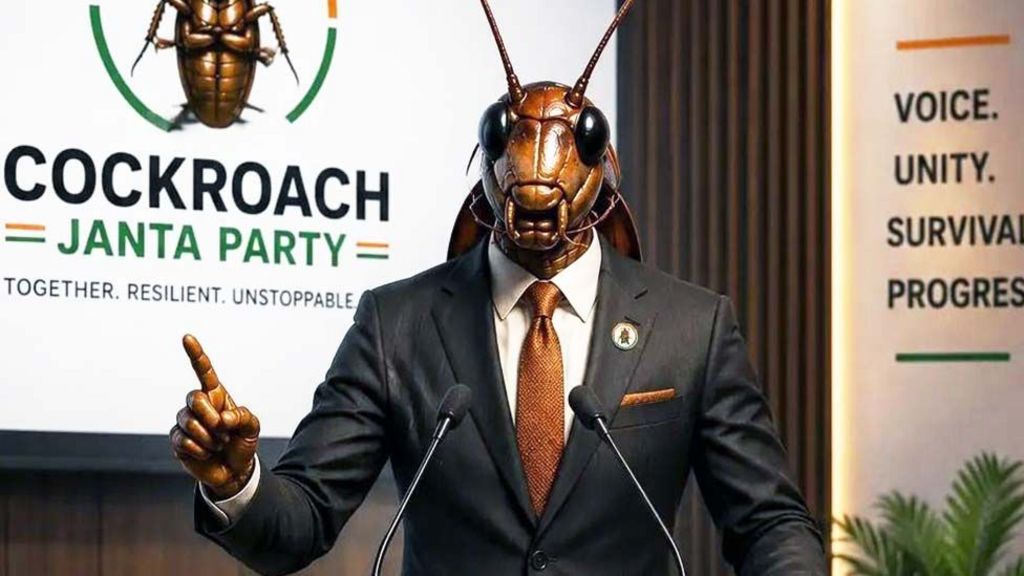
A satirical Indian political parody movement that has taken social media by storm is facing unexpected digital crackdowns, just days after its official website went live. The Cockroach Janta Party (CJP), which started as an internet joke following a controversial comment from India’s chief justice about unemployed youth, has already accumulated more than 20 million followers across its social media platforms, outpacing the reach of the ruling Bharatiya Janata Party by a wide margin.
The movement traces its origins to a public comment from India’s top judge, who reportedly compared unemployed young people to cockroaches. He later walked back the remark, clarifying that he was targeting only individuals holding fraudulent academic credentials rather than the broader Indian youth population. Even so, the offhand comparison struck a chord with millions of young Indians grappling with systemic unemployment, and the CJP was born as a tongue-in-cheek response.
The parody group deliberately names itself to echo Prime Minister Narendra Modi’s long-ruling Bharatiya Janata Party (BJP), positioning itself as a satirical opposition. Its mission statement, delivered with dry humor, claims it is the voice of “the lazy and unemployed,” with membership requirements that include being constantly active online and having the “ability to rant professionally.” To expand its online reach, CJP has leveraged AI-generated imagery for promotional content and sparked the viral hashtag #MainBhiCockroach, which translates to “I too am a cockroach,” that has spread widely across Indian social media.
Founded by Abhijeet Dipke, a political communications strategist and Boston University graduate student, the movement has grown far beyond a simple joke. Its Instagram account alone boasts more than 22 million followers — more than double the follower count of the official BJP Instagram page. In recent weeks, young supporters have even appeared at public clean-up drives and protest events dressed in full cockroach costumes, turning the online meme into a visible offline movement.
Now, just days after launching its official website, CJP has been hit with widespread digital access restrictions. The site is completely unavailable to users within India, and it appears to be unreachable from other global locations as well. The movement’s official X page, which had accumulated more than 200,000 followers, is also blocked for Indian users, who are shown a notice stating the page has been withheld “in response to a legal demand.” Dipke has also alleged that both his personal Instagram account and the group’s official account have been targeted by hackers.
In a post on his personal X account following the block, Dipke accused Indian officials of deliberately taking down the group’s platform. “They have taken down our iconic website,” he wrote, adding the pointed question: “why are they so scared of cockroaches?” He confirmed that the group, which is not registered as an official political party, is already in the process of building a new online home, closing with a defiant catchphrase: “Cockroaches never die.”
Political analysts say the rapid rise of CJP reflects deep-seated frustration among India’s large youth population. India is home to 1.4 billion people, nearly half of whom are under the age of 30, making it one of the youngest countries in the world. Despite this demographic reality, formal political representation for young people remains limited, and widespread unemployment has left many feeling disenfranchised by mainstream political parties. Dipke previously told the BBC that the movement’s overwhelming popularity is a direct reflection of this widespread discontent, noting that young Indians feel their concerns are being ignored by the country’s established political leadership.