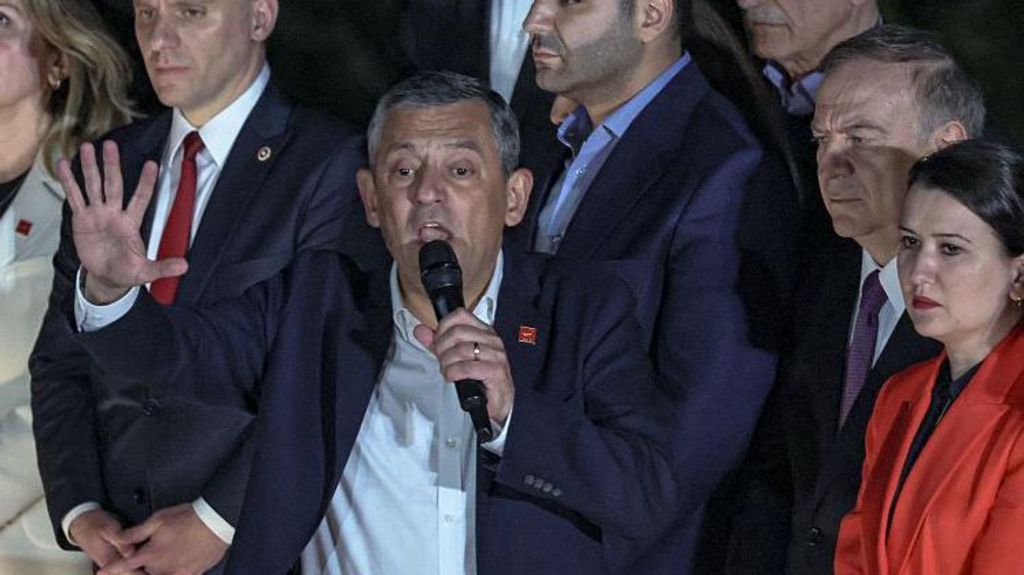
A controversial court ruling that nullifies the 2023 leadership election of Turkey’s main opposition Republican People’s Party (CHP) has plunged the country into a new political crisis, with opposition chief Özgür Özel slamming the decision as a carefully orchestrated “judicial coup” against democracy.
On Thursday, Ankara’s appellate court overturned a 2025 lower court ruling that had dismissed claims of vote rigging during the CHP primary that elevated Özel to the party’s top position. The appellate court’s judgment not only removes Özel and the entire CHP executive board from their posts, but also orders the reinstatement of 77-year-old Kemal Kilicdaroğlu, the long-time party leader who lost the 2023 presidential election to incumbent President Recep Tayyip Erdogan and was later voted out of his leadership role by CHP members. All policy and administrative decisions made by the current CHP executive are also expected to be invalidated following the ruling.
The decision triggered immediate shock and outrage across the CHP. BBC Turkey correspondent Ayşe Sayin reported that many CHP staffers at party headquarters were reduced to tears, and internal tensions boiled over when some members removed a portrait of Kilicdaroğlu from the building’s walls while labeling him a traitor. Thousands of supporters flocked to CHP headquarters in Ankara to protest the ruling within hours of its announcement.
Özel, who has positioned himself as one of Erdogan’s most vocal critics, has pledged an all-out fight against the court’s decision. “We are living through a dark day for Turkish democracy,” Özel told supporters. “These coup plotters do not arrive with tanks, cannons, rifles or camouflage; they come wearing the robes of judges and prosecutors.” The CHP leader has formally submitted an objection to the ruling to Turkey’s supreme election council (YSK), which began deliberations on the challenge on Friday. He also moved to dismiss widespread speculation of a party split, saying, “Tenants leave, homeowners stay.”
Critics argue the ruling is the latest in a years-long campaign by Erdogan and his ruling Justice and Development Party (AKP) to sideline political opponents and consolidate power. Özel has explicitly accused the AKP of pursuing a deliberate strategy to “eliminate its rivals.” A key red flag for opponents is the role of current Justice Minister Akin Gürlek, a hardline prosecutor who was hand-picked for the cabinet post by Erdogan earlier this year. Before his appointment, Gürlek served as chief prosecutor in Istanbul, where he led high-profile investigations targeting opposition figures—most notably Ekrem Imamoğlu, the popular CHP mayor of Istanbul who remains Erdogan’s most formidable potential challenger. Imamoğlu has been held in prison for more than a year on corruption charges brought by Gürlek that carry a combined potential sentence of more than 2,000 years behind bars.
Defending the court’s decision, Gürlek claimed the ruling “reinforces our citizens’ trust in democracy.”
Senior CHP figures have echoed Özel’s condemnation. Jailed and suspended Istanbul mayor Imamoğlu released a social media statement calling on all Turkish citizens to “stand together for their country.” Ankara Mayor Mansur Yavaş, another high-profile CHP leader, warned the ruling’s core goal is to split Turkey’s largest opposition bloc and neutralize it as a political force ahead of potential early elections. With Turkey’s economy already struggling, Yavaş argued that ruling-party leaders are likely to call snap elections before the 2028 scheduled date to capitalize on the opposition’s disarray.
The ruling has already rippled through Turkish financial markets: the country’s benchmark stock index plummeted 6% in late trading Thursday, though it clawed back some losses on Friday morning. While Özel plans to appeal the decision all the way to Turkey’s Court of Cassation, legal analysts warn the process will likely drag on for months or even years, leaving the opposition in limbo. Many political observers now suggest that if Özel cannot reverse the ruling through the courts, he and his supporters may be forced to form a new breakaway party to contest future elections.
In a separate, concurrent development that has drawn further criticism of the Erdogan administration, the president on Friday ordered the permanent closure of Istanbul Bilgi University, a respected independent higher education institution that enrolls roughly 22,000 domestic and international students. The 30-year-old university was effectively shut down overnight, according to Yaman Akdeniz, a law professor who has taught at the institution for 15 years. “An institution where I’ve taught for 15 years, one we’ve nurtured alongside thousands of young people, is being completely disregarded,” Akdeniz said. Turkey’s Council of Higher Education has stated it is putting measures in place to minimize disruption for current students and ensure they can continue their studies at other institutions.