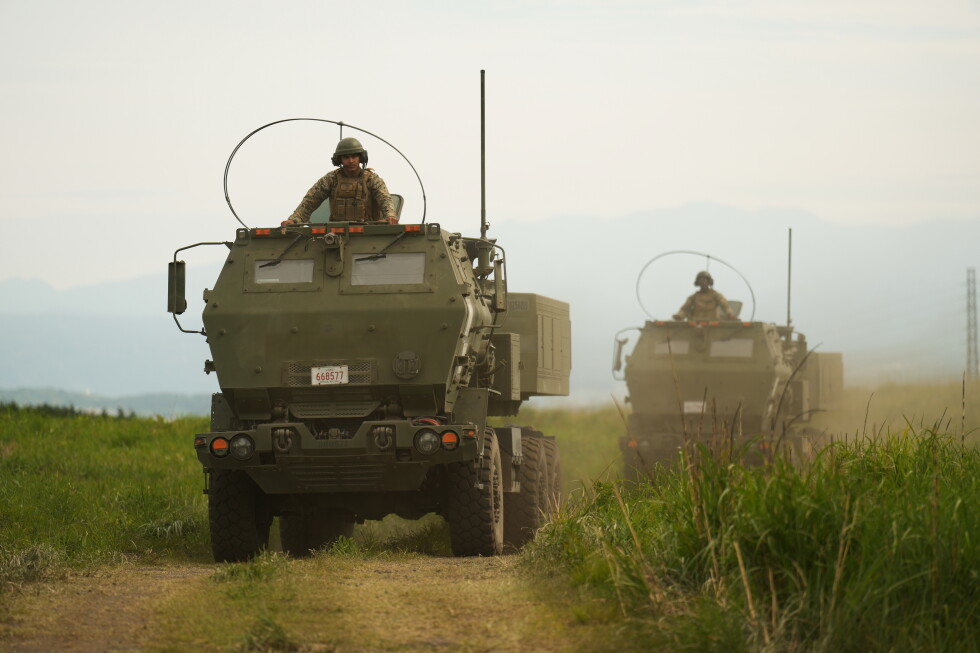
GOTEMBA, Japan — In a dramatic display of military capability against the quiet backdrop of training grounds tucked into the foothills of Japan’s iconic Mount Fuji, the first rocket launched by U.S. Marines from a mobile launcher tore across the clear blue sky. A burst of flame preceded a thunderous roar that shattered the area’s pastoral calm, the engine’s bright orange glow leaving a sharp, visible trail in its wake. Five additional rockets followed in rapid sequence, before a second High Mobility Artillery Rocket System (HIMARS) truck emerged from its concealed position in a grove of evergreen trees, launched its own six-rocket salvo, and immediately withdrew back into cover.
This week’s brief live-fire drill at the U.S. military’s Camp Fuji East Maneuver Area, which lasted only a matter of minutes, carries outsize strategic weight. As Washington works to deter potential Chinese military action against Taiwan — the self-governing democracy that Beijing claims as its own territory and has not ruled out seizing by force — the exercise serves as a clear signal of American military credibility to regional allies.
The drill also lays bare a deliberate shift in U.S. military tactics across the Indo-Pacific, a change driven by the rapid modernization and expansion of China’s military capabilities over the past decade.
“The United States’ core goal is preventing a Chinese invasion of Taiwan, but it is no longer banking on the traditional large-scale carrier-based attack air wings that defined past conflicts,” explained Euan Graham, senior defense analyst at the Australian Strategic Policy Institute. “During U.S. tensions with Iran, more than 40 American manned and unmanned aircraft were destroyed or damaged by a far less capable adversary. Against China, that vulnerability would be exponentially greater. That is why the U.S. is now prioritizing smaller, dispersed, mobile units.”
According to the Pentagon’s most recent annual report to Congress, the new strategic framework aims to “deny any nation in the Indo-Pacific the ability to dominate the region or overpower our allies,” with a core focus on strengthening deterrence “through strength, not confrontation.”
The core value of the HIMARS system is written into its name. Mounted on a standard military truck, the rocket pod can be easily hidden from drone or satellite surveillance, driven to a firing position to launch its precision GPS-guided missiles, then relocate to a new hidden position almost immediately — a tactic military officials call “shoot-and-scoot.”
“Depending on the crew, we can be in and out in as little as two to four minutes,” said Sergeant Kevin Alvarez, section chief for one of the two HIMARS units from Fox Battery, 3rd Battalion, 12th Marines, 3rd Marine Division that took part in the Camp Fuji exercise.
First introduced roughly 20 years ago, HIMARS saw combat service in Iraq and Afghanistan, but it rose to global public prominence only after Ukrainian forces deployed it to devastating effect against Russian invasion forces. Recent conflicts, marked by the widespread proliferation of surveillance drones that can quickly spot and target static artillery positions, have only underscored the critical advantage of mobile systems like HIMARS.
“Compared to traditional cannon artillery, HIMARS is far quicker, far more maneuverable, and much easier to conceal,” noted Lieutenant Colonel Ryan Anness, commander of the 3rd Battalion. “Combine that with precision strike capability, and it’s easy to see why this system is a priority for so many nations, and for the U.S. military in the Pacific.”
HIMARS is compatible with a range of missile types. Initially, the U.S. only supplied Ukraine with shorter-range munitions, but it later approved the delivery of Army Tactical Missile Systems (ATACMS), which can strike targets roughly 180 miles away. More recently, the U.S. has deployed the even longer-range Precision Strike Missile (PrSM), built by manufacturer Lockheed Martin, which can hit targets more than 310 miles away. According to Air Force General Dan Caine, chairman of the Joint Chiefs of Staff, PrSM saw its first combat use in February during operations against Iran, where HIMARS sank multiple Iranian surface ships and a submarine while docked in port.
Graham explained that when paired with the Army’s Typhon system — another truck-based launcher that fires longer-range Tomahawk missiles, though it is less maneuverable than HIMARS — the two systems can fully cover the Taiwan Strait and the strategically critical Luzon Strait between the Philippines and Taiwan if deployed on Taiwan and nearby Japanese and Philippine islands. Both waterways are central to any potential Chinese invasion or blockade of Taiwan.
“Ahead of any conflict over Taiwan, most large U.S. military assets would likely move outside the range of China’s coastal missile capabilities,” Graham said. “What would remain are highly survivable submarines, and small, dispersed units built around rugged, mobile systems like HIMARS.”
The Wednesday drill at Camp Fuji incorporated strict safety protocols: Japanese military observers oversaw the exercise, and a local road was closed as a precaution against stray projectiles, with some launches using inert, concrete-filled dummy rockets to meet safety requirements. Though the precautions slowed the drill compared to real combat operations, Anness emphasized that the exercise delivered tangible value both for troop readiness and for strengthening alliances in the region.
“Fielding long-range precision strike weapons directly bolsters deterrence here in the Pacific,” Anness said. “Training alongside our Japanese partners as often as we can ensures we are ready to respond if needed.”