BELGRADE, Serbia — As a new year of political opposition unfolds in the Balkan nation, Serbia’s dissident university student movement is preparing to stage its first major mass gathering this weekend, reigniting a grassroots campaign for sweeping systemic change under the long-ruling authoritarian administration of President Aleksandar Vucic.
Organizers expect thousands of participants to travel from across the country to converge on Belgrade’s iconic Slavija Square on Saturday, a location already etched into the nation’s recent protest history. This site hosted a massive anti-government demonstration last March, a gathering that ended abruptly amid contested claims that state forces deployed a sonic weapon against peaceful attendees — an allegation Vucic’s government has repeatedly denied.
This student-led movement first emerged as a formidable political force in late 2024, galvanized by public outrage over the Novi Sad train station collapse that killed 16 people. The tragedy struck a deep chord across Serbian society, with widespread public belief that the disaster stemmed from endemic corruption and systemic negligence in state-funded infrastructure projects. What began as a call for accountability quickly ballooned into a months-long nationwide movement: students blocked university faculties across the country throughout 2025, successfully forcing the resignation of former Prime Minister Milos Vucevic and his entire cabinet. Protesters argued this step was insufficient, however, and have continued to demand early national elections — a call Vucic has so far refused to answer.
Last year, the movement anchored a sweeping wave of anti-corruption street protests that posed one of the most significant threats to Vucic’s power in years. Today, student leaders say their efforts are now focused on upcoming national elections, expected to take place either later this year or in 2027, which they aim to use to remove Vucic’s right-wing populist government from power.
“We hope a great many people will join us, spend the day with our movement, and continue standing with students as we prepare for these elections,” youth movement representative Isidora Jovanovic told the Associated Press. “Serbia is long overdue for change, and students are the ones who will deliver that change.”
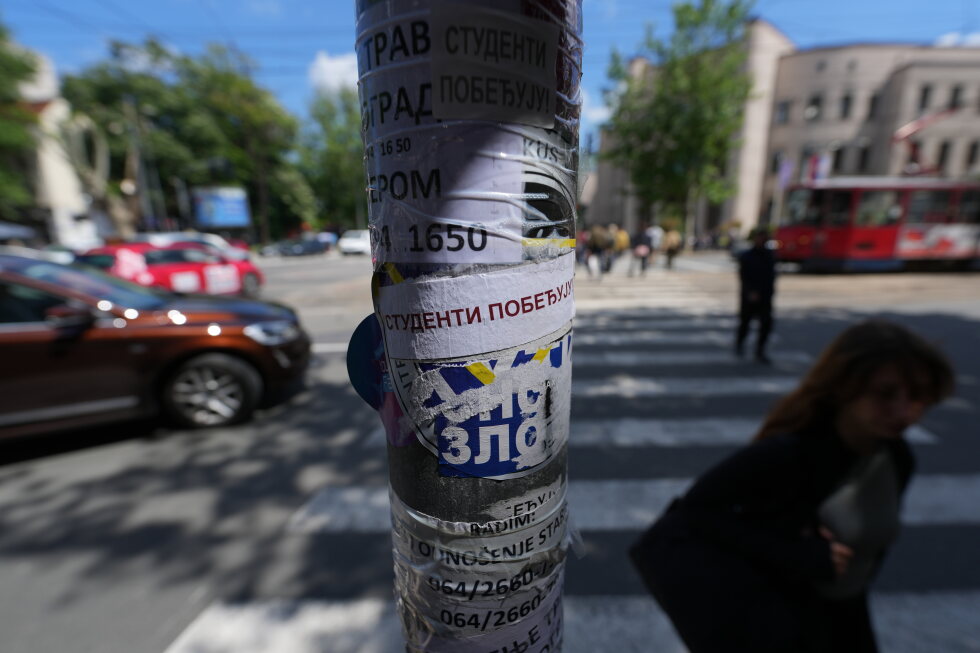
Tensions have already been building in the capital in the lead-up to Saturday’s rally. On Tuesday, police were forced to intervene to separate pro-Vucic loyalists from students printing “Students win” protest materials. Just days before that confrontation, an elderly man was injured when a driver rammed through a student-organized traffic blockade in central Belgrade. These incidents are not isolated: political violence has marred opposition gatherings for months, including clashes that disrupted local elections last March.
Jovanovic emphasized that event organizers have taken extensive steps to prevent unrest at Saturday’s gathering, noting that many attendees will be traveling from out of town. “We do not want any of our fellow citizens to leave with a bad experience or injuries,” she said.
Political analysts note that the once-reactive student movement has matured into a cohesive political force capable of challenging Vucic’s long-dominant Serbian Progressive Party. Dusan Vucicevic, a professor at Belgrade’s Faculty of Political Sciences, told the AP that the movement commands broad cross-public support and is positioned to deliver strong results in any future election.
“We finally have a legitimate political group that can effectively challenge the Serbian Progressive Party and Aleksandar Vucic himself,” Vucicevic said.
Vucic has not remained passive in the face of this growing opposition. Pro-government media outlets have repeatedly labeled student protesters and other critics as foreign-backed terrorists and agents seeking to destabilize Serbia, a rhetoric that has deepened the country’s already stark political divisions. For Saturday’s rally, Vucic’s loyalists are expected to occupy a pro-government park camp outside the presidency building that Vucic established last March, widely seen as a deliberate buffer against opposition demonstrations. Multiple attacks on protesters and journalists have been reported near the camp since its establishment.
Allegations of excessive force by police and arbitrary detentions of opposition activists have drawn sharp international scrutiny of Vucic’s government. The European Union has warned that Serbia’s ongoing democratic backsliding could result in the loss of roughly 1.5 billion euros ($1.8 billion) in accession funding allocated to the country as a candidate for EU membership.
Despite rising tensions and the threat of confrontation, a new generation of young Serbs is stepping up to join the movement, expressing unshakable optimism that political change is within reach. Branislav Vasic and Filip Novakovic, both 19-year-old freshmen at the Faculty of Political Sciences, confirmed they will be among the attendees at Saturday’s rally, saying standing with older opposition leaders is a matter of principle.
“Everyone has an obligation to join this rally, given the state of our country,” Vasic said. “I’m convinced that as long as people want change, we have the strength to deliver it.”
Novakovic echoed that sentiment, framing the moment as a historic opportunity for his generation to finish the work past generations could not complete. “We are all in this together, and we are one step away from a better future,” he said. “This is a long struggle, and I will keep fighting for it as long as I live.”