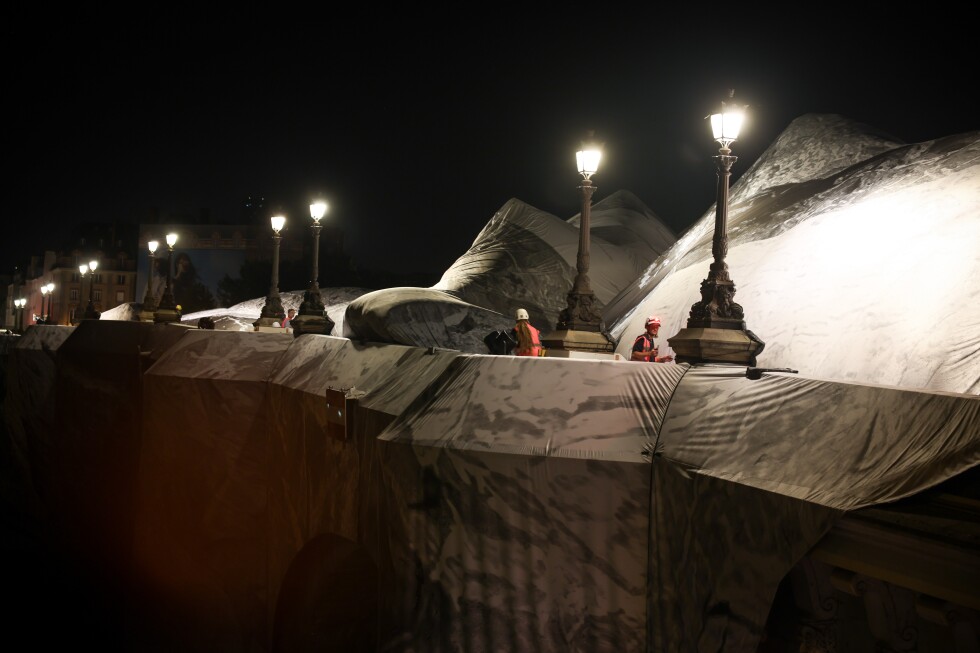
Paris’ oldest surviving river crossing, the 400-year-old Pont Neuf, has begun disappearing from the city’s iconic Seine river skyline this week, as globally renowned street artist JR — often dubbed the “French Banksy” — rolls out one of the French capital’s most ambitious public art installations in modern history.
The project, years in the planning and more than 12 months in active development, entered its most dramatic phase this week after a weather-related delay pushed back the overnight inflation of the massive rocky structure. What started as a concept has now emerged as a startling prehistoric-looking cliff rising from the heart of central Paris, gradually swallowing the 17th-century stone bridge from view.
Titled *La Caverne du Pont Neuf* (The Cave of Pont Neuf), the monumental work pays direct homage to one of the most famous public art pieces in Paris’ history: the 1985 installation where legendary artists Christo and Jeanne-Claude wrapped the entire Pont Neuf in shimmering golden fabric. That groundbreaking project helped redefine what large-scale public art could be in modern urban centers, and today a square adjacent to the bridge bears the pair’s names. JR acknowledges the weight of following in their footsteps, saying “It’s pretty hard to go after them.”
Funded through sales of JR’s original artwork and support from a small group of corporate partners, the installation will not open to the public until June 6, and will run around the clock through June 28. For the duration of the exhibition, the bridge will be closed to vehicle traffic, with the structure fully visible from the Seine quays, passing riverboats, and even the observation deck of the Eiffel Tower. Its run is timed to overlap with three major Paris cultural events: Paris Fashion Week, World Music Day, and the all-night contemporary arts festival Nuit Blanche.
The numbers behind the ephemeral artwork are staggering. The inflated cave stretches 120 meters along the bridge and rises 18 meters high — equal to the height of a six-story office building. Despite its massive size, the structure is constructed almost entirely of air: 80 hand-assembled fabric arches hold 20,000 cubic meters of air, bringing the total weight of the installation to just five metric tons. Each panel of the heavy-duty fabric was hand-stitched by 25 skilled artisans in a small village in Brittany, and the entire structure is designed to rest on the bridge without damaging its historic stonework. Engineers spent weeks testing the deflation process at an Orly Airport hangar to ensure that if power fails, the massive cave will deflate slowly and safely, with no risk to the landmark.
From the riverbanks, the installation appears as a solid rocky formation that disrupts Paris’ familiar cityscape — a deliberate choice, according to JR, who built his career creating large-scale photographic collages pasted on urban walls and landmarks across the globe. Unlike Christo’s wrapping, JR says his work does not cover the bridge, but “undresses” it, returning the bridge’s limestone blocks conceptually to the quarries that once supplied all the stone to build historic Paris. Beyond this geological nod, the artist also designed the cave to bring elements of raw nature back to the dense urban core.
The work also carries a sharp conceptual message rooted in Plato’s famous Allegory of the Cave, where imprisoned people mistake shadows cast on a cave wall for actual reality. JR draws a direct parallel to modern digital life, arguing that today’s “caves” are the smartphones that people carry everywhere. “Because we believe that our algorithm on social media is the reality,” he explains. This creates a deliberate paradox: to fully engage with the installation’s hidden layers, visitors will pull out their phones anyway. Partnering with Snap, JR has added a custom augmented reality layer that reveals elements of the work invisible to the naked eye, and the audio design — a low, resonant hum evoking the weight of stone — comes from Thomas Bangalter, the former member of electronic music duo Daft Punk, who was 10 years old when Christo wrapped the Pont Neuf.
Once inside, visitors will be able to walk the full length of the cave for free, moving through a dark, daylit-free tunnel designed to make people lose track of time — a rare moment of pause on one of Paris’ busiest central bridges, a goal JR says he intentionally set out to achieve.
When the exhibition closes on June 28, the installation will be fully deflated, and all materials will be reused or recycled. True to JR’s ethos, this temporary work leaves no permanent trace on the historic bridge: unlike permanent construction, a massive structure built of air leaves behind no scar. Just as Christo’s golden wrapping left the bridge unchanged after two weeks in 1985, the Pont Neuf will re-emerge exactly as it was, ready to serve Parisians for another 400 years.