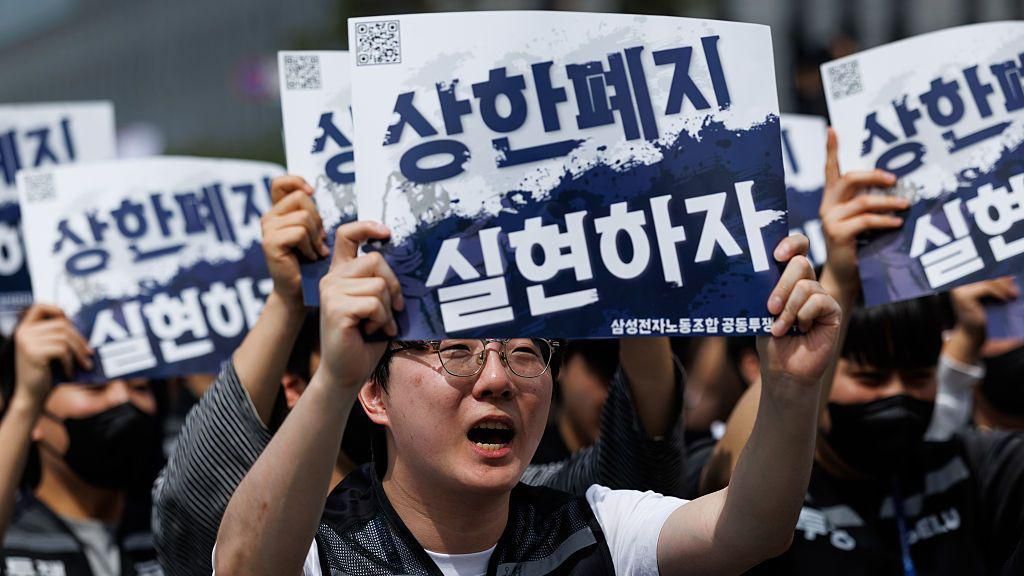
Tens of thousands of Samsung Electronics union members gathered at a major factory complex south of Seoul on April 23, bringing a high-stakes labor dispute to the brink of work stoppage that threatened global tech supply chains. On the eve of a planned strike, the tech giant and its largest employee union reached a last-minute tentative wage and bonus agreement, suspending industrial action set to begin Thursday while union members vote on the deal between May 22 and May 27.
The conflict erupted against a backdrop of unprecedented global demand for AI-related memory chips, which has sent Samsung’s profits and market valuation soaring in recent months. The core point of contention was the unequal distribution of record profits generated by the AI boom across different business units. Samsung initially proposed paying memory chip division workers bonuses equal to as much as 607% of their annual salary – far higher than the 50% to 100% offered to staff in other chip and electronics units, including those producing advanced semiconductors for major clients like Tesla and Nvidia.
The union, which represents nearly 48,000 Samsung employees, pushed back against the lopsided bonus structure, arguing that 23,000 non-memory chip workers should not be excluded from the windfall. The union also demanded the elimination of a company-wide 50% bonus cap on annual salaries and the allocation of 15% of annual operating profit to a shared worker bonus pool. Industry analysts widely noted that a full strike at Samsung – the world’s largest memory chipmaker by sales and a core supplier to global AI data center builders, smartphone manufacturers, and consumer electronics brands – would have sent shockwaves through already strained global chip supplies.
Samsung’s outsized role in the global economy amplifies the stakes of any labor unrest: the broader Samsung Group contributes roughly one-fifth of South Korea’s total economic output, making any production disruption a risk to the country’s entire export-driven economy. The dispute also comes at a moment of intensifying competition for Samsung, as rivals SK Hynix and Micron Technology capitalize on the AI chip boom to gain market share. Last year, SK Hynix scrapped its 10-year bonus cap, pushing average bonuses three times higher than Samsung’s previous offerings, which led to a noticeable exodus of skilled Samsung workers to the competitor.
By early May, booming AI chip demand pushed Samsung’s total market capitalization past the $1 trillion mark, following a 750% year-over-year jump in operating profit during the first quarter of 2025. Even as the deal was struck, legal constraints had already limited the scope of potential strike action: a South Korean court granted Samsung an injunction forcing the company to maintain full staffing for safety, facility maintenance, and quality control operations, and barred the union from blocking facility access or occupying plant grounds, with daily fines of $74,000 for any violations.
Financial analysts from JP Morgan had projected that a sustained strike could cut Samsung’s annual operating profit by between $14 billion and $20.8 billion, a blow that would have rippled through global tech markets. In a statement released after the tentative agreement was announced, Samsung said: “With a humble attitude, we will build a more mature and constructive labour-management relationship to ensure that such an incident never happens again.” Markets reacted positively to the news, with Samsung’s share price jumping more than 5% on Thursday morning following the announcement.
The American Chamber of Commerce in Korea had previously warned of the broader global risks of prolonged labor unrest, noting that “In today’s interconnected global economy, disruptions in strategically important industries can create ripple effects extending well beyond a single company or market. Competing regional manufacturing markets could benefit if concerns over predictability and continuity persist.” With the deal now headed for a member ratification vote, the temporary agreement has eased immediate fears of production disruption during a critical period of AI infrastructure expansion worldwide.