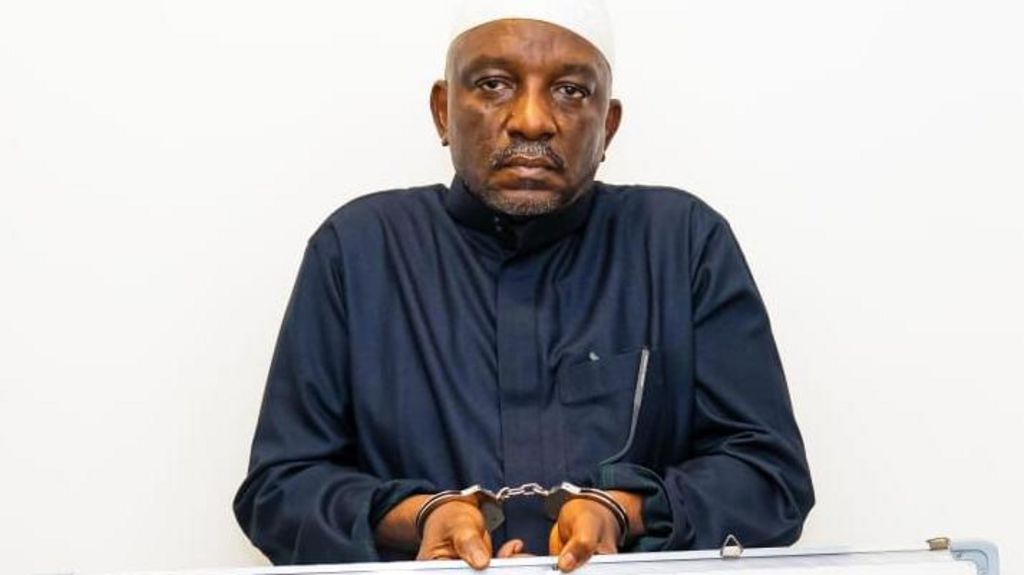
Nigeria’s top anti-graft body has apprehended a former federal power minister more than a week after a court handed down a substantial 75-year prison sentence for his role in diverting public funds earmarked for critical energy infrastructure, in a rare high-profile win for the West African country’s embattled fight against institutional corruption.
The Economic and Financial Crimes Commission (EFCC) confirmed that Saleh Mamman, who held the power minister portfolio from 2019 to 2021 under former President Muhammadu Buhari, was taken into custody in the early hours of Tuesday in northern Nigeria’s Kaduna State. The arrest followed weeks of coordinated surveillance and intelligence work by the agency’s operatives, after Mamman evaded authorities by going into hiding immediately following his conviction at an Abuja court earlier this month.
Mamman was tried in absentia after he failed to appear for his ruling, and was found guilty on 12 separate criminal charges connected to the siphoning of billions of naira allocated for two major hydroelectric power projects. Presiding judge established that prosecutors had successfully proven the charges beyond a reasonable doubt, documenting that Mamman and his network of associates used shell proxy companies to divert at least 22 billion naira, equal to roughly $14 million or £10 million, from the public infrastructure projects. The judge labeled the misappropriation a gross violation of the public trust placed in the former minister, noting that the stolen funds were intended to expand and improve Nigeria’s chronically unreliable electricity grid.
In a public statement following the arrest, EFCC Chairman Ola Olukoyede reaffirmed the agency’s commitment to ensuring the convicted former official serves out his full sentence. The multiple charges carried individual prison terms that are set to run consecutively, adding up to a total 75-year custodial sentence. “For us, getting the convict to serve his jail terms is extremely important in view of the seriousness with which we are tackling corrupt practices,” Olukoyede said.
The arrest marks an unusual example of follow-through in Nigeria’s campaign against high-level public corruption, where convictions of senior government officials remain extremely uncommon. Mamman also faces a separate ongoing corruption trial in Abuja centered on allegations of fraud involving an additional 31 billion naira, and an arrest warrant was already issued for him in that case earlier this month after he failed to appear for hearings.
Mamman’s conviction and arrest have reignited public anger over Nigeria’s persistent electricity crisis, a issue that the former minister had pledged to resolve during his time in office. Despite holding status as one of Africa’s largest energy producers, Nigeria continues to grapple with widespread, frequent blackouts that disrupt daily life for residential users and cripple business operations across the country. Millions of Nigerians rely on expensive private fuel generators to meet their power needs, a burden that has grown heavier in recent years amid skyrocketing global fuel prices.
This report was originally sourced from BBC Africa coverage of Nigerian affairs.