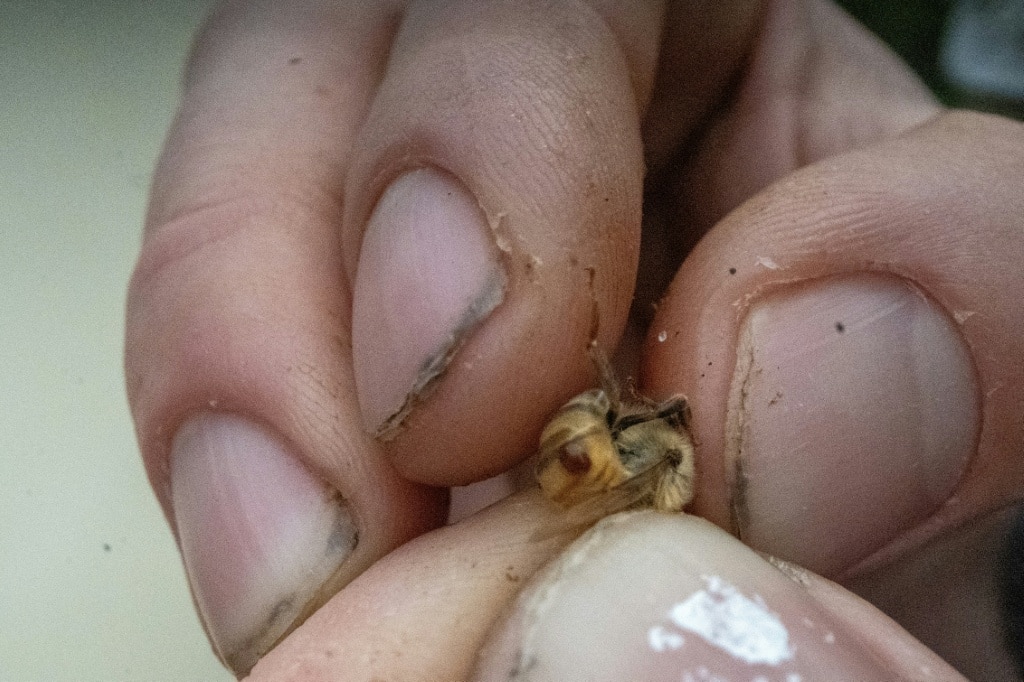
Nestled in a lot behind an abandoned gas station at the foot of Appalachia’s rolling mountains in West Virginia, a dozen apiarists gather around veteran commercial beekeeper Roy Funkhouser, the air thick with the low buzz of thousands of honeybees. What began as a regular monthly meeting for the group — a mix of casual hobbyists and full-time commercial operators — has shifted from a skill-sharing workshop to a forum for growing anxiety: as U.S. bee populations collapse to historic levels, a looming federal funding cut threatens to shutter the nation’s oldest bee research lab, a 100-year-old institution that has led global efforts to combat the threats facing honeybees.
For Funkhouser, the crisis is not an abstract policy debate — it is a devastating collapse of the livelihood he has built over decades. Where he once tended roughly 1,200 hives, fewer than 200 remain active this year. “It’s a real struggle,” he told Agence France-Presse. “The parasites that we’ve got now, the mites and everything — more viruses and more pesticide exposures, more chemical exposures — everything is just more of a struggle today than what it was in the past.”
Funkhouser’s experience is far from unique. The latest data from Apiary Inspectors of America shows that U.S. beekeepers lost more than half of all their managed colonies in the 12-month period ending April 2025, marking the worst annual loss rate since the organization began tracking colony health decades ago.
At the top of the list of threats facing colonies is *Varroa destructor*, a tiny 1.5-millimeter parasitic mite that the U.S. Department of Agriculture (USDA) recognizes as the single most damaging honeybee pest in the country, inflicting higher economic damage than all other apicultural diseases combined. The crab-like parasites feed on honeybee tissue and fat stores, and spread a debilitating, wing-deforming virus that can wipe out entire colonies in months. Beyond threatening apiculture, the mites put critical agricultural pollination at risk: commercial beekeepers like Funkhouser truck their colonies across the country to pollinate high-value crops, from California’s vast almond orchards to fruit farms across the Midwest. Without sufficient healthy bee populations, crop yields drop sharply, threatening food supplies and raising prices for consumers.
For years, Funkhouser and his fellow beekeepers have turned to researchers at the USDA’s Beltsville Agricultural Research Center (BARC) — home to the nation’s oldest bee lab — for evidence-based guidance to fight the mite crisis. Zac Lamas, one of the lead entomologists at the BARC bee lab, has worked directly with West Virginia beekeepers to sample colonies, test for genetic markers of disease and pesticide exposure, and develop tailored mitigation strategies.
“It’s not that we’re working with one beekeeper,” Lamas explained during a field training session with beekeepers. “We might be working with several million dollars’ worth of colonies, or several million dollars’ worth of pollination services that won’t exist because these colonies are at risk.”
But that support is now at risk of disappearing entirely. As part of a cost-cutting plan driven by congressional funding cuts that reduced USDA agricultural research budgets by more than $32 million in key priority areas, the agency is moving forward with plans to close the entire BARC facility. While some research programs will be redistributed to other federal facilities across the country, the fate of the iconic bee lab remains unclear, and the USDA has not responded to questions about where or if bee research operations will be reestablished.
Lamas, who has already accepted a new position at a local university after facing layoff from the lab, argues that the closure is a short-sighted decision that undermines decades of progress. The entire bee lab program costs just $3.2 million annually, he says, a tiny fraction of the $600 million in annual economic losses that bee colony collapse currently inflicts on U.S. agriculture. “The idea that we’re redundant and expensive isn’t a good way to generalize the value of this lab or the cost of this lab,” he noted.
Beyond the direct funding gap, Lamas warns that breaking up the lab will erase irreplaceable institutional knowledge. For a century, BARC has assembled a team of specialists with overlapping skills focused entirely on protecting bee health and supporting national food security. “When we have a new problem, multiple people with complementary skills can work on it quickly,” he said. That collaborative capacity will be lost if the team is scattered, he added.
For beekeepers already grappling with record losses, the impending closure comes as a devastating blow. Just as researchers are beginning to untangle the complex mix of parasites, viruses, and environmental stressors driving colony collapse, the cut threatens to halt progress. “We’ve got results from a lot of our testing and figured out a lot of the things that are going wrong,” Funkhouser said. “The unfortunate thing is, it seems like when you figure out one thing the next year, it’s something else. Without the lab, we’ll be flying blind.”