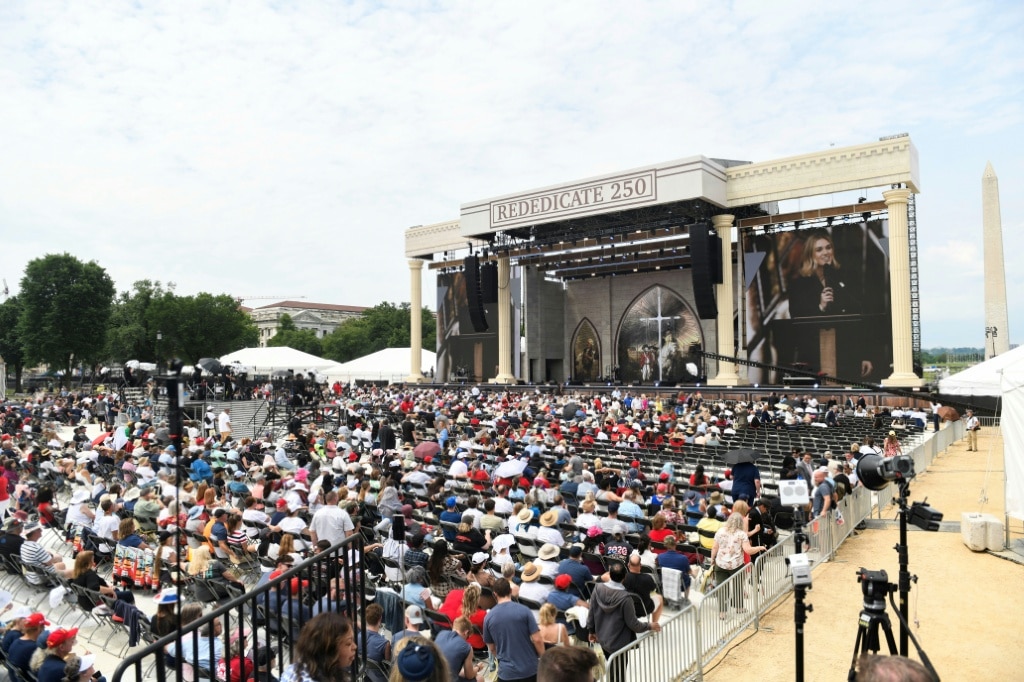
On a Sunday on Washington’s National Mall, thousands of conservative Christian supporters gathered for a high-profile mass prayer rally organized by the Trump White House, kicking off a controversial event tied to the United States’ 250th anniversary celebrations that has reignited fierce national debate over the intersection of faith and government. The gathering was framed by organizers as a mission to revive what they frame as the nation’s forgotten founding principles rooted in Christianity, but critics immediately decried it as a blatant embrace of Christian nationalism that erodes the constitutional separation of church and state.
The day-long outdoor event featured a lineup of political leaders and prominent evangelical figures, mixing religious worship with overt political messaging. Attendees filled the open green space of the Mall, singing contemporary Christian hymns and listening to a series of addresses from both pastors and top Trump administration officials. Vice President JD Vance and Defense Secretary Pete Hegseth delivered pre-recorded video remarks to the assembled crowd, while former and current President Donald Trump made a brief video appearance, reading a well-known biblical passage promising divine healing for nations that turn to God. House Speaker Mike Johnson opened the event with a prayer targeting what he called “sinister ideologies” spreading across the country, arguing that the nation’s core moral and spiritual identity had come under sustained attack. “We’ve witnessed attacks on our history, on our heroes and the cherished moral and spiritual identity of this great nation,” Johnson told the gathering. “We turn to you once again to save us from these afflictions.”
The event comes as muscular Christian nationalism – an ideology that binds American national identity explicitly to Christian faith – has gained unprecedented access to power following Trump’s return to the presidency, with white evangelical voters remaining one of the president’s most loyal and vocal base of support. Hegseth, one of the most high-profile evangelical figures in the cabinet, is a member of an ultra-conservative evangelical congregation and has drawn attention for framing ongoing U.S. conflicts including the Iran war through bellicose religious rhetoric. Speaking to the crowd, Virginia pastor Gary Hamrick doubled down on this framing, framing the moment as an existential spiritual conflict for the nation’s future. “Today, friends, we are in a spiritual war,” Hamrick said. “This is a battle for the very soul of America.”
The U.S. Constitution’s First Amendment explicitly prohibits the federal government from establishing an official national religion, while also guaranteeing the free exercise of all religious beliefs, a balance that has been at the center of debate around the event. Ahead of the rally, Johnson pushed back against critics during an appearance on Fox News Sunday, arguing that the term “Christian nationalism” is nothing more than a pejorative label invented by opponents seeking to censor Christian voices in public life. For many attendees who traveled from across the country to attend the rally, the event was a long-overdue correction to what they see as decades of declining religious influence in American public life. Jeana Dobbins, a 67-year-old retiree who made the trip from North Carolina, told Agence France-Presse she came to “rededicate our country back to God. Our country has fallen away in so many areas.” Sarah Tyson, who traveled from New York with a church group and held a hand-painted “Jesus Saves” sign, echoed that sentiment, saying she believes Trump was divinely chosen to lead a national spiritual revival. “God ordained him for a time like this, because these United States needs to wake up,” Tyson said.
While every modern U.S. administration has hosted or attended faith-based gatherings to mark national holidays or moments of national significance, Sunday’s event stands out for its massive scale and the direct involvement of nearly the entire top tier of the Trump administration. Of the 20 scheduled “faith leader” speakers, nearly all were evangelical Protestant, with only a single rabbi and one retired Catholic archbishop included on the roster. Religious studies scholars note that while blending conservative Christianity and nationalist rhetoric is not a new tactic in American politics, the scope of official government backing for the event marks a significant shift.
“It’s not unprecedented to have a group of evangelical pastors or conservative clergy come together for something like this and blend a certain kind of nationalism with a certain kind of conservative Christianity,” said Sam Perry, a professor at Baylor University, a prominent Christian higher education institution in Texas. But “the Trump administration taking the lead on this celebration at this scale is different than previous events,” Perry added. Julie Ingersoll, a professor of religious studies at the University of North Florida, argued that the narrow lineup of speakers reveals an underlying vision of American identity that excludes non-Christians and people of color. While the event’s official website claims it welcomes “Americans of every background,” Ingersoll said the speaker list reflects “an idea of American identity that is rooted in whiteness and Christianity.” The event, she added, “sends a specific message… that they are the mainstream Americans, and the rest of us are sidelined.”
The rally took place on the National Mall, the iconic stretch of federal parkland between the U.S. Capitol and the Lincoln Memorial that has hosted decades of defining mass gatherings for American democracy, most notably the 1963 March on Washington for Jobs and Freedom, where 250,000 people gathered to hear Martin Luther King Jr. deliver his historic “I Have a Dream” speech.