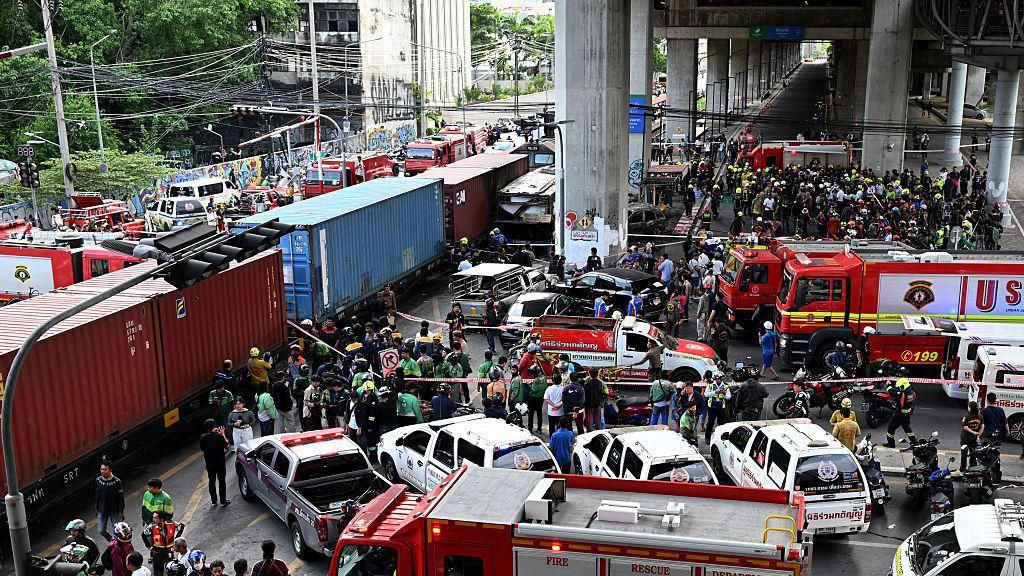
On a Saturday afternoon in central Bangkok, a devastating collision at the Asoke-Din Daeng railway crossing has left eight people dead and dozens more injured, after a freight train slammed into a public bus that became stranded on active tracks, triggering an intense fire that engulfed the vehicle. In the days following the tragedy, Thai authorities have unveiled troubling findings that point to both human error and longstanding systemic failures as core causes of the deadliest railway incident in the country in recent years.
Officials confirmed late last week that the freight train driver tested positive for illegal substances following the crash, and has since been formally charged with reckless driving. Preliminary data pulled from the train’s black box shows the driver only activated the emergency braking system when the train was roughly 100 meters from the stopped bus — a distance too short to stop the heavy vehicle in time to avoid impact. Beyond the train driver, two other people are also facing criminal charges: the bus driver, who got stuck on the tracks amid peak-hour gridlock, and the manual crossing guard responsible for lowering safety barriers, which failed to deploy correctly because the bus was blocking the mechanism.
The crash has pulled back the curtain on long-known safety hazards at the Asoke-Din Daeng crossing, a high-traffic chokepoint that connects to one of Bangkok’s busiest downtown intersections. Structural engineers familiar with the site warn the crossing has operated well above its safe capacity for years: Dr. Amorn Phimarnmas, president of the Structural Engineers Association of Thailand, estimates that more than 100,000 road vehicles pass through the crossing every single day, far exceeding the safety threshold for an at-grade, manually operated railway crossing.
Decades of unplanned urban growth have exacerbated the risks, experts note. The railway tracks were laid decades before the surrounding road network and dense commercial and residential development sprung up around them, creating a persistent conflict between rail and road traffic that has become normalized over time. Local commuters regularly skirt safety rules: motorcyclists frequently weave around partially lowered barriers to cut through crossing, beating congested traffic but creating constant risks of collision with oncoming trains. This routine exposure to risk has led to what Dr. Amorn calls “risk normalization” — a dangerous dynamic where commuters, operators and regulators accept daily unsafe conditions as the status quo, until a disaster strikes.
In response to the crash, Thailand’s top rail transport regulator has announced immediate new safety rules to prevent similar tragedies. Pichet Kunadhamraks, director-general of Thailand’s Department of Rail Transport, ordered mandatory pre-shift drug and alcohol testing for all train operators and railway staff across the country, a sweeping change meant to rule out impairment on the job. Authorities have also launched a full review of all at-grade railway crossings across Thailand to identify high-risk sites that need upgraded safety infrastructure or full grade separation to eliminate conflicts between road and rail traffic.