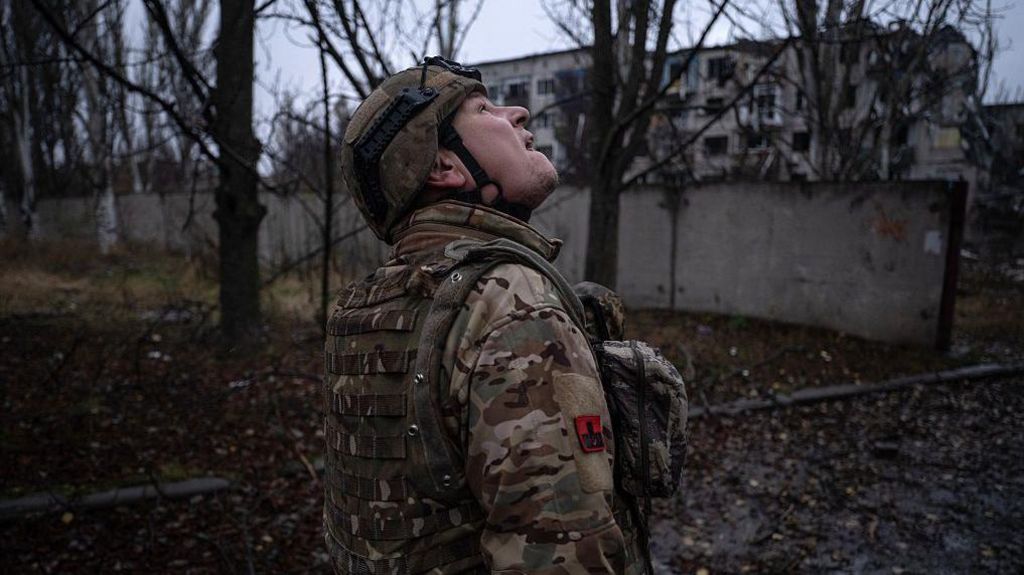
Deep in the desolate frontline landscape outside Kostyantynivka, one of eastern Ukraine’s most hotly contested hotspots, a Ukrainian infantryman known only as Kenya sat trapped in a cramped forward foxhole for 225 straight days. Cut off from rotation by the constant, deadly threat of Russian surveillance and attack drones, five attempted relief efforts by his unit failed to reach him. By the time he finally escaped, months of immobility had left his muscles so atrophied he could barely stand, requiring a grueling two-day, 11-kilometer trek through minefields and under constant drone watch to reach the safety of his 93rd Brigade headquarters.
Kostyantynivka has emerged as a critical linchpin in Russia’s long-stated campaign to seize full control of the Donbas region, a priority goal Moscow has targeted for completion this year, according to Ukrainian intelligence. If the strategic city falls to Russian forces, it will open up three-pronged access from the north, east, and south to the last remaining major Ukrainian strongholds in Donbas: Kramatorsk and Sloviansk. President Volodymyr Zelenskyy has warned that the Kremlin is preparing a large-scale new offensive this summer to push for these gains. Still, Russia’s advance has slowed considerably in recent months: Ukrainian conflict monitoring outlet DeepStatedata reports that Russian territorial gains in Donbas fell by half between March and April 2026, to just one-sixth of the territory Moscow captured in December 2025. The U.S.-based Institute for the Study of War further notes that Russia lost more territory than it gained in Ukraine last month, in part due to renewed Ukrainian strikes on Russian supply lines and logistics networks.
For the soldiers of the 93rd Brigade tasked with holding Kostyantynivka’s outskirts, the current conflict represents a striking paradox of 21st-century warfare. While drones have replaced mass tank assaults and large infantry charges as the primary source of firepower and surveillance, the fundamental rule of warfare remains unchanged: no territory can be permanently held without boots on the ground. Drones cannot seize and hold fortified positions, control high ground or strategic river crossings, so small teams of infantry are still required to garrison forward outposts in the so-called “kill zone” — a wide, unpopulated grey area along the front where every moving object is hunted by remote-controlled drones from both sides.
In this new landscape of combat, speed matters far more than heavy armor for survival. Assaults are no longer carried out by massive columns; instead, small teams of two or three soldiers cross open terrain on foot, motorbikes, bicycles, or even horseback to avoid detection. For the troops stuck in forward dugouts, daily life is a relentless battle against deprivation and fear. All overland supply routes to the kill zone are cut off, so food and ammunition must be ferried in by small delivery drones — a precarious system that often fails when drones are shot down or jammed, leaving garrisons with intermittent supplies. Kenya told reporters that mice infested his foxhole, gnawing through all non-canned food stores, and the most critical shortage his unit faced was clean drinking water. For him, a rare rainstorm was a moment to remember: it let him strip down and wash after months without clean water. During the winter, when temperatures plummeted to -25°C, worn-out sleeping bags offered little protection against frozen ground and concrete basement floors. Khani, another 93rd Brigade soldier who spent 122 days in a forward outpost, lost a comrade to hypothermia during the cold snap.
Khani’s own story of survival illustrates the constant, close-quarters danger these troops face. His position in the basement of a ruined two-story home was detected by Russian drones, which directed heavy artillery fire to collapse the building. When Russian troops approached, Khani and his partner opened fire, triggering a coordinated assault: drone strikes, followed by a fiber-optic guided drone that infiltrated the basement before becoming tangled in its own wiring. Khani disabled the drone by shooting its cable reel, cutting its connection to the Russian pilot. Two Russian soldiers then stormed the remains of the basement, detonating anti-tank mines to collapse the entrance and leaving the pair for dead. The two men escaped via a hidden emergency exit they had dug months earlier. Another soldier, Granata, who recently exited the front after 110 days of garrison duty, recalled an incident where Russian forces used a gas-filled explosive to force his team out, leaving his partner severely wounded.
Even as Ukraine targets Russian logistics to slow the impending summer offensive, frontline infantry like Kenya, Khani and Granata remain the backbone of Ukrainian defense in Donbas. Every time troops leave their dugouts for rotation or resupply, they risk their lives, and even basic movement requires hiding from thermal cameras with short-lived anti-drone cloaks that last barely 20 minutes. “Every time when we had to come out of our positions, we prayed we would come back alive,” Kenya said. Without these small, exposed garrisons holding every kilometer of the front line, Khani says, the entire defensive line would crumble. The experience of these soldiers confirms that even in an era of AI-guided drones and remote warfare, the human cost of holding territory remains as high as ever.