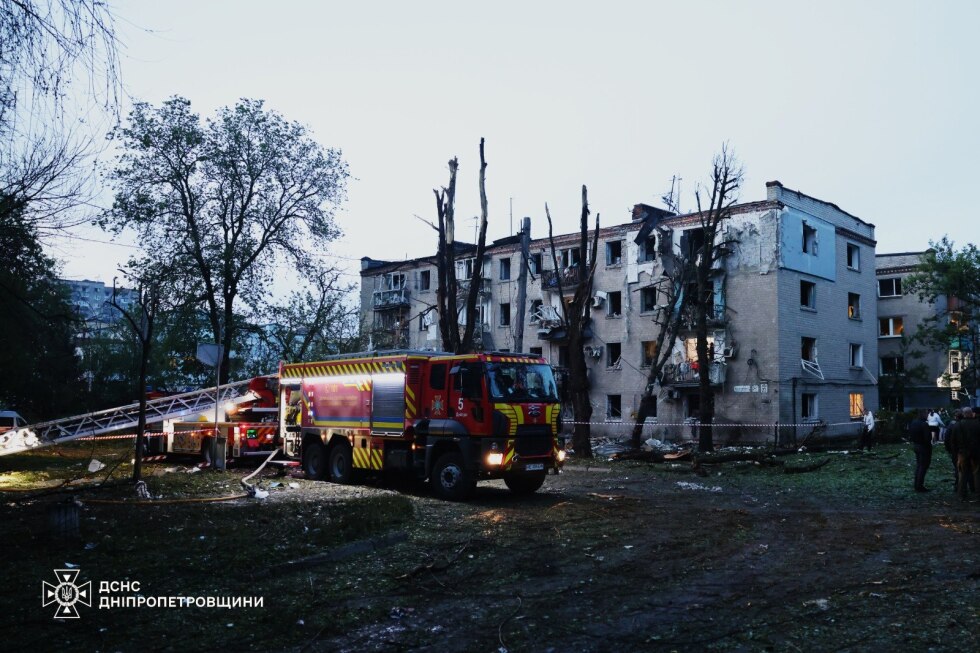
Fresh waves of large-scale reciprocal long-range strikes between Russian and Ukrainian forces have sent civilian casualty numbers climbing and ratcheted up tensions in the more than four-year full-scale invasion, just days before Russian President Vladimir Putin’s scheduled meeting with Chinese President Xi Jinping in Beijing.
Ukrainian President Volodymyr Zelenskyy confirmed Monday that Russian forces launched a massive overnight aerial assault across eight Ukrainian regions, deploying a total arsenal of 524 attack drones alongside 22 ballistic and cruise missiles. The central Dnipropetrovsk region, anchored by the major city of Dnipro, absorbed the heaviest blow from the barrage, with bombardment persisting for six consecutive hours that targeted both energy infrastructure and residential areas. Ukraine’s State Emergency Service reported at least 26 wounded civilians across the region, including two children. Additional structural damage and casualties were recorded in Ukraine’s Odesa, Chernihiv, and Zaporizhzhia regions, bringing the total number of injured civilians across the country to more than two dozen, including three children overall. This latest attack follows a string of intensifying large-scale Russian strikes that gained momentum after a brief May 9-11 ceasefire called at the request of former U.S. President Donald Trump, a proposal that failed to produce any lasting reduction in hostilities. Just one week prior, a multi-day Russian bombardment flattened a residential apartment building in Kyiv, killing 24 people. To date, U.S.-led diplomatic efforts to broker a lasting peace settlement have yet to yield tangible progress, with no formal negotiations or draft agreement currently in development.
The escalation is not one-sided: just one day before Russia’s latest attack, Ukraine carried out one of its largest cross-border drone strikes on Russian territory to date. Russian local authorities confirmed Sunday that the attack killed at least four people, three of whom died in suburbs near Moscow, and left a dozen more injured. Over more than four years of full-scale conflict, Ukraine has methodically built up its domestic long-range strike capabilities, allowing it to consistently target key assets deep inside Russia, including critical oil infrastructure that forms the backbone of the Russian federal budget. These deep strikes have drawn widespread attention from the Russian public and increased domestic pressure on Putin, who made the questionable claim earlier this month that the war was nearing its conclusion even as his ground forces struggle to secure significant territorial gains across the front line.
Zelenskyy framed these expanding capabilities as a transformative turning point in the conflict. In a post to the social platform X Sunday evening, he noted, “Our long-range capabilities are significantly changing the situation — and, more broadly, the world’s perception of Russia’s war. Many partners are now signaling that they see what is happening and how everything has changed — both in attitudes toward this war and in the reachability of Russian targets on Russian territory.”
Russian defense officials pushed back on Sunday, announcing that their air defense systems had intercepted or jammed more than 1,000 Ukrainian drones over the preceding 24-hour period, with roughly 80 of those unmanned vehicles headed toward the Moscow region. Separately, the ministry confirmed Monday that between late Sunday and early Monday, air defenses shot down a total of 50 Ukrainian drones across multiple regions.
The rising violence comes as Putin prepares to travel to Beijing this week for high-level talks with Xi. In the years since Russia launched its full-scale invasion, political and economic cooperation between Moscow and Beijing has deepened substantially, even as most Western nations have moved to diplomatically and economically isolate the Kremlin.
This reporting draws from on-the-field contributions from AP correspondent Henry Hatton, based in Lisbon, Portugal. Full coverage of the Russia-Ukraine conflict is available on AP News’ dedicated conflict hub.