In an underground command center tucked away from Russian surveillance, the head of Ukraine’s unmanned combat forces, Robert Brovdi — who goes by the call sign “Madyar” — spends his days mapping out a growing campaign of long-range strikes deep inside Russian territory. For Brovdi, these escalating attacks are not just military strategy: they are deliberate retribution for Moscow’s full-scale invasion of Ukraine.
In an exclusive interview with Agence France-Presse conducted ahead of one of the war’s largest drone barrages, Brovdi laid out the strategic logic and expanding scope of Ukraine’s deep-strike campaign. In the wave of attacks that followed the interview, Kyiv launched nearly 600 drones across Russia, leaving four people dead.
Brovdi and other Ukrainian officials frame the strikes as a targeted effort to undermine Russia’s war capacity, prioritizing two key types of infrastructure: defense manufacturing sites and oil storage and processing facilities. By crippling these assets, Ukraine aims to cut off the resources Russia relies on to sustain its invasion.
“All sources that fund Putin’s war effort have become legitimate, priority military targets anywhere in the occupying country’s territory, from the south to the Urals and even Siberia,” Brovdi stated.
Over the past several months, Ukraine has dramatically expanded its deep-strike operations, launching attacks more frequently and hitting targets farther from the shared border than ever before. Kyiv estimates that attacks on major sites including the ports of Tuapse and Primorsk have caused billions of dollars in damage, while Russian officials have confirmed multiple civilian and military casualties from the strikes.
Brovdi identified three core drivers behind Ukraine’s new, more aggressive approach to cross-border strikes: greater access to resources to build and deploy long-range drones, a deliberate strategic shift to disrupt Russia’s war machine at its source, and the gradual weakening of Russia’s integrated air defense network.
“The enemy built a multi-layered wall of air defenses, and we had to cut a door through it to get inside,” he explained. Starting in December 2025, his forces launched a systematic campaign to pick apart Russian air defense systems, prioritizing their destruction to clear a path for deeper strikes. While Brovdi acknowledged that destroying the entire national air defense network remains a distant goal, he said the campaign has already yielded tangible results.
“We’ve gotten to the point that there isn’t much more air defense left to destroy to open up access to almost all of Russian territory,” he said. “With such a vast land mass full of high-value sensitive targets, the enemy can never predict where we will strike next.”
Ukrainian President Volodymyr Zelensky has defended the cross-border strikes as a legitimate right of self-defense, following a massive Russian missile attack on Kyiv earlier this month that killed 24 civilians.
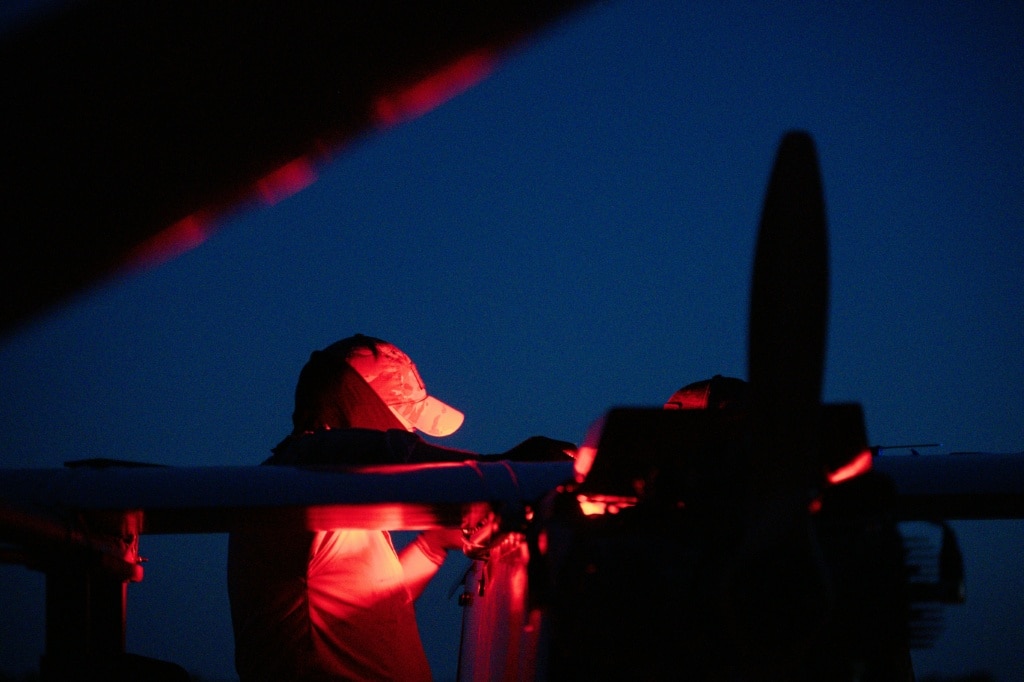
On the night of the large-scale barrage that followed Brovdi’s interview, AFP reporters on the ground observed Ukrainian drone operators preparing long-range unmanned aerial vehicles for launch in total darkness, working only by the faint glow of red flashlights. The drones, which resemble small fixed-wing aircraft, lifted off into the night leaving trails of orange flame behind them. After the attack, Ukraine’s Security Service (SBU) confirmed that the strikes demonstrated even the heavily fortified Moscow region is no longer beyond Ukraine’s reach.
The growing threat of Ukrainian strikes has already caused palpable disruption in Russia. Earlier this year, Moscow significantly scaled back its annual May 9 Victory Day parade, the country’s most important symbolic military celebration. For the first time in almost 20 years, no military hardware was displayed along Red Square. Russian authorities had previously warned Kyiv against striking the celebration, threatening severe retaliation — until former U.S. President Donald Trump announced a three-day ceasefire would take effect, paired with a planned major prisoner swap of 1,000 POWs from each side.
Brovdi explained his decision to hold off on planned strikes targeting the parade celebrations, posing a rhetorical question about the trade-offs of such an attack: “Is a dramatic image of explosions in the heart of the war, in central Moscow, worth more than 1,000 lives that could be saved in the prisoner swap? Is it worth risking our relationship with the Americans?” A delay of just a few days made no meaningful difference to the overall campaign, he added.
Looking ahead, Brovdi vowed that Ukraine would continue its campaign of strikes without letup, relying on unpredictability to keep Russian defenses off balance. “Surprise is like that children’s shooting gallery game, where the bunny pops up out of different windows one after another — you have to be fast to catch it,” he said. “We will fight relentlessly.”