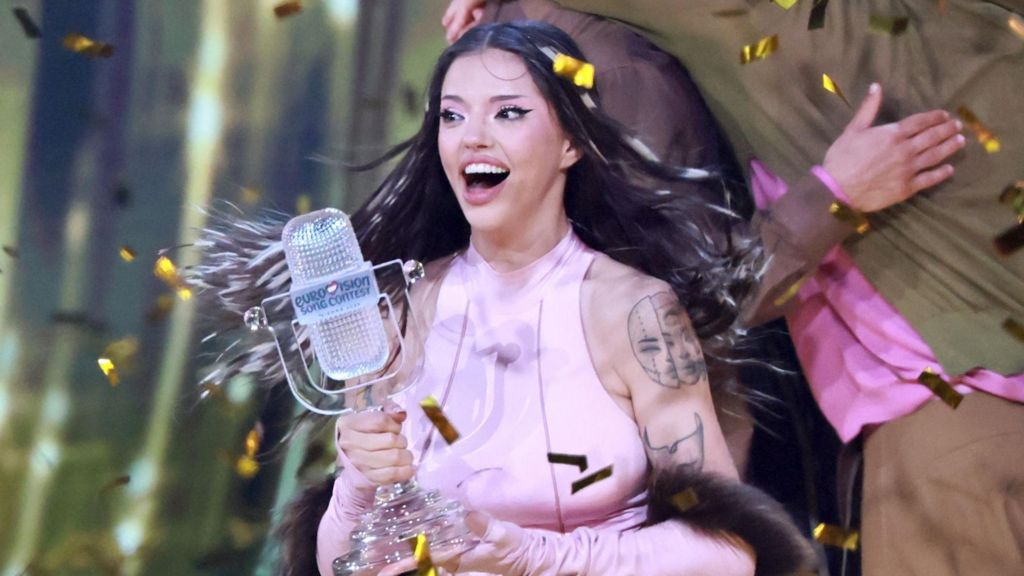
The 2026 Eurovision Song Contest, held in Vienna to mark the iconic competition’s 70th platinum anniversary, delivered a stunning upset when Bulgarian pop star Dara claimed the nation’s first ever victory with her high-energy dance track *Bangaranga* — a surprise win that capped a night of political tension, unexpected results, and memorable live performances.
Going into the grand final, Dara was far from the favorite to win, with bookmakers having favored Finnish duo Pete Parkkonen and Linda Lampenius for weeks and many commentators tipping Australian star Delta Goodrem to take the trophy. But the 27-year-old Bulgarian talent, already a household name in her home country with more than 80 million combined streams and views and a coaching role on Bulgaria’s *The Voice*, defied all pre-contest expectations. She dominated both the jury and public vote to finish with a massive 516 points, a nearly 200-point lead over second-place finisher Israel’s Noam Bettan. Third place went to Romania’s Alexandra Căpitănescu, followed by Goodrem and Italy’s Sal Da Vinci to round out the top five.
Beyond its catchy, unforgettable chorus and high-impact choreography, *Bangaranga* carries a deeply personal meaning for Dara. The track’s title, often mislabeled as just another whimsical Eurovision nonsensical phrase, translates to “uproar” in Jamaican patois, and its lyrics explore her journey managing anxiety and ADHD, a diagnosis she received just one year prior. Her dynamic performance drew inspiration from Bulgaria’s ancient Kukeri tradition, where masked performers drive out evil spirits, with whiplash-inducing choreography that earned her the pre-final award for best staging, voted on by contest commentators including the UK’s Graham Norton. After accepting the crystal microphone trophy, Dara told backstage reporters: “I want to thank everybody who felt the Bangaranga and felt connected to the force.” Bulgarian National Television has since confirmed that the 2027 Eurovision contest will be hosted in the country’s capital, Sofia.
This year’s contest was overshadowed by significant political controversy surrounding Israel’s participation, sparked by widespread anger over the Gaza war’s civilian death toll. Five countries including Spain, Iceland and seven-time winners Ireland boycotted the event, and large public protests were held in central Vienna in the lead-up to the grand final. Anti-Israel chants interrupted Bettan’s semi-final performance, and the singer was booed during the final when he briefly held the top spot on the leaderboard, though no major disruptions marred his performance of the heartfelt Mediterranean love song *Michelle*. Bettan ultimately held on to secure second place.
For the United Kingdom, the contest brought another disappointing result, marking the third time since 2020 that the nation has finished in last place. UK entry Look Mum No Computer, a YouTube creator best known for building unusual musical contraptions, earned just one single point for his synth-driven track *Eins, Zwei, Drei*. The artist had pre-emptively acknowledged the song’s divisive appeal, calling it “Marmite — you either love it or hate it”, and maintained a positive attitude after the results, saying “I always say to expect nothing, because if you expect nothing, you lose nothing.” Norton noted after the final that “He gave it his all, it just clearly didn’t shine with the audiences across Europe.”
Several other unexpected moments shaped the night’s competition. Pre-contest favorites Parkkonen and Lampenius failed to meet expectations, their duet *Liekinheitin (Flamethrower)* finishing in sixth place, outside the top five. Goodrem, tipped to become Australia’s first ever Eurovision champion, delivered a viral vocal performance of her power ballad *Eclipse* from a stage platform borrowed from Beyoncé, but the track was ultimately seen as too dated to claim the top spot, finishing fourth. Romania’s Căpitănescu faced controversy over her track *Choke Me*, with campaigners accusing the song of glorifying sexual violence, but the artist explained the track is actually about the suffocating weight of self-doubt. Her nu metal-influenced performance resonated with voters, pushing her to a surprise third-place finish.
A minor technical disruption interrupted Czech entrant Daniel Žižka’s performance, when a camera error distorted the video feed and briefly cut away from the singer. Žižka requested an opportunity to restart his performance, but contest organizers declined, noting that the audio and core performance had not been affected by the “small camera issue”.
To mark the 70th anniversary of the contest, which launched in 1956 as the European Grand Prix with just seven participating nations, organizers put together a star-studded tribute to seven decades of iconic Eurovision music. Former winners joined special guests to reimagine classic hits: Finnish rock winners Lordi performed a heavy metal rework of Brotherhood of Man’s *Save Your Kisses For Me*, Ukrainian icon Verka Serduchka delivered a playful version of Sandie Shaw’s *Puppet On A String* accompanied by an Oompah band, Finnish star Erika Vikman recreated ABBA’s iconic 1974 winning performance of *Waterloo*, and Norwegian winner Alexander Rybak gave Cliff Richard’s *Congratulations* a hoedown twist. The tribute closed with a mass audience singalong of *Nel blu, dipinto di blu*, the 1958 Italian winner that has sold more than 18 million copies worldwide, and remains the only Eurovision track to ever top the US Billboard charts.
Across the 26 competing entries, the 2026 final showcased a wide range of themes and styles, from the opening number from Denmark’s Søren Torpegaard Lund that set a tone of raw passion, to Croatia’s folk band Lelek, who told the untold story of Catholic women’s resistance during the Ottoman Empire through haunting harmonies and symbolic face paint. Lithuania’s Lion Ceccah delivered a commentary on algorithmic culture, painting his entire body silver to illustrate his message of reclaiming humanity from digital systems, while Greece’s Akylas wove a sweet story of working to lift his parents out of poverty into a high-energy techno performance full of theatrical stunts.