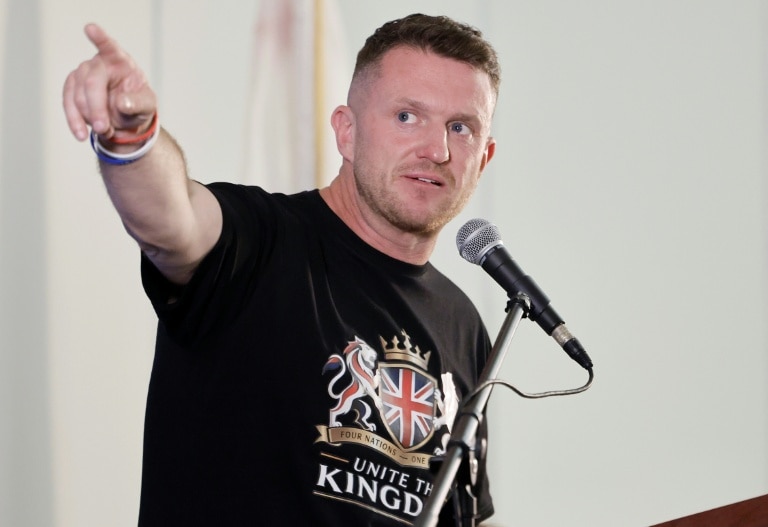
On a busy Saturday in central London that also hosted English football’s iconic FA Cup Final, dual large-scale demonstrations – one organized by high-profile far-right figure Tommy Robinson, and a counter-rally merging pro-Palestine activism and anti-fascism – drew tens of thousands of attendees, requiring one of the largest UK police deployments in recent memory.
London’s Metropolitan Police Service (Met) had prepared extensively for the dueling events, pre-positioning 4,000 officers supported by mounted units, canine teams, surveillance drones and helicopters to separate the rival crowds and prevent public disorder. The force estimates the entire security operation will cost £4.5 million (approximately $6 million), marking an unprecedented investment in protest policing for a domestic demonstration. In a new regulatory move, organizers have for the first time been held legally responsible for ensuring invited speakers do not violate UK hate speech legislation, with police announcing a strict zero-tolerance policy for any violence, harassment or hate speech.
Robinson, whose real name is Stephen Yaxley-Lennon, a former football hooligan turned anti-Islam activist who has gained massive online traction in recent years, organized the event billed as the “Unite the Kingdom” march, which set off from Holborn in central London. Ahead of the rally, the UK government barred 11 foreign far-right agitators from entering the country to attend, including U.S.-based extremist Valentina Gomez, who authorities condemn for repeated inflammatory, dehumanizing rhetoric targeting Muslim communities. Early Saturday morning, officers arrested two men en route to Robinson’s rally who were wanted on suspicion of grievous bodily harm linked to a Birmingham incident where a man was hit by a vehicle; no further details have been released about that case.
Many attendees of Robinson’s rally framed the event as a patriotic gathering centered on British national culture, with multiple participants describing their presence as a stand against current UK immigration policies, which have drawn widespread public anger over the tens of thousands of migrants crossing the English Channel in small boats each year. Natasha, a 44-year-old attendee draped in a Union Jack and wearing a Union Jack-patterned bucket hat, told reporters “it’s nice to be around my own culture,” calling the event patriotic and denying any racist intent. Justin, a 56-year-old from Essex who declined to share his last name, echoed that framing, confirming that immigration was a core issue driving attendance. This rally follows a September 2023 event organized by Robinson that drew up to 150,000 people to central London, a shocking turnout for the far-right that featured a video address from X (formerly Twitter) owner Elon Musk. That event ended in clashes that injured dozens of police officers, pushing the far-right’s growing influence into the national spotlight.
Across the capital, the competing counter-demonstration combined three separate initiatives: a commemoration of Nakba Day, which marks the 1948 displacement of Palestinians during the founding of Israel; a pro-Palestine protest; and an anti-fascism rally organized by the group Stand Up to Racism. The Met projected an estimated 30,000 people would attend this combined event, which began in west London before marching toward central London. Simon Ralls, a 62-year-old attendee from Nottingham, explained his participation as a direct response to the growing confidence of far-right groups in the UK. “The right (wing) are emboldened — we’re here to try and counter that, make sure people aren’t ignorant,” he told reporters ahead of the march.
The dual demonstrations come amid heightened domestic security tensions in the UK. Just two weeks prior, the country’s terrorism threat level was raised to “severe” – the second-highest possible level – with security officials citing growing risks from both Islamist extremism and extreme right-wing terrorism. The events also follow a recent string of violent anti-Semitic attacks targeting London’s Jewish community, a wave of violence that some have linked to hostile rhetoric at pro-Palestine rallies across the country. To boost security, police are deploying live facial recognition technology for the first time ever at a UK protest, a move that has sparked debate over privacy and surveillance even as authorities defend it as a necessary public safety measure.
Adding to the strain on policing resources, the FA Cup Final – one of the biggest dates on the UK football calendar – kicked off at Wembley Stadium at 4 pm GMT, drawing tens of thousands of football fans to the capital just miles from the protest routes. Prime Minister Keir Starmer spoke out a day before the demonstrations, issuing a strong warning that “anyone who sets out to wreak havoc on our streets, to intimidate or threaten anyone… can expect to face the full force of the law.” Starmer explicitly condemned organizers of Robinson’s rally, accusing them of “peddling hatred and division.” For his part, Robinson has urged attendees to avoid masks, excessive alcohol, and any disruptive behavior, calling on supporters to remain “peaceful and courteous.” Police have nonetheless voiced concerns about potential unrest from known football hooligan groups that have a history of supporting Robinson’s events.