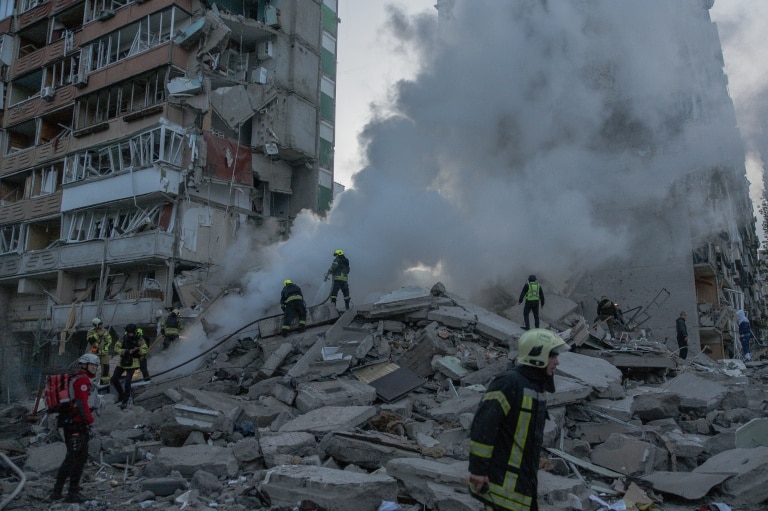
A devastating seven-hour Russian aerial assault on Ukraine’s capital Kyiv earlier this week that killed 24 civilians and left residential buildings in ruins has laid bare a critical and dangerous divide in Ukraine’s air defense capabilities, nearly four years into the full-scale invasion.
After years of constant combat, Ukraine has honed an extremely effective homegrown network to combat Russian long-range drones – a success that has drawn admiration even from advanced global militaries. In this latest wave of attacks, Russia launched 675 drones and 56 missiles targeting Kyiv and other populated areas. Ukraine’s integrated defense system, which combines electronic jamming technology, anti-aircraft artillery, fighter jets and helicopters, and small interceptor drones, managed to shoot down all but 22 of the incoming drones, a 97% success rate. President Volodymyr Zelensky publicly commended his air forces for achieving a 94% overall drone interception rate across recent attacks.
But when it comes to Russian ballistic and cruise missiles, the picture is drastically different. Fifteen of the 56 missiles fired in this week’s barrage penetrated Ukrainian defenses, and Ukrainian officials confirm these missiles were responsible for nearly all of the attack’s civilian casualties and structural damage. This gap exposes a chronic, acute shortage of the advanced Western anti-missile systems and their costly ammunition that Ukraine needs to stop incoming projectiles.
“The real damage was done by missiles, especially in Kyiv,” said Sergii Beskrestnov, an advisor to Ukraine’s defense minister, following the assault. Zelensky echoed the assessment, acknowledging that “the most difficult challenge is defending against ballistic missiles.”
Zelensky has repeated urgent calls to Western allies for additional support, pushing for faster arms deliveries through the PURL procurement platform that partner nations use to source U.S.-made weapons for Kyiv. Shortly after the attack, British Defense Secretary John Healey announced London would speed up deliveries of British air defense and counter-drone systems to Ukraine. But a growing global shortage of anti-missile ammunition, exacerbated by concurrent defense demands in the Middle East, has left Ukraine in a precarious position.
The most capable system Ukraine operates against ballistic missiles is the U.S.-made Patriot battery, whose PAC-3 interceptor missiles cost roughly $4 million apiece. The U.S. only produces around 600 of these interceptors annually, and multiple interceptors are often required to destroy a single incoming missile. Zelensky noted that Middle Eastern allies recently used 800 PAC-3 interceptors to fend off Iranian drone and missile attacks – a total number Ukraine has never had access to across its entire four-year war. One senior Ukrainian official told AFP bluntly that the interceptors “have become harder to find.”
Even before this latest massive barrage, Ukrainian air force spokesman Yuriy Ignat told local media that ammunition was already being rationed due to persistent supply chain issues. “The launchers that are part of certain units and batteries are half-empty — and that’s putting it mildly,” Ignat said, adding that stockpiles were already depleted after Russia’s sustained winter campaign targeting Ukraine’s energy infrastructure. He added that Ukrainian negotiators are often forced to beg allies for as few as five to 10 additional Patriot interceptors at a time.
While short-term solutions remain scarce, long-term and even some medium-term pathways do exist. Ukraine’s proven track record defeating Iranian-designed drones has caught the attention of wealthy Gulf nations, which have faced repeated attacks from the same type of drones. On multiple diplomatic visits to the region, Zelensky has signed several new air defense cooperation agreements, with details still under wraps. He has publicly proposed a trade: Ukraine shares its hard-earned anti-drone expertise with Gulf states, in exchange for Patriot ammunition or investment in Ukraine’s domestic defense production. Lockheed Martin, the manufacturer of the Patriot system and PAC-3 interceptors, has also announced plans to ramp up production over the next seven years to meet global demand. Over time, Ukraine can also expand its own domestic defense production with Western backing.
Yet for the immediate threat Russia poses, options are severely limited, according to Jade McGlynn, a research fellow in the Department of War Studies at King’s College London. “Bluntly I can’t see any significant solution or significant improvement that is available in the short term, beyond just giving Ukraine more of the air defence systems that are a bit more available than the Patriots,” McGlynn told AFP.