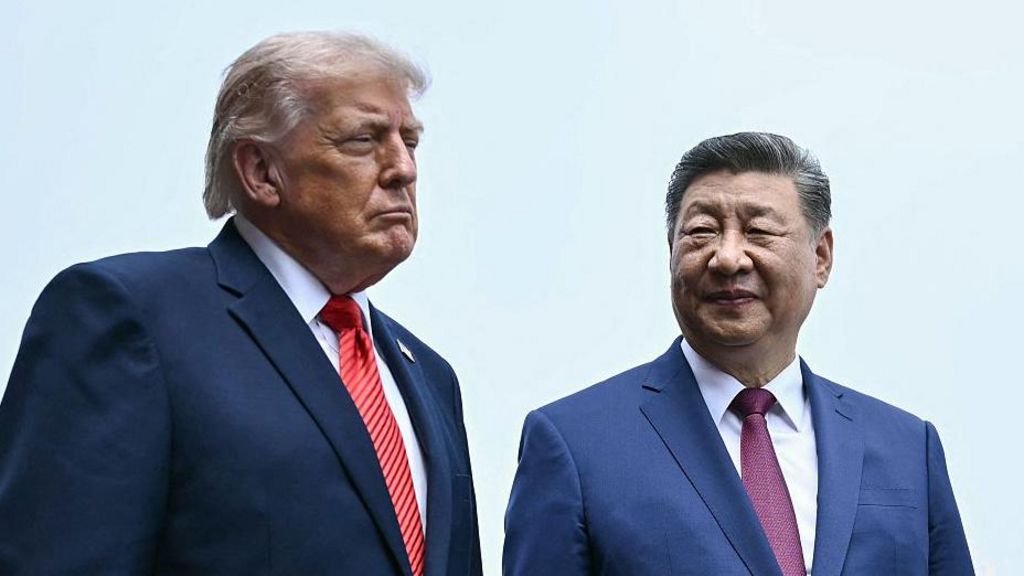
When Air Force One touched down in Beijing on Thursday, the carefully choreographed welcome ceremony immediately set the tone for a US-China summit defined as much by deliberate symbolism as by tangible policy outcomes. What followed was more than two hours of closed-door talks between US President Donald Trump and Chinese President Xi Jinping, a meeting that framed the world’s largest bilateral economic relationship but ultimately failed to deliver the sweeping trade breakthrough many had anticipated.
The most visually striking departure from standard diplomatic protocol came in the order of deplaning: Tesla CEO Elon Musk and Nvidia chief Jensen Huang stepped off the aircraft ahead of senior White House cabinet members, including Defense Secretary Pete Hegseth, Senator Marco Rubio and US Trade Representative Jamieson Greer. Both tech leaders remained close to Trump throughout the official welcome at the Great Hall of the People, a placement that carried unavoidable symbolic weight. Musk and Huang represent the most contentious, high-stakes pressure points in the modern US-China economic relationship: electric vehicles, advanced artificial intelligence, and semiconductor manufacturing. Both companies also maintain deep, high-stakes exposure to the Chinese market. Tesla’s global production and revenue rely heavily on its Shanghai Gigafactory and domestic Chinese consumer demand, while Nvidia’s cutting-edge chips are the backbone of the global AI race, and have been the target of strict US export controls designed to block Beijing from accessing advanced computing capabilities. Notably, Huang was not included on the original US delegation list, a last-minute addition that fueled widespread speculation that AI and semiconductor access would hold a more central place in negotiations than previously publicly disclosed.
Following the talks, both sides offered measured positive framing of the discussions. Trump called the meeting potentially “the biggest summit ever” and described the US-China partnership as “the world’s most consequential economic relationship”, with the White House ultimately characterizing the talks as “highly productive”. For his part, Xi noted that prior bilateral trade negotiations held in South Korea had delivered incremental progress, but paired that acknowledgment with a stark, unprecedented public warning that reshaped the framing of the summit. “If mishandled, the two nations could collide or even come into conflict,” Xi stated of the Taiwan question, according to China’s foreign ministry. This marked a clear shift from past negotiations, where Taiwan was treated as one of several friction points. At this summit, Beijing explicitly framed the Taiwan issue as a core condition for the future of the broader US-China trade and economic relationship. In Beijing’s official readout, Xi emphasized that “the Taiwan question is the most important issue in China-US relations”, and confirmed the two sides had agreed to a “new positioning” for ties centered on “constructive strategic stability”.
Despite the optimistic rhetoric from both sides, no major new trade deals or structural economic agreements emerged from the meeting. The primary tangible outcome was an agreement to uphold the terms of the October trade truce, which saw Washington suspend planned steep tariff increases on a wide range of Chinese goods, while Beijing rolled back restrictions on rare earth exports to the US. Both leaders also agreed to establish a new “Board of Trade”, a permanent bilateral mechanism designed to manage trade frictions without reopening full, high-stakes tariff negotiations. US officials quickly cautioned, however, that extensive technical work remains to be done before the new board becomes fully operational.
US negotiators had entered the summit hoping to see new commitments for increased Chinese purchases of American goods, with a particular focus on Boeing commercial aircraft, agricultural products, and energy exports. US Treasury Secretary Scott Bessent had publicly predicted that “large Boeing orders” would be announced during the visit, and noted that Beijing had signaled it would expand purchases of US agricultural and energy goods. While Xi told a gathering of US business leaders that China “doors will open wider” and that American firms would have “broader prospects” operating in the Chinese market, no firm, concrete details for new purchase commitments were released. Bessent later downplayed expectations of major new agricultural breakthroughs, noting that many existing soybean purchase commitments were already covered under prior agreements, but added that there remains significant room for China to expand imports of US energy, including liquefied natural gas (LNG). US farmers have long sought greater access to the Chinese market for soybeans, beef, and poultry, a goal that remains unfulfilled with no new progress announced at the summit.
Technology and advanced semiconductors remain the deepest unresolved divide between the two powers. The Trump administration’s strict export controls on advanced semiconductors and chipmaking equipment, implemented to slow China’s development of frontier AI capabilities, remain fully in place. Beijing continues to push for loosening these restrictions, while criticizing the controls as an unfair effort to constrain China’s industrial and technological development. Beyond economic issues, Trump also sought Chinese cooperation to stabilize global oil markets amid the ongoing Iran conflict. Volatility in oil prices and repeated disruptions to shipping through the Strait of Hormuz, the world’s most critical energy chokepoint, have driven up import costs for China and pushed global energy prices higher. Trump had publicly stated he hoped China would use its diplomatic influence to encourage Iran to stabilize energy flows through the strait. Chinese readouts confirmed the Middle East was discussed during the summit, but no details of any new agreements or commitments were released.
For US multinational corporations, the summit left the status quo largely intact: China remains one of the world’s largest consumer markets, but continues to present a challenging operating environment shaped by strict regulation, bureaucratic red tape, and persistent geopolitical uncertainty. While the meeting laid the groundwork for a new ongoing trade dialogue, analysts note that core frictions ranging from semiconductor controls to Taiwan’s status remain unresolved, leaving the future of the bilateral relationship uncertain.