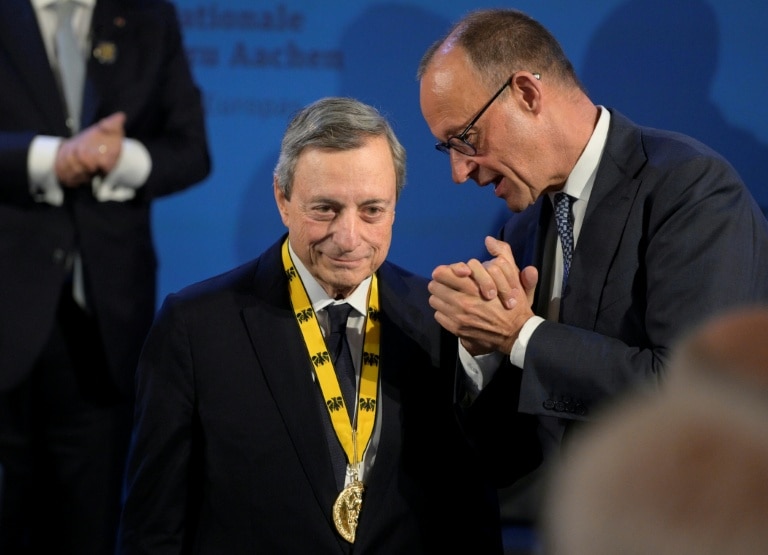
A pivotal debate over the future of the European Union’s long-term budget has taken center stage at the 2026 Charlemagne Prize ceremony in Aachen, Germany, where Chancellor Friedrich Merz has called for sweeping structural reform to align the bloc’s spending with 21st-century challenges. The event, which honored former European Central Bank President Mario Draghi for his decades of work advancing European integration, became a platform for confronting longstanding frictions over EU fiscal policy and competitiveness.
The 27 EU member states are currently locked in tense negotiations over the 2028-2034 multiannual budget. A bloc of so-called frugal nations, led by Germany and the Netherlands, has already pushed back against a substantial spending increase proposed by the European Commission, the EU’s executive body. Speaking at the award ceremony Thursday, Merz, a conservative leader, argued that the EU’s current budget framework is hopelessly outdated. “We cannot meet the challenges of the 21st century with a 20th-century budget,” he declared, echoing growing frustration across the bloc over stagnant budget structures that have not shifted in decades.
Merz backed a landmark 2024 competitiveness report from Draghi, which warned that the EU risks falling behind global rivals the United States and China without a fundamental shift in policy. He criticized that the EU budget’s core content and structure has remained virtually unchanged for generations, with more than two-thirds of all EU funding still allocated to redistribution programs and direct subsidies. For decades, the EU has leaned heavily on these subsidies and redistribution mechanisms to offset economic disruptions from internal trade integration and support less wealthy eastern European member states as the bloc expanded. But Merz argued this model is no longer fit for purpose, calling for an overall reduction in unnecessary budget spending and a major reallocation toward investments that boost EU competitiveness and collective defense.
Despite backing Draghi’s call for increased joint investment, Merz drew a firm line against the funding mechanism Draghi proposed: collective debt issuance by all EU member states. “Excessive indebtedness threatens sovereignty and limits the capacity to act,” Merz stated. Analysts widely note the comment also carries weight for domestic German politics, where the country relaxed its long-standing strict constitutional “debt brake” rules only last year, after years of adhering to rigid fiscal limits, to fund increased defense and infrastructure investment.
In his acceptance speech for the Charlemagne Prize, which recognizes individuals who work to advance European unity, Draghi offered a sharp critique of the bloc’s overreliance on external free trade deals as a growth driver — a long-standing priority for German economic policy. Draghi argued that pursuing new trade agreements is far easier than tackling “unfinished work at home,” a reference to the EU’s incomplete single market. He noted that reform requires confronting entrenched vested interests that benefit from fragmented energy markets and an incomplete single market, choices European leaders have long avoided.
Draghi, who also served as Italian prime minister from 2021 to 2022 and led the ECB from 2011 to 2019, is widely credited with preventing the collapse of the euro during the 2010s eurozone debt crisis. His successor at the head of the ECB, Christine Lagarde, reinforced his calls for urgent action in a speech delivered the night before the ceremony, noting that global competition has shifted dramatically. “The United States and China have entered a new age of industrial strategy and geopolitical competition — intensified by tariff wars and rare-earth battles — and all this amid the worst energy crisis on record,” Lagarde said, echoing Draghi’s warning that the EU must act fast to avoid falling behind in global competitiveness.