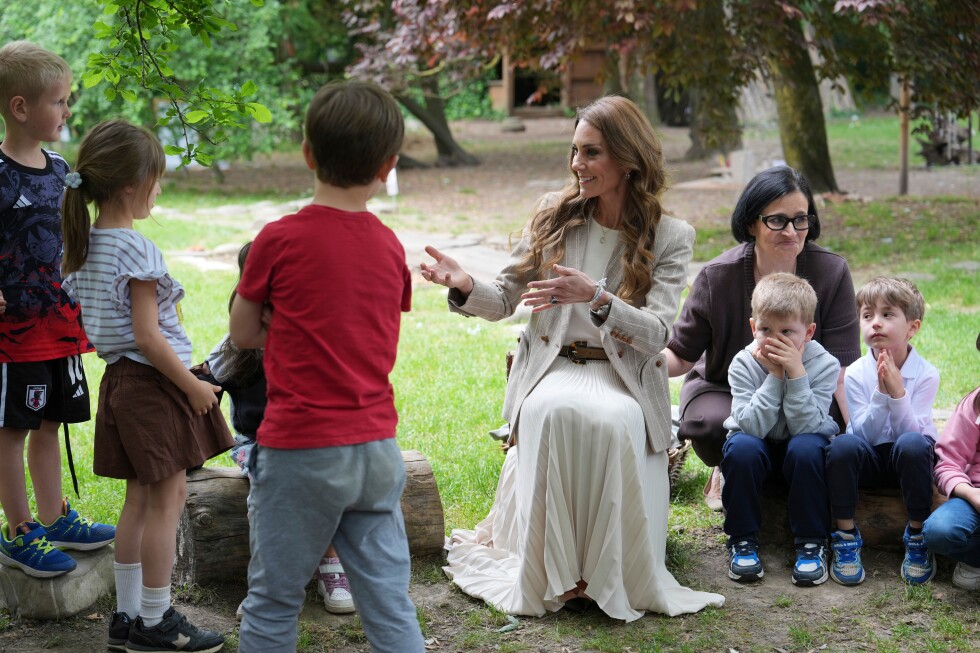
When the Princess of Wales touched down in northern Italy for her first solo international trip following her cancer remission, she did not come for a simple ceremonial visit. Instead, her two-day tour of preschools in Reggio Emilia has pulled back the curtain on one of the world’s most revolutionary early childhood education models, a framework that upended conventional ideas about how toddlers learn and continues to spark debate about educational standardization decades after its founding.
For Catherine, who has centered her public advocacy on early childhood development, the trip offered a first-hand look at a philosophy that aligns perfectly with her policy priorities. “I love that you put children and childhood at the heart of the community, and I’m really fascinated to learn more about it,” she told local educators during her Wednesday arrival at one of the city’s flagship preschools. On Thursday, she joined young students in the garden at Reggio Emilia’s Salvatore Allende daycare, kneeling in the grass to examine insects with a magnifying glass and even letting a slimy wild newt crawl across her open palm, noting that similar newts are found in gardens back in her home country.
The Reggio Emilia Approach, as it is formally known, is rooted in a child-first philosophy that stands in stark contrast to the test-heavy, standardized early education frameworks common in the U.S. and United Kingdom. Unlike traditional models that cast teachers as lead instructors, Reggio frames educators as facilitators who guide children’s curiosity, rather than dictating lesson plans. The approach also requires active participation from parents and the local community, centering early learning as a collective public responsibility rather than a private individual pursuit. Partially built on the foundations of the earlier Montessori method, another Italian-origin educational philosophy, Reggio has spread to every corner of the globe, but it remains unevenly adopted even in its home country.
Its origins stretch back to the immediate aftermath of World War II, when Reggio Emilia, a hub of anti-Fascist resistance left decimated by conflict, began the slow work of rebuilding. A group of local mothers, eager to create a safe space for children while the rest of the community rebuilt their lives and livelihoods, banded together to launch a new preschool. “They sold the metal from a abandoned German tank for funds and they hand-carried stones from the nearby river to reconstruct a place for the children to be cared for,” explained Margie Cooper of the North America Reggio Emilia Alliance. That grassroots effort caught the attention of innovative pedagogical scholar Loris Malaguzzi, who expanded on Montessori and other early 20th century educational reform movements to formalize the Reggio framework for children aged 0 to 6.
At the time, Malaguzzi’s core argument — that young children hold inherent curiosity, existing capabilities, and unique perspectives worth centering — was radical. Mid-20th century conventional wisdom viewed children as incomplete adults-in-training, with no valuable knowledge or skills of their own. Malaguzzi captured the philosophy in a iconic poem that became the movement’s manifesto, arguing that children communicate and understand the world through hundreds of forms of expression: drawing, painting, dancing, singing, play, and exploration, not just written or verbal instruction.
The approach quickly spread to other progressive, left-leaning municipalities across northern Italy, but faced decades of political pushback from Rome’s national government, which was led by conservative Christian Democrats until the 1990s. Historians attribute that resistance to Reggio’s deep roots in the communist-led resistance movement of Reggio Emilia. Today, that old political opposition has faded, but adoption remains uneven across Italy. Cash-strapped local governments often lack the funds to invest in specialized teacher training required for the model, so expansion is largely left to individual educators who seek out training on their own, explained Elisabetta Nigris, professor of didactic programs and evaluation at the University of Studies Milan-Bicocca.
Unlike many traditional early education settings, Reggio classrooms prioritize natural materials, open green space, and long-term student-teacher relationships: children typically stay with the same teacher for multiple years, rather than moving between instructors each academic year. Students often help prepare meals, and outdoor exploration and art are core components of daily learning. Research from University of Chicago senior researcher Sylvi Kuperman, who published a 2017 study of Reggio outcomes in Italy, has found measurable long-term benefits: children who attended Reggio early education programs saw higher high school graduation rates and better employment outcomes in adulthood compared to peers who did not have access to formal early childcare.
Still, even for Italian parents who experienced rigid rote learning in their own childhoods, the lack of structured test preparation can cause anxiety, particularly as children approach age 5 and primary school. “When the children are 3 or 4, they’re totally fine with it. And then when they hit 5, they (the parents) start getting a little twitchy because they’re thinking about Grade 1,” where children are expected to sit still for extended periods and master formal reading and writing skills, said Kathryn Ramsay, a veteran early childhood educator who runs a Reggio-inspired bilingual program north of Rome.
Ramsay’s center, called Wild Joy, embodies the modern Reggio approach: a sprawling grassy outdoor space replaces traditional playground equipment, with no bright branded posters or rigid classroom layouts. Most learning happens outside, at a “mud kitchen” play area, a digging pit, and a large rock climbing slide. Ramsay argues that unstructured child-led play is actually the best preparation for formal academic skills, because it teaches children to focus by following their own curiosity. “They don’t learn to concentrate by being told what to concentrate on. They’re learning to concentrate by having the freedom to be able to follow their own interests,” she said.
For the United Kingdom, Catherine’s visit carries particular significance, because the Reggio Approach is not formally recognized in UK national education policy, and the vast majority of British early childhood programs are run by for-profit private organizations, explained Peter Moss, emeritus professor at University College London’s Institute of Education. Moss added that while the model is influential, its origins in post-Fascist reconstruction make it difficult to replicate elsewhere. “Reggio Emilia is a reaction to 20 years of authoritarian rule under Mussolini and, after that fell, of course a lot of places in Italy were asking the question ’How do we make sure that never happens again?’” he noted, pointing out that the child-centered, community-focused model was intentionally designed to foster democratic values from a young age.