BEIJING – When former U.S. President Donald Trump launched the most intensive segment of his official visit to China on Thursday, diplomatic observers and policymakers on both sides entered the diplomatic summit braced for more symbolic spectacle than substantive progress. Key sticking points from bilateral trade to U.S. policy toward Taiwan and the ongoing conflict in Iran have created low expectations for landmark agreements, even as the visit unfolds against a backdrop of carefully curated ceremonial pageantry.
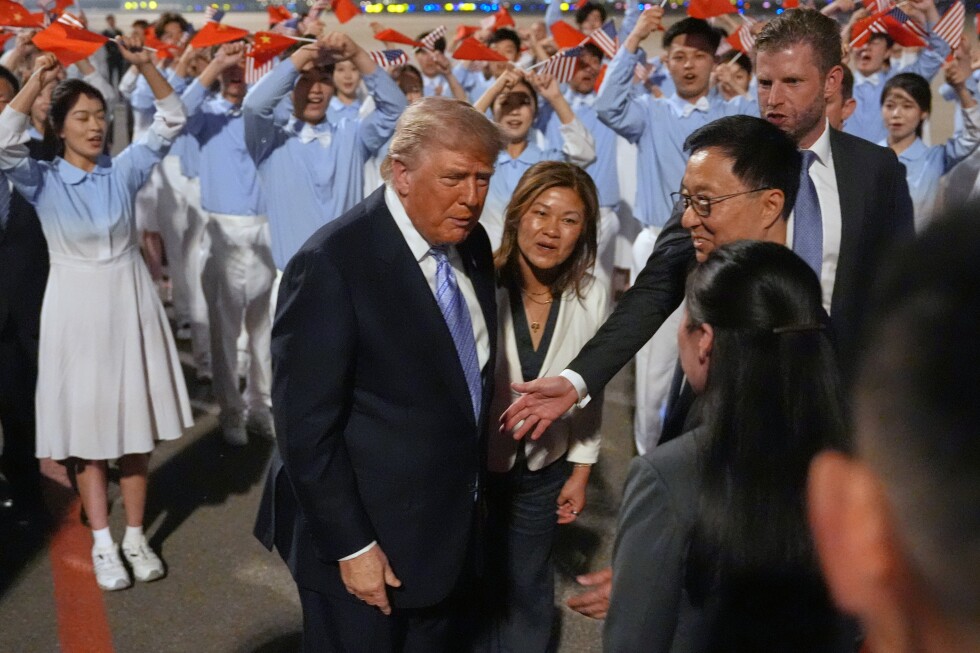
Trump’s arrival in the Chinese capital Wednesday evening opened with an elaborate formal welcome ceremony. His motorcade processed down central Beijing thoroughfares lined with alternating American and Chinese national flags, past towering skyscrapers illuminated with large red Chinese characters reading “Beijing Welcome.” After the procession, the U.S. president traveled to his downtown accommodation with no public engagements scheduled for the rest of the evening.
On Thursday, Chinese leader Xi Jinping is scheduled to meet Trump for an official welcoming ceremony at the Great Hall of the People, China’s top legislative venue located on the western edge of Tiananmen Square, which also hosts major state and cultural events. Following the opening ceremony, the two leaders will hold a one-on-one bilateral working meeting, after which Trump will tour the Temple of Heaven, a 15th-century imperial religious complex once used by Ming and Qing dynasty emperors to perform annual rituals for good harvest, that carries deep symbolic meaning for traditional Chinese concepts of cosmic order. The day will conclude with a formal state banquet hosted in Trump’s honor. A working meeting over tea and lunch is scheduled for the pair on Friday.
The White House has pushed back against low expectations, maintaining that Trump entered the trip with clear goals to secure tangible outcomes before his departure. Senior administration officials have hinted that potential trade-related announcements could come during the visit, including a expected Chinese commitment to increase purchases of American agricultural goods including soybeans and beef, as well as U.S.-manufactured commercial aircraft. The Trump administration is also pushing to formalize a new bilateral Board of Trade designed to address longstanding commercial frictions between the two global economic powers through ongoing structured dialogue.
Yet concrete details of any potential agreements remain elusive, even as geopolitical friction over the Iran conflict adds an extra layer of complexity to talks. China’s longstanding close economic ties to Iran have put Beijing at odds with Washington’s policy goals in the region, creating a major point of tension ahead of the summit.
Trump’s three-day Beijing trip comes as the Iran conflict continues to dominate domestic U.S. political discourse, stoking growing fears of economic weakness in the U.S. as the country enters a heated midterm election cycle. With November’s congressional elections approaching, Trump’s Republican Party is fighting to retain control of both chambers of Congress, and the economic fallout from the Iran war has emerged as a top voter concern. The U.S.-led conflict with Iran has resulted in the effective closure of the Strait of Hormuz, a critical global chokepoint for oil and natural gas shipments, leaving energy tankers stranded and driving sharp spikes in global energy prices that threaten to undermine global economic growth.
The extended, structured schedule of one-on-one engagement between Trump and Xi, set against the backdrop of formal diplomatic events, will create ample opportunity for the two leaders to tackle the full slate of thorny bilateral and global issues on the agenda. Beyond Iran and trade, those topics include the longstanding dispute over Taiwan and a proposed three-way nuclear arms limitation pact between the United States, China and Russia.
Despite the open agenda, most diplomatic analysts expect little progress beyond ceremonial pleasantries and the mutual public praise that Trump and Xi have exchanged consistently for years. Jim Lewis, a technology policy fellow at the Center for European Policy Analysis, predicted that neither side will make meaningful headway on the two most contentious foreign policy issues up for discussion. “Trump will press the Chinese to help him on Iran. They’ll be unwilling. The Chinese will press Trump to make concessions on Taiwan. We’ll see what we get out of that,” Lewis explained.
Back in Washington, domestic political tensions over the Iran conflict deepened Wednesday, when Senate Republicans again blocked Democratic legislation aimed at ending U.S. hostilities in Iran. The vote saw a rare party break from Alaska Republican Senator Lisa Murkowski, who crossed party lines to vote with Democrats, becoming the third Senate Republican to oppose continued U.S. military engagement in the conflict.
As the world’s largest buyer of Iranian crude oil, China’s position on Iran is a core priority for the Trump administration. Trump has publicly downplayed suggestions that he will push Xi to take stronger action to pressure Iran to reopen the Strait of Hormuz, though senior White House officials have confirmed that the president will make that case to Xi in closed-door negotiations.
The president has also stressed that concerns over U.S. economic fallout will not soften his demands in negotiations over Iran, even amid a fragile current ceasefire. When asked as he departed the White House whether the financial strain on ordinary American households would factor into his Iranian negotiations, Trump responded bluntly: “Not even a little bit.”
“I don’t think about Americans’ financial situation. I think about one thing: We cannot let Iran have a nuclear weapon,” Trump said, adding that he believes “every American understands” that priority.
The Trump administration has struggled to present a consistent public message on inflation and the Iran conflict, however. Vice President JD Vance told reporters Wednesday that Trump remained “laser focused” on tackling inflation, pushing back against the president’s own explicit comments that the U.S. economy was not a factor in resolving the war. When asked about Trump’s comments, Vance claimed, “Well, I don’t think the president said that. I think that’s a misrepresentation of what the president said.”
Discussions over trade and Taiwan are also expected to be tense. The status of Taiwan looms large over the summit: China has long claimed the self-governing island as part of its sovereign territory, and Beijing has strongly objected to U.S. plans to sell advanced military weapons to Taipei. The Trump administration has already approved an $11 billion arms package for Taiwan, but has not yet moved forward with implementing the sale. Trump has also openly expressed greater ambivalence about U.S. commitments to Taiwan, a shift that has sparked widespread speculation about whether he could be open to rolling back American support for the island democracy.
Taiwan is the world’s leading producer of advanced semiconductors, which are critical components for cutting-edge artificial intelligence development. Trump has sought to advance new trade deals with Taiwan that would incentivize increased chip manufacturing within the United States.
Trump personally invited Jensen Huang, CEO of leading chipmaker Nvidia, to join him on Air Force One during a refueling stop in Alaska en route to Beijing. Huang is one of a dozen high-profile CEOs from the technology, defense, finance and agricultural sectors joining Trump’s official delegation. Other senior members of the U.S. delegation include Secretary of State Marco Rubio, Treasury Secretary Scott Bessent, Defense Secretary Pete Hegseth, as well as Trump’s son Eric Trump and daughter-in-law Lara Trump. Tesla and SpaceX CEO Elon Musk, who previously led Trump’s initiative to cut federal staffing and shrink the size of the federal government, is also part of the delegation.
The U.S. and China reached a bilateral trade truce last year that eased tit-for-tat threats of steep new tariffs on each other’s goods. The White House says ongoing discussions have shown mutual interest in extending the agreement, though it remains unclear whether any formal announcement of an extension will come during this visit.
Trump has said he will press Xi to grant greater market access to U.S. firms in China, saying he will urge his Chinese counterpart to “‘open up’ China so that these brilliant people can work their magic.” He is also seeking to extend an existing agreement that allows China to continue exporting rare earth minerals to the United States, a deal that has so far prevented Beijing from restricting global rare earth supplies in response to Trump’s earlier tariff threats.
Senior U.S. officials have also confirmed that Trump will raise the proposal for a three-way nuclear arms pact between the U.S., China and Russia that would place caps on each nation’s nuclear arsenal, an idea that Beijing has previously viewed with open skepticism.
Associated Press writer Seung Min Kim in Washington contributed reporting to this article.