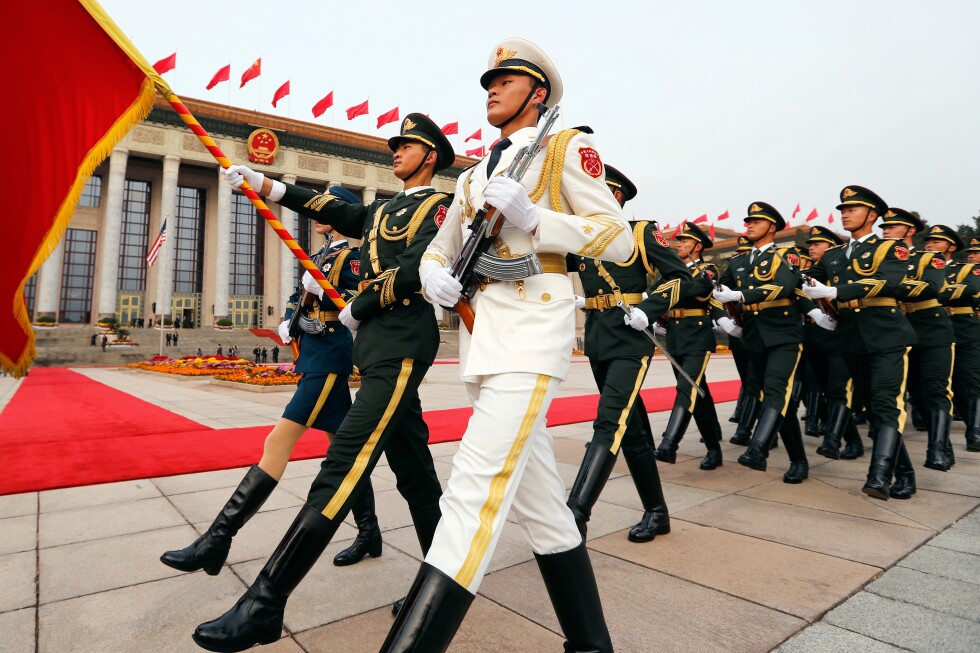
As U.S. former President Donald Trump prepares to touch down in Beijing this Wednesday, global diplomatic observers are fixing their attention not on pre-summit policy leaks or meeting agendas, but on the small, symbolic details of his official reception: which ranking Chinese official will greet him on the tarmac, what ceremonial anthems will be played, and whether young Chinese and American attendees will line the route waving national flags and floral arrangements. In China’s long-standing tradition of hierarchical diplomatic practice, ceremonial protocol carries far more than aesthetic weight—it serves as a deliberate tactical signal of how Beijing views the current state of bilateral ties.
Analysts broadly agree that this year’s welcome for Trump will be warm, flattering and carefully calibrated to appeal to the former president’s well-documented preference for grand pageantry, but it will not match the extraordinary “state visit plus” extravaganza Beijing rolled out for Trump’s first trip to China in 2017. That 2017 event remains unprecedented: it is the only “state visit plus” China has ever extended to a foreign head of state, packed with one-of-a-kind gestures that included a private after-hours tour of Beijing’s Forbidden City Palace Museum, an intimate dinner hosted by President Xi Jinping and his wife Peng Liyuan, and a traditional opera performance in a royal theater that had sat unused for a century. Trump himself has frequently reminisced about the 2017 welcome, praising Xi’s hospitality and highlighting the precision of the honor guard he inspected.
A lot has changed for U.S.-China relations in the nine years since that first visit. What began as a framework defined by broad engagement has shifted into an era of systemic competition, with ties hitting new lows during the height of the U.S.-China trade war and the global COVID-19 pandemic. That shifting context is reflected directly in the scaled-back nature of Trump’s 2025 itinerary. The visit was originally scheduled for the end of March, but it was delayed by the outbreak of the U.S.-Israeli led war in Iran, which has blocked the Strait of Hormuz and sent shockwaves through global energy markets. When Trump finally arrives, his stay will be far shorter than it was in 2017, and first lady Melania Trump will not accompany him. According to Danny Russel, a former senior U.S. diplomat specializing in East Asian affairs, the compressed itinerary has been stripped down to core essential meetings, lasting barely one full day.
That said, analysts emphasize that China still plans to roll out a full red-carpet welcome for Trump, as the U.S. retains a unique position in Beijing’s foreign policy priorities. Just as in 2017, Trump can expect a gold-edged red carpet stretching down the stairs from Air Force One, a 21-gun ceremonial salute, and an inspection of a neatly ranked Chinese People’s Liberation Army honor guard. A formal welcome ceremony will be held with President Xi Jinping in attendance, and the rank of other Chinese officials present will itself be a signal of bilateral priorities.
Beijing has also planned a special, symbolic gesture for this visit that marks a warm welcome, while still falling short of the 2017 “state visit plus” standard. Xi will personally accompany Trump on a private tour of Beijing’s Temple of Heaven, the 600-year-old former imperial ceremonial site where Chinese emperors once prayed for abundant harvests. To accommodate the visit, the entire Temple of Heaven Park will be closed to the public for Wednesday and Thursday, with core attractions including the iconic circular Hall of Prayer for Good Harvests and the Echo Wall closing a day early for pre-visit preparations. This full closure marks a departure from recent practice: earlier this year, when the prime ministers of Britain and Spain visited Beijing’s major historical sites, no full park closure was implemented, and Xi did not personally accompany either leader on their tours.
Russel notes that the pageantry is no accident: it is an open secret across global diplomatic circles that Trump responds far more positively to flattering spectacle than dry policy negotiations. “The pomp and pageantry is designed both to flatter Trump and to pacify him, making him more amenable to Chinese asks and reducing the risk of an embarrassing public confrontation,” he explained.
Beyond flattery, the scaled-back nature of this year’s reception carries its own message. Rush Doshi, C.V. Starr Senior Fellow for Asia Studies at the Council on Foreign Relations and an assistant professor of security studies at Georgetown University who previously served on former President Joe Biden’s National Security Council and helped plan Biden’s 2022 and 2023 summits with Xi, argues that the more muted welcome reflects three key shifts in Beijing’s perspective. “That reflects greater Chinese confidence in their position, greater skepticism of Trump, and the awkwardness of the current relationship,” he said.
The ongoing Iran war has further shifted the bargaining dynamic ahead of the summit, analysts add. The conflict has disrupted global energy supplies and roiled international markets, putting Beijing in a stronger negotiating position as China’s control over key global supply chains and its expanding economic clout give it added leverage. This has already pushed the Trump administration to adopt a far more pragmatic policy approach toward China than many initially expected, experts note.
For Doshi and other China-watchers, every detail of this week’s reception will act as a window into the future of bilateral ties. “China uses diplomatic protocol as a method of signaling favor or disfavor. That is why we should pay close attention to how President Trump is received,” Doshi said.