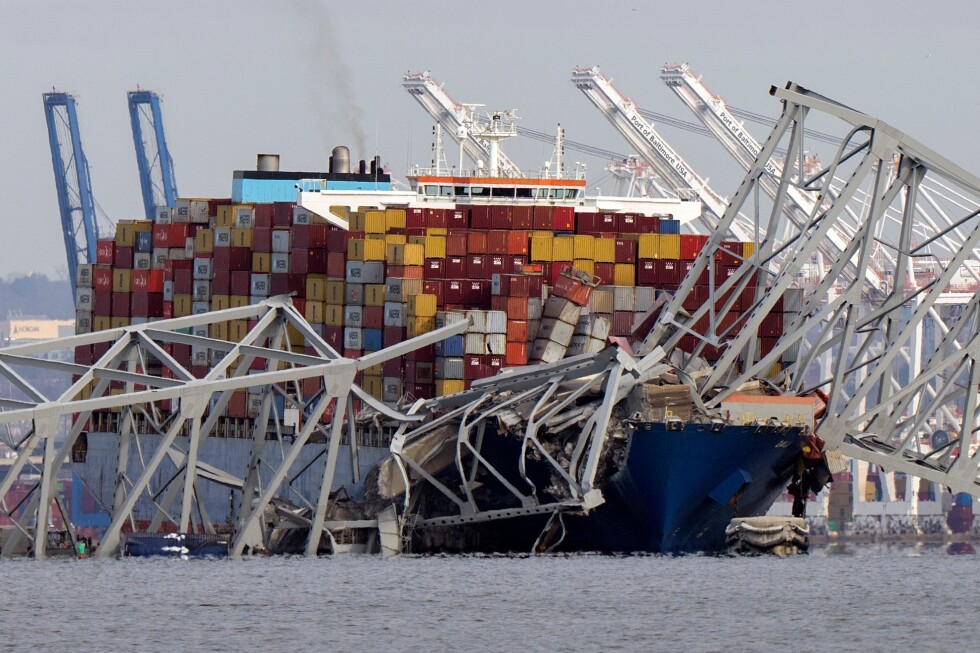
BALTIMORE — Nearly eight months after the catastrophic collapse of Baltimore’s iconic Francis Scott Key Bridge claimed six lives, U.S. federal prosecutors have unveiled criminal charges against two ship management firms and a senior maritime employee, alleging the preventable disaster stemmed from reckless decision-making and systemic failures on the part of the accused.
Announced Tuesday, the indictment names two entities: Singapore-based Synergy Marine Pte Ltd. and Chennai, India-headquartered Synergy Maritime Pte Ltd. Also charged is 47-year-old Indian national Radhakrishnan Karthik Nair, who served as the technical superintendent overseeing the container ship Dali, the vessel that struck the bridge in March 2024.
On the early morning of March 26, the Dali was outbound from the Port of Baltimore en route to Colombo, Sri Lanka, when a sequence of power failures left the massive cargo ship adrift. Investigations from the National Transportation Safety Board (NTSB) later confirmed two overlapping electrical blackouts — one triggered by a faulty loose wire onboard the vessel, and a second caused by unaddressed fuel pump malfunctions — completely disabled the Dali’s steering and propulsion systems. At roughly 1:30 a.m., the uncontrolled vessel crashed into a key support pylon of the 1.6-mile steel bridge, causing the entire span to collapse within minutes.
At the time of the crash, six construction workers were on the bridge completing routine pothole patching work; all six were killed in the disaster. Beyond the tragic loss of life, the collapse triggered widespread economic disruption across Maryland and the broader mid-Atlantic region. The Port of Baltimore, one of the busiest East Coast cargo hubs, was shut down for weeks, disrupting supply chains and costing thousands of maritime and logistics workers their livelihoods. Road traffic that previously used the bridge was rerouted through already congested local communities, placing unplanned strain on regional infrastructure. Maryland officials estimate total replacement costs for the bridge will fall between $4.3 billion and $5.2 billion, with the new span not projected to reopen to traffic until late 2030.
Built over five years and opened in 1977, the Francis Scott Key Bridge was long a critical piece of regional transportation infrastructure, allowing through traffic to bypass downtown Baltimore and cutting commute times for hundreds of thousands of drivers annually. It also held status as a beloved local landmark for the Baltimore region.
“The collapse of the Francis Scott Key Bridge was a preventable tragedy of enormous consequence,” Acting U.S. Attorney General Todd Blanche stated in announcing the charges. The accused face four counts total: conspiracy, willful failure to immediately alert the U.S. Coast Guard of a known hazardous condition on the vessel, obstruction of a federal agency investigation, and making false statements to investigating authorities. The FBI’s probe into the crash centered specifically on whether vessel management and the crew were aware of critical systemic flaws before the Dali departed Baltimore’s port.
The announcement of criminal charges follows a settlement in principle reached in April between the State of Maryland, Synergy Marine, and Grace Ocean Private Limited — the Singapore-based owner of the Dali. The state’s civil lawsuit alleged the crash was the result of negligence, mismanagement, and reckless operation of a vessel that was not seaworthy and should never have been cleared to depart port. Parties to the civil claim include the families of the six killed workers, cargo owners whose freight was lost or damaged in the disaster, and local governments seeking compensation for widespread economic losses. Full details of the April settlement have not been made public, and portions of the civil litigation remain ongoing. The settlement also does not resolve any claims the state has filed against Hyundai, the shipbuilder that constructed the Dali.
The state’s civil claim seeks compensation for bridge destruction, environmental harm to the Patapsco River and surrounding ecosystem, lost tax and operational revenues, and widespread economic harm inflicted on Maryland and its residents.