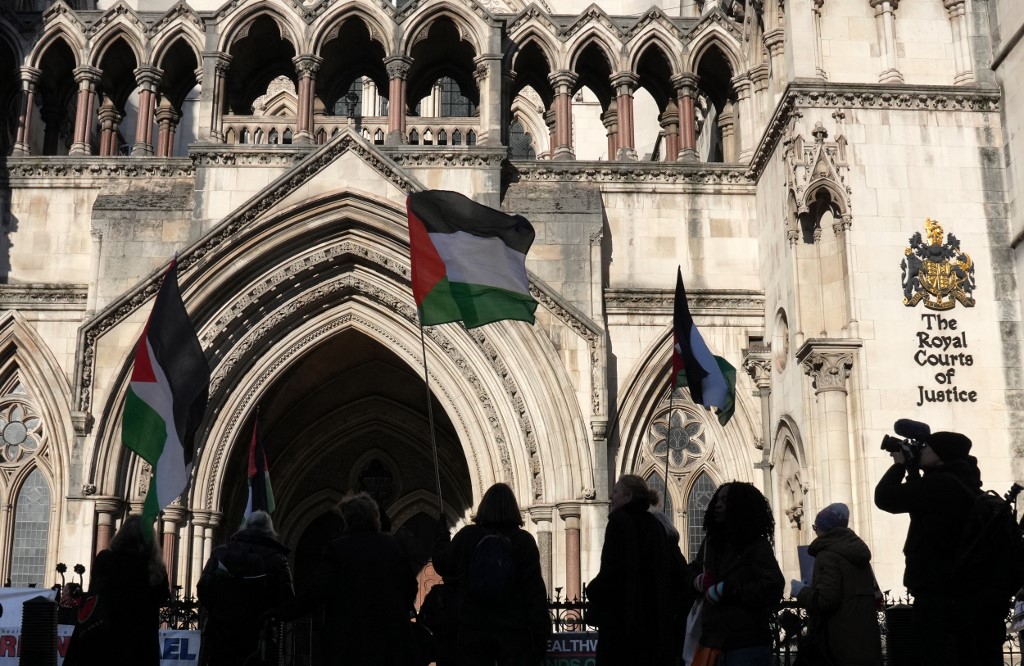
In a landmark ruling with few parallels in modern English legal history, a prominent human rights barrister who represented Palestine Action activists has successfully overturned a contempt of court proceeding brought against him over his conduct during a high-profile trial of climate and pro-Palestinian protesters.
Rajiv Menon KC, a legal professional with 30 years of courtroom experience, stood accused of violating judicial directions issued by presiding Justice Johnson during the first trial of six Palestine Action defendants at Woolwich Crown Court. The defendants in that case were charged with causing criminal damage to equipment at an Israeli arms manufacturer, Elbit Systems, which operates a facility outside Bristol, and faced additional charges of aggravated burglary. After the first trial resulted in all defendants being acquitted of aggravated burglary, a retrial was ordered, and four of the six activists were ultimately convicted of criminal damage last week.
The contempt case against Menon stemmed from a direct clash over the long-standing legal principle of jury equity, also known as jury nullification — the right of juries to acquit defendants based on conscience, even if evidence technically supports a conviction. Ahead of closing statements, Justice Johnson issued a strict order barring defense lawyers from two key actions: they could not ask jurors to disregard the court’s formal rulings or existing law, and they could not remind jurors of their inherent right to issue acquittals based on personal conscience.
In his closing argument defending defendant Charlotte Head, who was tried in both proceedings, Menon deviated from the judge’s order by reading aloud the text of a commemorative plaque at London’s Old Bailey. The plaque honors Bushell’s Case of 1670, the historic legal ruling that first cemented juries’ right to deliver verdicts aligned with their own convictions rather than judicial direction. Menon also argued to the jury that the defendants had been improperly restricted from introducing evidence about Elbit Systems’ role in supplying arms for Israel’s military campaign in Gaza, claiming it would be absurd to ask jurors to ignore this broader political and humanitarian context that motivated the activists’ actions. He further noted that a trial judge had no authority to order jurors to return a guilty verdict.
In response, Justice Johnson ruled that Menon’s speech had directly undermined his direction to jurors to set aside their views on the Gaza war and the broader Middle East conflict, and referred the contempt matter to the High Court’s Administrative Court for action. Menon’s legal team launched an immediate appeal, arguing that the High Court had no legal jurisdiction to hear the case unless the country’s top law officer, the Attorney General, formally intervened in the matter.
On Monday, the UK Court of Appeal upheld Menon’s challenge, ruling that Justice Johnson had acted improperly in initiating the contempt proceedings on his own. The court found that the trial judge should have either resolved the issue on the spot during the trial or referred the matter directly to Attorney General Lord Hermer for review.
Following the ruling, Jenny Wiltshire, Menon’s solicitor from the law firm Hickman & Rose, told reporters that her client “is delighted that the Court of Appeal has found in his favour”, adding that he “hopes that this is now an end to the matter”. Under the terms of the Court of Appeal’s ruling, the case is sent back to the original trial judge, and the contempt proceedings will be formally dismissed unless the judge chooses to refer the matter to Lord Hermer for further action. Legal observers note that the proceeding against Menon was unprecedented: no other lead defense barrister has faced contempt action in modern English legal history for conduct during closing arguments in a criminal trial, making the appellate ruling a critical win for defense advocacy rights in high-profile political cases.