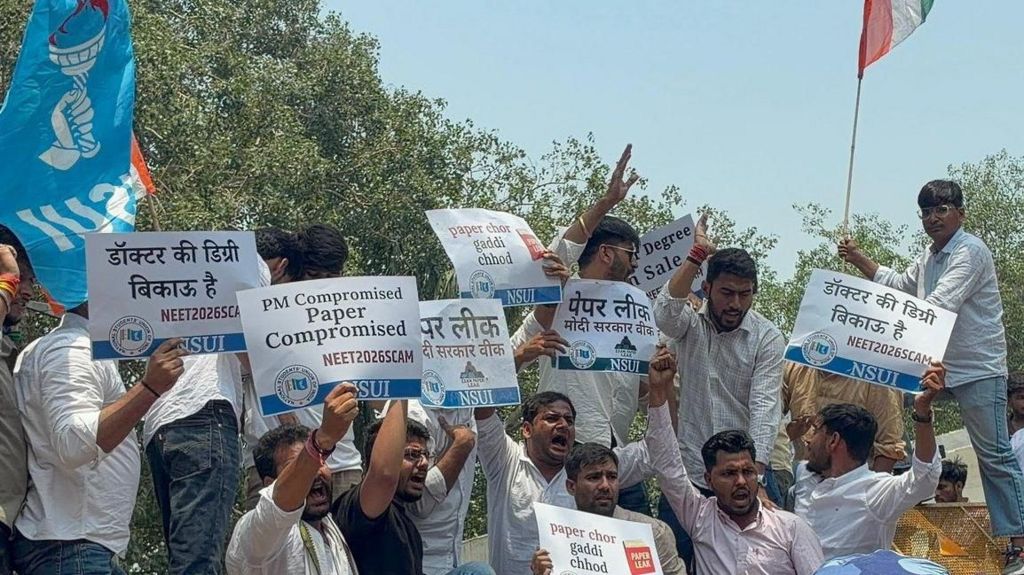
India’s highly competitive National Eligibility cum Entrance Test (Undergraduate), the mandatory gateway for admission to every medical college across the country, has been officially canceled following widespread allegations of a major pre-exam paper leak, triggering mass protests in the national capital New Delhi and leaving 2.28 million aspiring medical students reeling from the fallout.
Held across more than 5,000 test centers nationwide on May 5, the exam faced immediate backlash within days of being administered, after rumors and evidence of a leaked question paper began circulating on social media. Student anger and political pressure mounted steadily through the following week, until the National Testing Agency (NTA), the federal body tasked with organizing the high-stakes exam, announced on Tuesday that the entire 2025 exam process would be scrapped. In a statement, the NTA said the decision was made because the compromised exam “could not be allowed to stand,” adding that the cancellation was necessary to uphold the integrity of India’s national examination system and protect the interests of test-takers.
To date, no new date for a retest has been confirmed, leaving students and their parents in limbo over potential delays to the 2025-2026 medical college admission cycle. Investigative reports from Indian media outlets indicate the leak is believed to have originated in the western state of Rajasthan, several days before the exam was held. A senior Rajasthan police official told Asian News International (ANI) that probes are centered on a “guess paper” — a predicted question set commonly circulated by coaching institutes — that was shared privately before the exam. Of the roughly 410 questions included in the leaked guess paper, approximately 120 matched exactly to questions that appeared in the chemistry section of the actual NEET-UG exam, which is split into four different versions, each with 180 compulsory questions across physics, chemistry, and biology.
The case has since been transferred to the Central Bureau of Investigation (CBI), India’s federal investigative agency, for a full national probe. For the millions of young aspirants who dedicated months, and in many cases multiple years, to rigorous preparation for the test, the cancellation has been a devastating blow. Many students attend costly private coaching classes outside of standard school education, adding 4 extra hours of study on weekdays and up to 9 hours of study on weekends, often forcing them to skip major family and social events to keep up with preparation.
A 17-year-old Delhi-based test-taker, who requested anonymity, shared that her entire life for the past two years has revolved around NEET preparation. She even attended a mandatory mock exam the same week her grandfather passed away, turning down the chance to be with her family during the funeral. “I don’t know what to do now. We study so hard and spend days and nights working towards our goal and then the exam is cancelled,” she said, echoing the sentiment of thousands of fellow aspirants. Most students are calling for the retest to be held within 30 days to minimize disruption to their academic timelines.
The scandal has also thrown a harsh spotlight on long-running systemic failures in India’s competitive examination system, which has faced repeated allegations of paper leaks and administrative irregularities over the past decade. Opposition political figures have been quick to condemn the ruling Bharatiya Janata Party (BJP) for failing to prevent the leak, accusing the government of enabling corrupt networks. Congress party leader Rahul Gandhi called the scandal “a crime against the future of the youth,” saying “the hard work, sacrifices and dreams of the students have been crushed by this corrupt BJP regime.” Former Delhi Chief Minister Arvind Kejriwal, leader of the Aam Aadmi Party, alleged the leak was enabled by “complete collusion” between paper leak gangs and ruling party politicians, claiming that these criminal networks “operating under political patronage are shattering these youths’ trust and morale.”
Leading the ongoing protests in Delhi is the National Students’ Union of India (NSUI), the student wing of the opposition Congress party. Viral videos circulating on social media and broadcast on national television show student protesters climbing police barricades as officers attempt to disperse the crowd. Speaking to reporters at the protest site, NSUI president Vinod Jakhar said “the future of those who prepared for the NEET examination with utmost diligence and integrity has been sold off.” He and dozens of other protesters have also demanded the resignation of India’s Education Minister Dharmendra Pradhan, who has yet to issue a public response to the demands or allegations. BJP MP Jagdambika Pal responded to the criticism by stating that the “government holds those responsible accountable and ensures strict action against them so that such incidents do not recur.” The Federation of All India Medical Association, the national body representing practicing doctors across India, has also joined calls for immediate accountability for those behind the leak.
This is not the first time NEET-UG has been mired in controversy: in 2024, the exam faced similar allegations of paper leaks, fraud, and irregularities in the awarding of grace marks, which triggered nationwide protests after thousands of candidates received unusually high, unearned scores.