After months of political gridlock that stalled action against escalating settler violence in the occupied West Bank, the European Union’s 27 foreign ministers formally approved new targeted sanctions against extremist Israeli settlers and settlement-affiliated organizations on Monday. The breakthrough came after a recent change in Hungary’s government removed the veto that had blocked the measure under former Prime Minister Viktor Orbán, a longstanding close ally of Israel.
The approval marks a significant shift in the EU’s approach to the escalating crisis in the West Bank, where the United Nations has recorded a dramatic surge in settler-led attacks on Palestinian communities since the outbreak of the Gaza war in October 2023. Settlements constructed on Israeli-occupied West Bank and East Jerusalem land are universally recognized as illegal under international law, and the territories remain the core of Palestinian claims for an independent future state.
EU High Representative for Foreign Affairs Kaja Kallas emphasized the urgency of the action, stating, “It was high time we move from deadlock to delivery… extremisms and violence carry consequences.” French Foreign Minister Jean-Noël Barrot echoed this sentiment in a social media post, clarifying that the sanctions target the leading Israeli organizations responsible for advancing the “extremist and violent colonisation of the West Bank.”
According to EU diplomatic sources and Israeli media reports, seven individual settlers and settler organizations will be subject to the new measures. The sanctioned list includes Daniella Weiss, a veteran figure widely referred to as the “godmother of the settler movement,” who is already subject to United Kingdom sanctions. Four leading settlement promotion and support organizations are also targeted: Nachala and Regavim, which push for the expansion of Israeli settlements on occupied land, and HaShomer Yosh and Amana, which provide financing and logistical support for unauthorized outposts built without Israeli government approval. Senior leaders of Regavim and HaShomer Yosh, Meir Deutsch and Avichai Suissa respectively, are also named on the sanction list; Suissa was previously sanctioned by the U.S. in 2024 before being removed from the list during the second Trump administration.
The sanctions also expand EU restrictive measures to include additional Hamas representatives, a move that Israeli officials have criticized as an unfair moral equivalence between Israeli civilians and the designated terrorist group.
Israeli Foreign Minister Gideon Sa’ar rejected the decision in sharp terms, dismissing it as “arbitrary and political.” He asserted that Israel will continue to uphold “the right of Jews to settle in the heart of our homeland,” and added that the EU’s move “is equally outrageous… imposing sanctions on Israeli citizens and entities because of their political views and without any basis.” He also condemned the joint sanctions on both settlers and Hamas representatives, calling the comparison “completely distorted.”
Successive Israeli governments have overseen the expansion of settlements since the 1967 Middle East War, when Israel occupied the West Bank and East Jerusalem. Today, roughly 700,000 Israeli settlers reside across approximately 160 established settlements in the occupied territories. Settlement expansion accelerated sharply after Prime Minister Benjamin Netanyahu returned to office in late 2022 at the head of a far-right, pro-settler coalition, and the pace of both expansion and settler violence has grown even more rapidly since the start of the Gaza war.
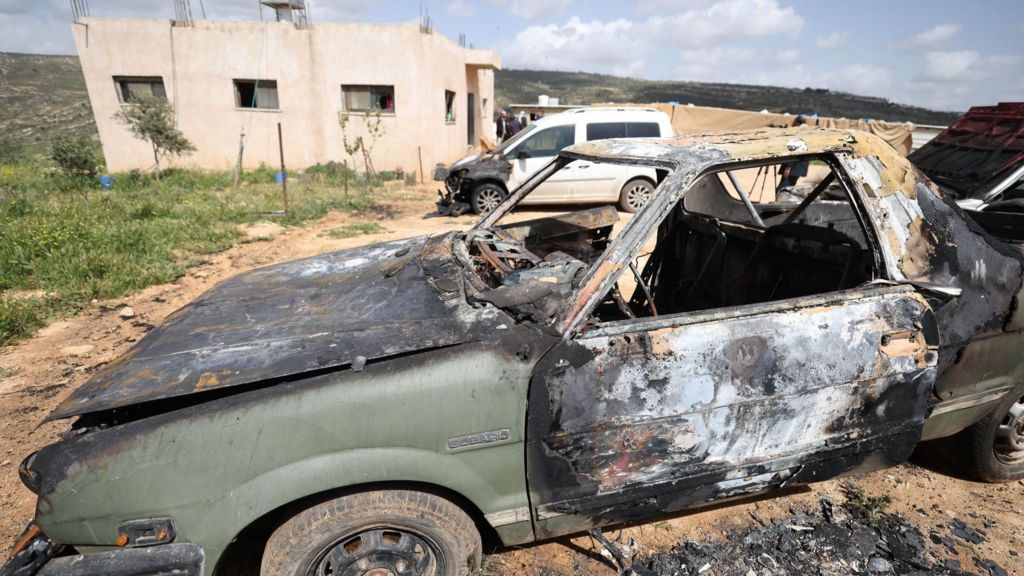
United Nations data underscores the scale of the ongoing violence: in 2025 alone, the UN documented more than 1,800 settler attacks that caused Palestinian casualties or property damage across 280 West Bank communities. Recent high-profile incidents have included an incident where settlers allegedly forced local Palestinians to exhume a grave – which the UN Human Rights Office condemned as “appalling” – the fatal shooting of a Palestinian man during a settler raid on the village of Tayasir, and multiple arson attacks targeting Palestinian homes, civilian vehicles, and agricultural land. One recent example cited earlier this year was an attack south of Nablus, where settlers set fire to a Bedouin tent and two civilian vehicles. Just weeks before the EU’s sanction vote, Israeli activists confirmed that the former Sa-Nur settlement had been reestablished on a hill southwest of Jenin, marking another expansion of settler presence in the northern West Bank.
Before the sanctions can be formally implemented, the EU must complete remaining technical and legal procedural steps. While several EU member states have also pushed for a broader ban on goods produced in Israeli settlements, the bloc has not yet reached a collective consensus to move forward with that additional measure.