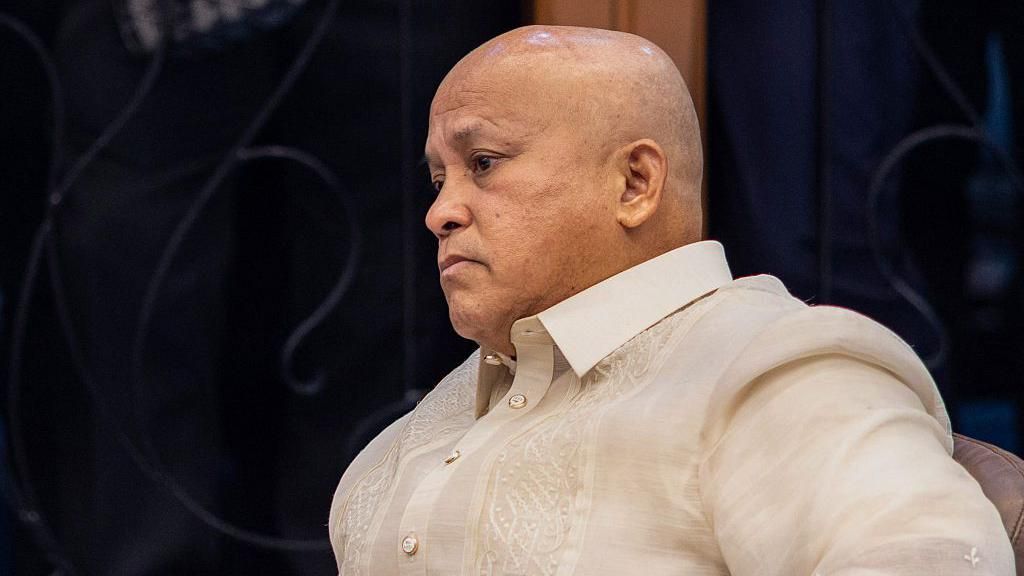
A high-stakes political and legal standoff is unfolding in the Philippines this week, after a sitting senator who once led the implementation of former President Rodrigo Duterte’s deadly anti-drug campaign sought shelter inside the national Senate to avoid an impending arrest warrant issued by the International Criminal Court (ICC).
Filipino Senator Ronald “Bato” dela Rosa, who previously served as national police chief under the Duterte administration, was spotted fleeing into the Senate building on Monday, narrowly evading pursuing agents from the country’s National Bureau of Investigation (NBI). Footage from Senate security cameras, shown to sitting lawmakers, captured NBI officers chasing dela Rosa up multiple staircases and along an internal corridor shortly after he arrived at the complex. Following a hours-long standoff between NBI officials and Senate authorities, the NBI chief announced that law enforcement would not move to detain dela Rosa while he remained under the chamber’s protective custody.
The ICC unsealed its arrest warrant for dela Rosa hours after he entered the Senate. The warrant charges dela Rosa as an “indirect co-perpetrator” in crimes against humanity linked to the anti-drug campaign, accusing him of direct responsibility for the extrajudicial killings of at least 32 people between 2016 and 2018. Thousands of suspected drug users and dealers were killed nationwide during the crackdown launched by Duterte after he took office in 2016. This development comes two months after Duterte himself was taken into ICC custody in The Hague following his arrest in March 2025.
Dela Rosa has publicly stated that he will remain on Senate premises and take every possible step to avoid being extradited to the Netherlands to face trial. His legal team has already filed a petition with the Philippine Supreme Court seeking to block his arrest, arguing that no valid domestic judicial warrant has been issued for his detention. On Tuesday morning, the senator addressed supporters who had gathered outside the Senate building, urging them to maintain a continuous vigil outside the complex until the Supreme Court issues its ruling.
In a direct challenge to President Ferdinand Marcos Jr., whose political bloc has been locked in a bitter feud with the Duterte political dynasty, dela Rosa called on Marcos to file domestic criminal charges against him if he believes the senator is guilty of wrongdoing. “If I have an obligation, I will answer it in the local court, not a foreign one,” dela Rosa told reporters, echoing longstanding objections to ICC jurisdiction over Philippine citizens raised by Duterte and his allies.
The standoff comes at a moment of extreme political tension in the Philippines, as relations between the Duterte and Marcos political clans collapse after three years of uneasy alliance. The two blocs ran together on a unified ticket to win the 2022 national election, but their partnership has fractured entirely in recent months. On Monday, the same day dela Rosa fled into the Senate, the 24-member chamber, which is currently controlled by Duterte allies, elected a new Senate president, Alan Peter Cayetano, who immediately confirmed that the body would only recognize arrest warrants issued by domestic Philippine courts. In contrast, allies of Marcos hold a majority in the country’s lower House of Representatives, which voted earlier on Monday to impeach incumbent Vice President Sara Duterte, Rodrigo Duterte’s daughter, for a second time.
Sara Duterte, who is currently the leading front-runner in polling for the 2028 presidential election, has publicly accused Marcos of using ICC arrest warrants and impeachment proceedings as political weapons to weaken her ahead of the upcoming vote. Rodrigo Duterte and his allies have repeatedly rejected the ICC’s jurisdiction over the drug war cases, pointing to the Philippines’ 2019 withdrawal from the Rome Statute, the international treaty that established the court. However, judges from the ICC Pre-Trial Chamber rejected that legal argument just last month, ruling that the alleged crimes under investigation took place between 2011 and 2019, a period when the Philippines remained a full member of the court. That ruling cleared the legal path for the court to move forward with arrests and an eventual trial for Duterte and his top aides.